Story audio is generated using AI
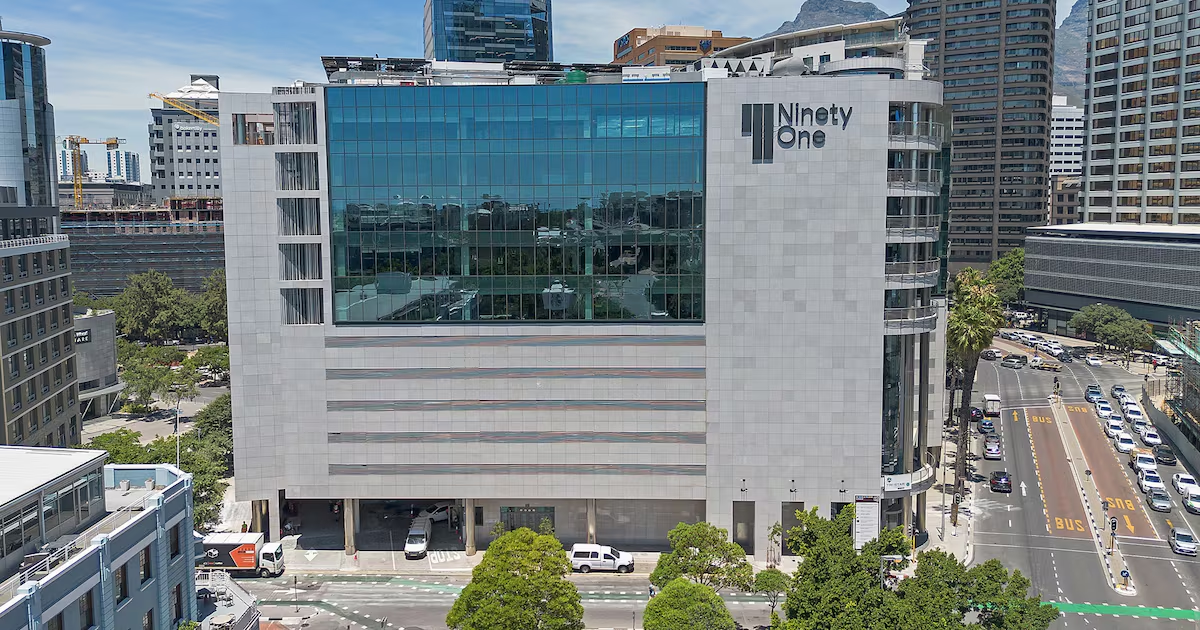
For many years, the debate around green buildings has centred on a single question: does sustainability make financial sense?Today, after a decade of independent South African market data, we have a clear answer.The latest MSCI Green Annual Property Index, produced in partnership with the Green Building Council South Africa and sponsored by Growthpoint Properties, confirms what many have long believed — certified green buildings are not simply good for the environment. They are increasingly delivering stronger financial performance, greater resilience and lower risk.The 2025 index marks an important milestone. For the first time, we can look back across 10 years of consistent local data and evaluate performance through an entire property cycle. The findings are compelling.Green-certified prime and A-grade office buildings delivered an annualised total return of 6.98% over the past decade, compared with 5.26% for non-certified office assets. That annual advantage of 172 basis points has accumulated into an overall outperformance of 28.2%.Perhaps even more importantly, the performance gap has remained remarkably consistent despite economic volatility, changing market conditions and major disruptions affecting the property sector. This is no longer a theoretical discussion; it is evidence.For years, many property owners viewed sustainability as an additional cost that required justification. While that perception still exists in some corners of the market, the growing body of local evidence increasingly tells a different story.The MSCI data shows that green-certified offices continue to generate 34% higher gross income per square metre than comparable non-certified offices. They also maintain significantly lower operating cost-to-income ratios, with certified offices operating at 41% compared to 48% for non-certified assets. Vacancies tell a similar story. Green-certified offices recorded vacancy rates of 10.3%, compared with 13.1% for non-certified buildings.These are not marginal differences. They point to stronger underlying fundamentals, better operational performance and sustained occupier demand. Importantly, they also suggest that sustainability is becoming increasingly aligned with what investors, tenants and asset managers value most — resilient income streams, efficient operations and future-proofed assets.Sustainability is becoming less about environmental compliance and more about business resilience.One of the most significant shifts we are seeing is that sustainability is becoming less about environmental compliance and more about business resilience. Climate risk is now firmly on the agenda of property owners, investors, lenders and boards.During the recent MSCI Green Annual Property Index webinar, Eileen Andrew, vice-president of client coverage at MSCI South Africa, highlighted that climate risk assessments are increasingly becoming part of acquisition due diligence processes. Investors are beginning to ask important questions about both physical climate risks and transition risks before making investment decisions.This reflects a broader shift taking place globally. Property owners are increasingly recognising that climate resilience is not a future issue. It is a present business consideration.How will a building perform during more frequent heatwaves? How resilient is its energy supply? How exposed is it to water stress? How well positioned is it to adapt to changing regulations, investor expectations and tenant requirements? These questions increasingly influence value.The concept of a “brown discount”, where less efficient and less resilient buildings experience value erosion over time, is becoming a reality. Markets around the world are beginning to explore the relationship between sustainability performance and asset valuation.While South Africa’s transaction data is still developing in this area, the direction it is moving in is increasingly clear. The other important lesson emerging from the research is that certification matters. In an environment where sustainability claims are becoming more common, independently verified certification provides something extremely valuable — credibility.While South Africa’s transaction data is still developing in this area, the direction it is moving in is increasingly clear. The other important lesson emerging from the research is that certification matters. As the market becomes more sophisticated, simply claiming that a building is sustainable will not be enough. Investors, occupiers and regulators increasingly want measurable, transparent and independently verified performance. This is one reason why standardisation matters.Growthpoint has been one of the pioneers helping drive this evolution. During the webinar, Engelbert Binedell highlighted the importance of having a consistent framework that allows stakeholders to compare assets on a like-for-like basis while reducing the risk of greenwashing.His comments reflect a broader trend we are seeing across the industry. Sustainability is becoming integrated into investment decision-making, portfolio management and long-term asset strategies rather than being treated as a standalone environmental initiative.That evolution is critical because green building is about far more than energy and water efficiency. Building performance includes resource efficiency, certainly, but it also includes occupant wellbeing and comfort, resilience, climate adaptation, materials, management practices and broader social outcomes.These dimensions increasingly matter because they influence how buildings perform for the people who use them.A comfortable, healthy and resilient building is often a more productive building. It is also frequently a more attractive building for tenants. This is particularly important as property owners continue adapting to changing workplace expectations and evolving tenant demands.Sustainability journeyThe findings also reinforce another important message: every building can begin its sustainability journey. The conversation should not be limited to a small group of high-profile flagship developments. The greatest opportunity often lies within existing buildings and retrofit programmes. Retrofitting existing assets remains one of the most powerful tools available to reduce emissions, improve resilience and preserve long-term value.South Africa has developed a globally respected green building market over the past two decades. We have world-class expertise, proven certification systems and a growing body of local evidence. What we need now is scale.We need more property owners, more listed companies, more institutional investors and more public-sector participants to recognise that sustainability is no longer a niche consideration. It is becoming a core component of good asset management.The conversation has changed. The question is no longer whether sustainability creates value. The question now is how quickly the rest of the market is prepared to act on that knowledge.• Smit is CEO of the Green Building Council South Africa.