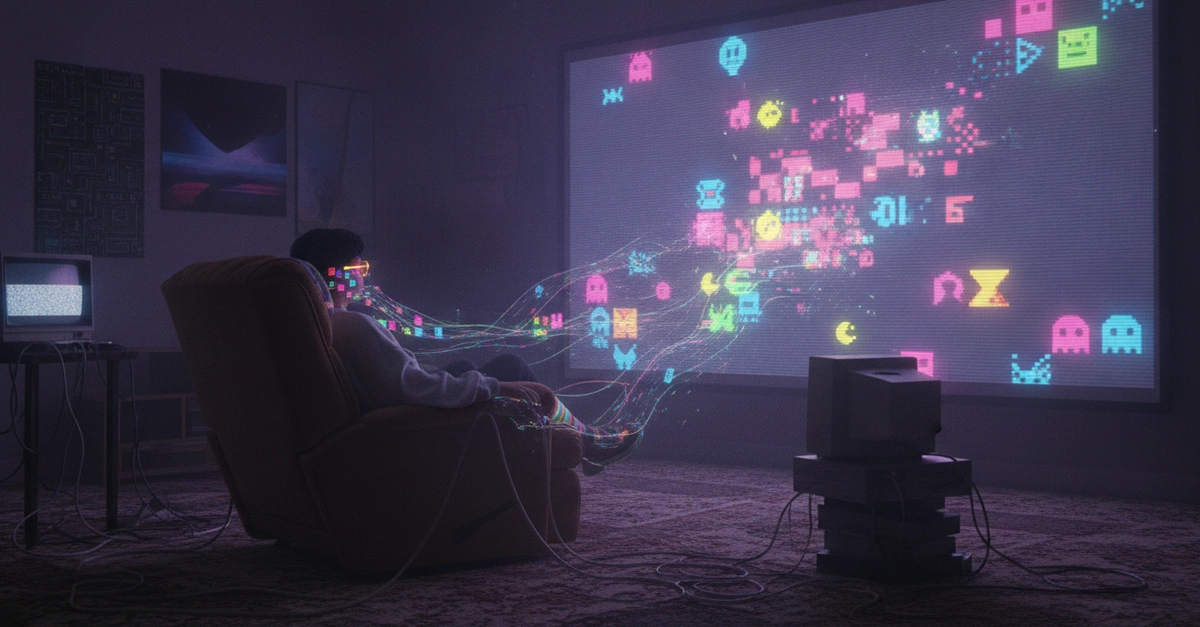
How I built a gamified, infinite-scroll video installation for the TIAT "Slop Epistemologies" exhibition—and optimized heavy web media to run smoothly on a $15 single-board computer.
In David Foster Wallace’s Infinite Jest, "The Entertainment" is a film cartridge so fatally mesmerizing that anyone who watches it loses all desire to do anything else, eventually dying of starvation while locked to the screen.
For the TIAT (The Intersection of Art & Technology) "Slop Epistemologies" exhibition in San Francisco, I wanted to explore this concept through the lens of modern algorithmic content consumption. We live in an era of infinite short-form video slop—hyper-optimized feeds designed to bypass critical thinking and keep our attention spans permanently "cooked."
The result is BrainRot TV — The Entertainment: an interactive, physical art installation where gallery visitors step up to a monitor, grab a physical USB slide advancer, and voluntarily "LOCK IN" to an endless, deteriorating stream of curated video slop.
While the conceptual premise is artistic, bringing it to life required solving fascinating full-stack and embedded systems engineering challenges. I had to build a responsive, immersive web application capable of playing endless video feeds, generating procedural audio, and tracking gamified psychological decay—all running flawlessly on a low-end Orange Pi Zero connected to a 640×480 CRT-style display.