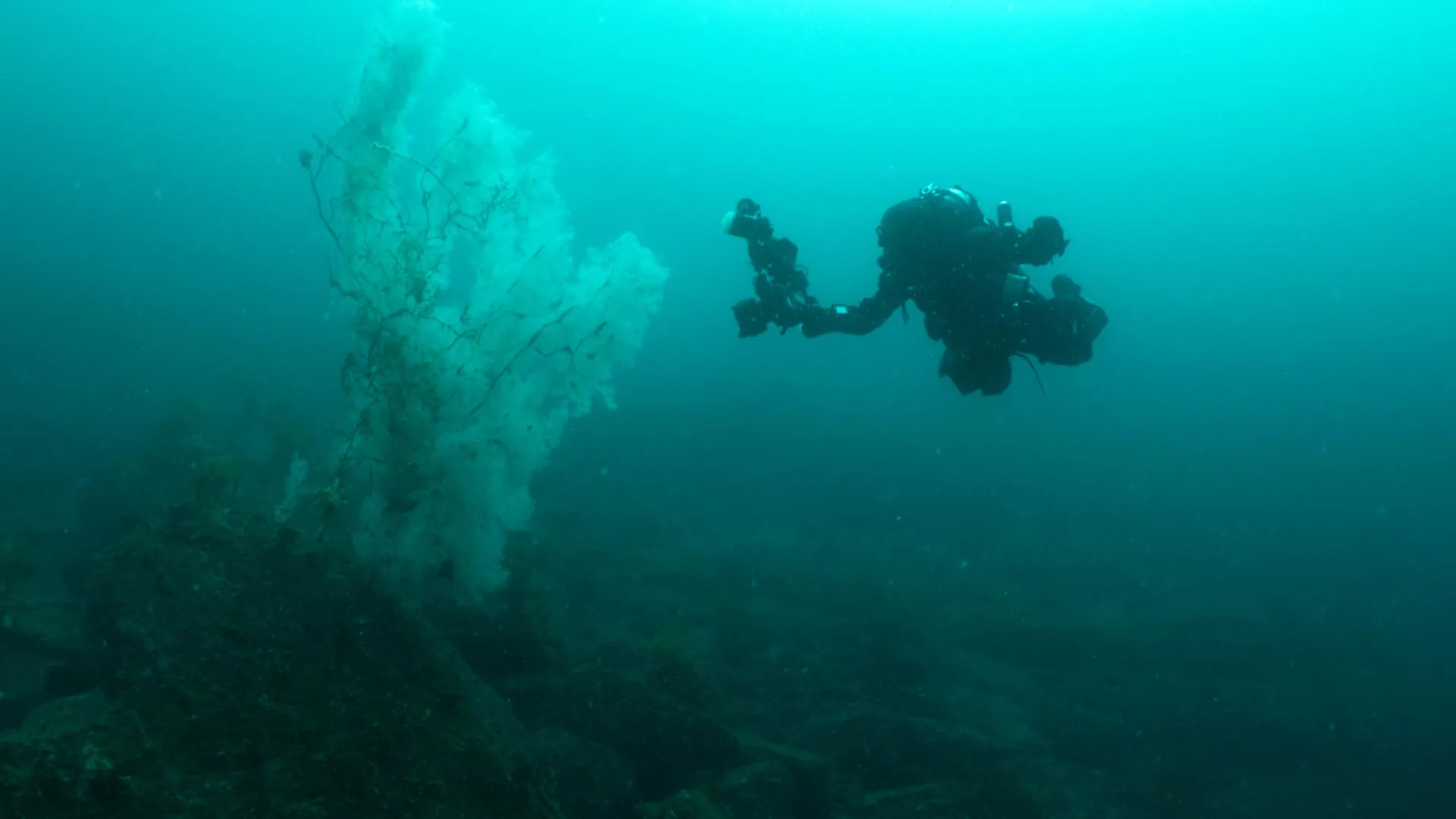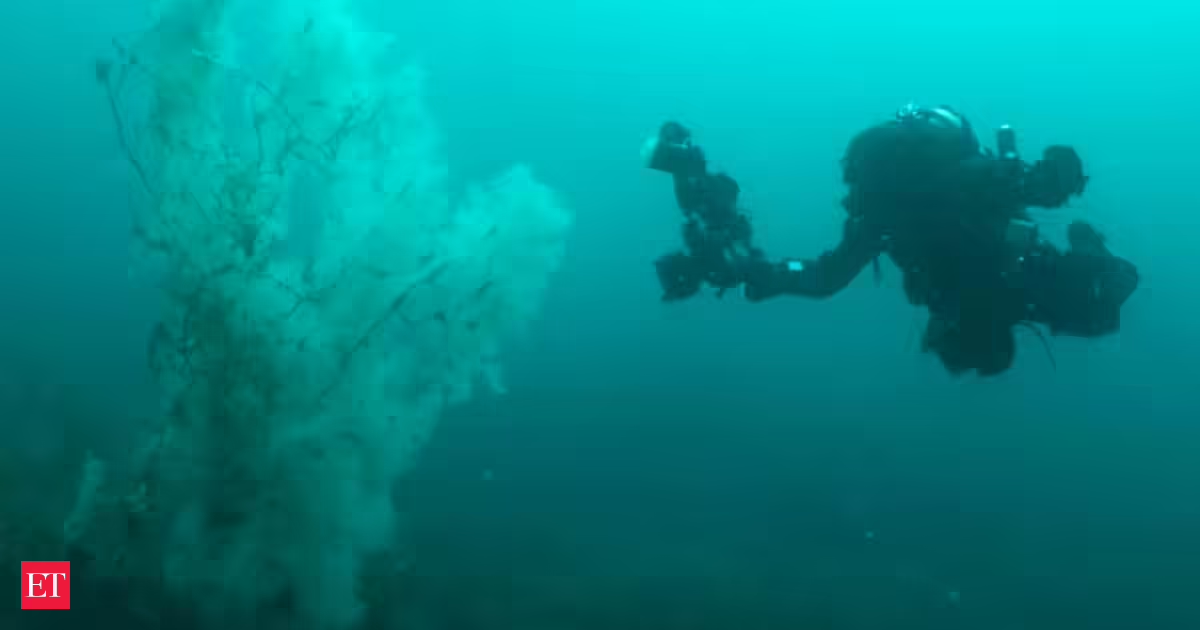
A gigantic 400-year-old black coral in New Zealand's Fiordland, measuring 4 meters tall and 4.5 meters wide, has scientists calling it "absolutely huge" and using the find to map where these slow-growing corals still surviveSynopsisA colossal black coral, estimated to be 300-400 years old and one of the largest ever found in New Zealand, has been discovered in Fiordland's deep waters. This ancient marine giant, surprisingly white when alive, plays a crucial role in providing breeding stock and habitat for other sea life. Scientists are now seeking public help to map the distribution of these vital, slow-growing corals.The coral towers over a diver at 4 meters tall and 4.5 meters wide. Image Credits: James BellDeep in the cold, dark waters of Fiordland, New Zealand, a dive team recently came face-to-face with something that left even the most seasoned scientists speechless. Te Herenga Waka — Victoria University of Wellington research has revealed a giant black coral, 4 meters (about 13 feet) tall and 4.5 meters (nearly 15 feet) wide, thought to be between 300 and 400 years old, and believed to be one of the largest black corals ever recorded in New Zealand waters.Professor James Bell, a marine biologist at the university, had one word for it: "absolutely huge." According to Professor Bell, it is by far the largest black coral he has seen in his 25 years as a marine biologist. Most black corals seen during dives are small, with the largest less than 2 to 3 meters tall, he added.The black coral isn't actually blackThis is the part that shocks most people. New Zealand's Department of Conservation says that living black coral colonies aren’t actually black, as you might expect. The species found in Fiordland, Antipathella fiordensis, is more likely to be white when alive. The black color is only in the inner skeleton, hidden under the living tissue. The name refers to the skeleton, not the animal you can see.The species was first described by New Zealand zoologist Ken R. Grange in 1990 from material collected in Fiordland in the southeastern South Island of New Zealand. It is protected under New Zealand’s Wildlife Act, and it is illegal to intentionally collect or damage it.A close-up of the coral's white branches: the black color is found only in the internal skeleton. Image Credits: James Bell/Te Herenga Waka — Victoria University of WellingtonHow old is 300–400 years, really?To put that age into perspective, this coral was alive during the time when the Pilgrims were settling in North America. And by the standards of a group renowned for longevity, the lifespan of Antipathella fiordensis is extraordinary.A 2026 study published in Deep Sea Research Part II: Topical Studies in Oceanography found that black coral species had lifespans ranging from 71 years for Antipathella fiordensis to 2,221 years for other Antipatharia species, with radial growth rates of 2.6 to 126.7 micrometers per year. The slow growth and recovery rates make these corals highly vulnerable to physical disturbances.According to a study titled ‘Ageing Deep-Sea Black Coral Bathypathes patula’ in Frontiers in Marine Science on New Zealand black corals, some species in the region, including deep-sea species like Bathypathes patula, have been found to attain ages in excess of 385 years, with the slow growth and extreme longevity of these animals meaning they have very low resilience and slow recovery times following any disturbance or removal, potentially taking centuries to bounce back from human impacts.Why the size matters more than you'd thinkThe large size of this coral is not just a visual spectacle, but has direct conservation relevance. According to Te Herenga Waka — Victoria University of Wellington, larger colonies play an important role in the species' survival by providing valuable breeding stock.Dive Magazine notes that large colonies are especially important for reproduction as they produce more gametes during spawning events, which helps to protect future generations of the coral. Colonies don’t reach maturity until they’re about 0.7 to 1.0 meters tall and at least 30 years old, and female colonies produce between 1.3 million and nearly 17 million oocytes each year.The coral looms out of the darkness: despite its name, it appears white when alive. Image Credits: James Bell/Te Herenga Waka — Victoria University of WellingtonBlack corals are also an important habitat for the marine life surrounding them. A 2023 study in Scientific Reports found that black coral forests alter the physical and biogeochemical properties of their environment through their complex three-dimensional architecture, changing water flow and increasing the retention of fish larvae, playing a stabilizing role in resource availability across the seascape, similar to other marine ecosystem engineers such as kelp forests and seagrass meadows.A ranger's once-in-a-career momentSenior biodiversity ranger at New Zealand's Department of Conservation, Richard Kinsey, was part of the dive team that found the coral. According to Te Herenga Waka — Victoria University of Wellington, Kinsey described it as "pretty special," noting that in nearly 20 years as a marine ranger in Fiordland, it is easily the largest coral he can remember seeing.Scientists are now looking for moreVictoria University researchers are working with the Department of Conservation and the Fiordland Marine Guardians to study and map where the protected coral species are located around the fiords. The goal is practical: knowing exactly where the big corals grow lets authorities tell boaters and fishers where to keep their anchors and pots.Professor Bell says the team is also crowdsourcing help; anyone who knows of a black coral in Fiordland greater than 4 meters is encouraged to report it, so researchers can map their distribution and find out just how common such large colonies are. This coral could be a giant, but it might not be alone.Read More News onRead More News on
A gigantic 400-year-old black coral in New Zealand's Fiordland, measuring 4 meters tall and 4.5 meters wide, has scientists calling it "absolutely huge" and using the find to map where these slow-growing corals still survive
Researchers uncovered a colossal black coral, estimated to be 400 years old, in Fiordland, New Zealand. Dive in to learn about its massive size, ecological significance, and ongoing conservation efforts.
950 words~4 min read