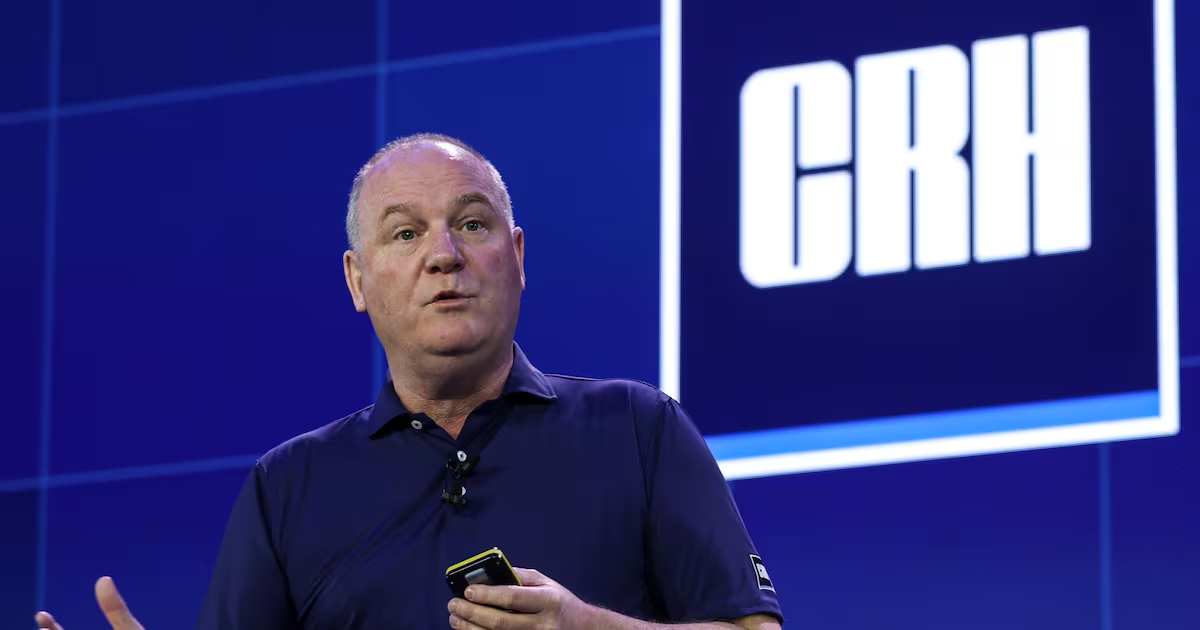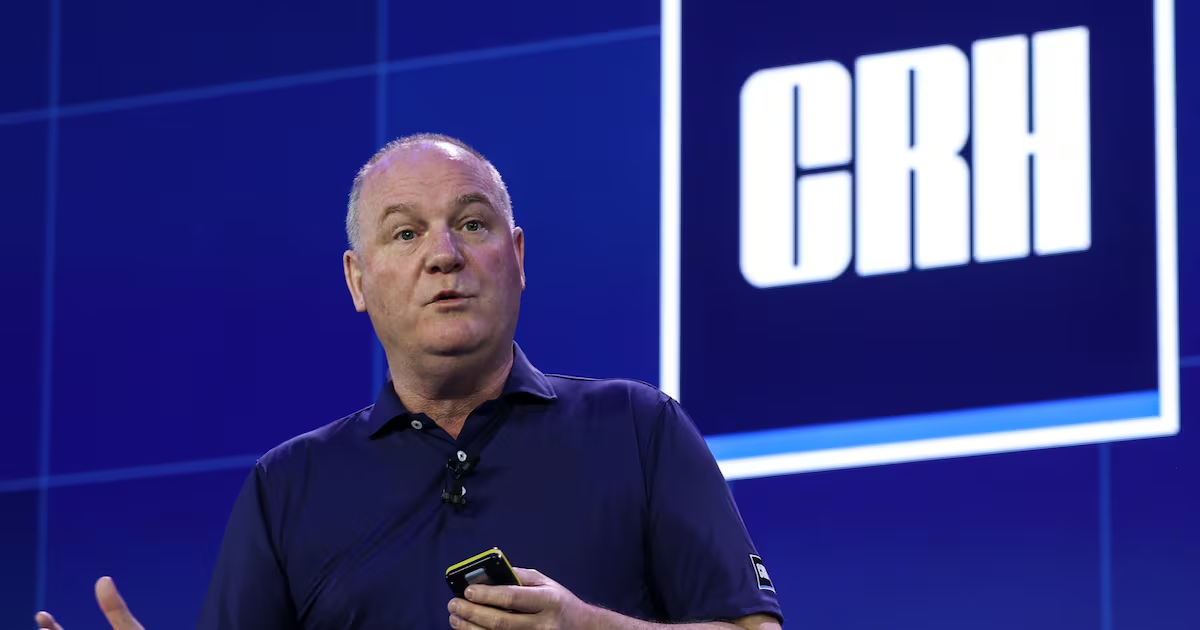
CRH boss Jim Mintern tipped his Stetson in emphatic style this week to Texas, one of the fastest-growing economies in the US, by unveiling an $8.5 billion (€7.4 billion) deal to buy Dallas-based peer Arcosa. The largest transaction in CRH’s history dispels any doubts about Mintern’s ambition. It comes less than 18 months after succeeding Albert Manifold, whose swashbuckling deal-making over the previous decade – buying and selling billions of dollars of assets – had transformed the group from being a price-taking business that essentially crushed big rocks into cement, aggregates and asphalt, into a much higher-margin group that provides complete solutions for major infrastructure projects.It also brings the total number of purchases of the group, which was formed in 1970 through the merger of Cement Limited and Roadstone Limited, to more than 1,200. Arcosa has also spent the past decade reshaping itself. Spun out from industrial conglomerate Trinity Industries in 2018, it went on to divest businesses ranging from storage tanks to barges, and reinvested in construction materials and engineered products – including electricity pylons and wind towers.It is also a leading sand and gravel producer in Texas, which was already – according to Mintern on an analyst call on Monday – the “biggest state in CRH”. And while he said there was a bit of geographic overlap in the Lone Star state, Arcosa will push the group into the fast-growing Dallas-Fort Worth metropolitan region as well as Phoenix, Arizona. All told on the construction materials front, Arcosa produces 35 million tonnes of high-quality, natural and recycled aggregates and serves 13 of the 50 largest US metropolitan regions, across Texas, New Jersey, Arizona, Florida and Tennessee. It will bring CRH’s total annual production to more than 265 million tonnes.“As the leading infrastructure player in North America, we are uniquely positioned to capitalise on three large and growing megatrends: transportation, water and re-industrialisation,” said Mintern. “The acquisition of Arcosa will enhance our exposure and capabilities in each of these areas.”The purchase will use up about 30 per cent of the $28 billion Mintern had ringfenced for deals and investment when he outlined his strategic priorities out to 2030 last September, leaving plenty more in the pot. But it has also revived market chatter that it is only a matter of time before CRH – having moved its main listing to the New York Stock Exchange in 2023, quitting the Irish market in the process – spins off its operations outside of North America. Mintern had been key to the Wall Street move as chief financial officer at the time. While Dublin remains the corporate headquarters, Mintern has brought the CEO office to New York. He removed CRH from the London market in April and cancelled the last financial instrument listed in Dublin – a bunch of preference shares – this week. The New York Stock Exchange welcomed CRH on September 22nd, 2023, to celebrate its transition to a US primary listing. Photograph: NYSE North America became CRH’s largest market in 2012, as the US recovered from the financial crisis while Europe was still mired in a sovereign debt downturn. Although CRH’s previous biggest deal – of €6.5 billion of assets divested in 2015 during the merger between peers Holcim and Lafarge – consisted mainly of European assets, the group has since shifted its spending power decisively towards the US. North America accounted for 71 per cent of CRH’s $7.7 billion adjusted earnings before interest, tax, depreciation and amortisation last year and three-quarters of its net profit. The Arcosa deal – together with the completion earlier this month of the $700 million purchase of a US water treatment solutions company – will decrease the significance of CRH’s non-North American businesses, which were bundled together in one division, called international solutions, in late 2024. This combined CRH’s two previous European divisions with operations in Australia and the Philippines. CRH no longer strips out its Irish revenues in its list of primary geographic markets in its annual report. The last time it did so was in 2023, when the Republic accounted for €916 million – or 2.6 per cent – of group sales. CRH last stated Irish investor’s share ownership in its 2022 report, when it amounted to 3.5 per cent. North American investors then held less than a third of the stock. Mintern said in May that shareholders based in the US now account for almost two-thirds of the group, following the move to Wall Street. “With CRH further increasing its share of revenue in North America with this acquisition, we reiterate our view that the group may consider spinning off its smaller international division (which is mainly Europe) as a separate company, to establish CRH as a pure-play North American business,” said Harry Goad, an analyst with German investment bank Berenberg in a report this week, adding that such a move could lead to a narrowing of the valuation gap between CRH and some of its higher-rated peers. Bernstein analyst Pujarini Ghosh highlighted in a note that the legacy European business is “often viewed as a management distraction” by Wall Street investors. They are not alone. Bank of America analysts highlighted as far back as early last year that shareholders were beginning to discuss the potential for CRH to eventually hive off its operations outside of North America.[ Loveholidays CEO: ‘Ryanair thought all online travel agencies were pirates. But not us’Opens in new window ]While CRH’s shares have risen as much as almost 5 per cent this week, they remain down more than 10 per cent so far in 2026. Its closest listed rival, Vulcan Materials, has risen 7 per cent over the same period, while another, Martin Marietta, is little changed. Even though CRH’s stock is now double the value of where they stood on relisting in New York, it continues to trade at meaningful discounts – relative to earnings – to both.Long-time company observers say there are many benefits from Europe remaining core to the group, including transferring significant expertise and best practice from Europe to North America, particularly in sustainable construction. Europe’s regulatory environment is also driving innovation in building materials that can be leveraged on the other side of the Atlantic, they add. Equally, CRH has opportunities to bring expertise from its more advanced US building solutions model to Europe. But Wall Street, for now, doesn’t appear to be buying it.
CRH’s US mega deal stokes chatter of a European spin-off
Arcosa purchase may be latest step to CRH becoming a pure US business
1,064 words~5 min read