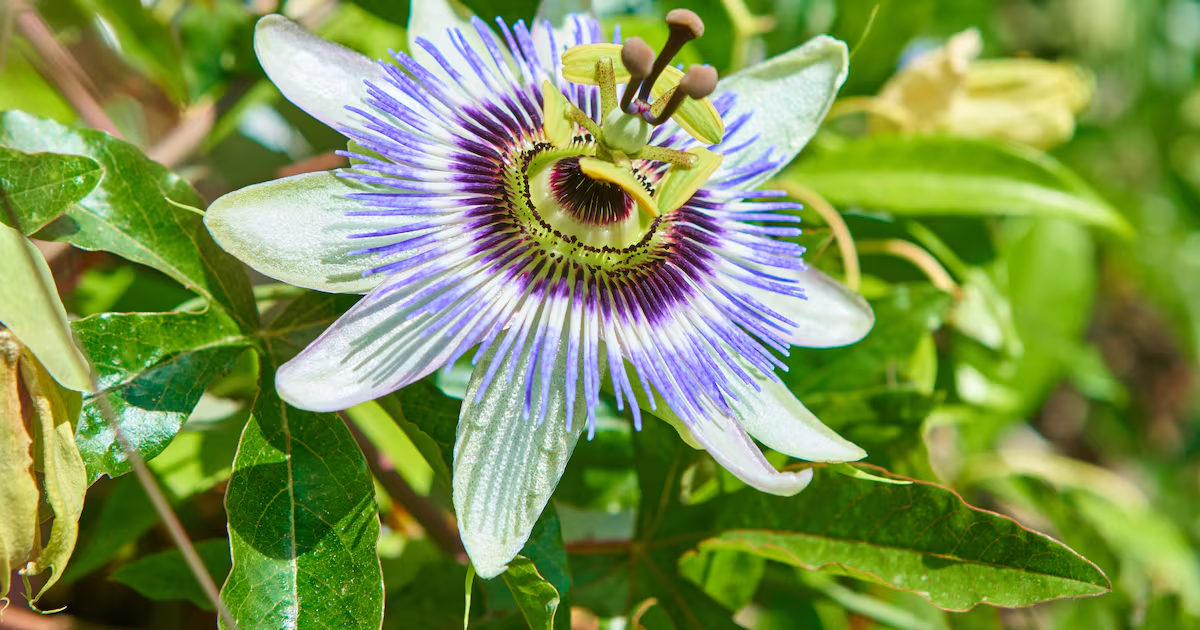
As a country bumpkin, I sometimes envy townies when it comes to the opportunity to do something fantastical with their gardens. Plonk a banana plant slap-bang in the middle of rural Ireland, for example, and there’s a high chance that it’s going to look weirdly out of place. Plant a palm tree right next to an 18th-century rustic farmhouse and it’s almost certainly going to look a little odd. Stick Aeonium ‘Zwartkop’ into a cottage-garden style flower border and you’ll have a job on your hands convincingly integrating this fleshy exotic into the rest of the planting. But none of this is the case when it comes to urban plots enclosed by high walls and hedges, where these kinds of striking, non-native species can all be grown without hitting a jarring note.In this sense, small city gardens are akin to theatrical stages just waiting for the right props to set the tone, one where mood is everything. Much of this is down to the fact that these intimate outdoor spaces almost inevitably tend to look inwards rather than outwards in their design, providing a leafy, restful refuge from the increasing busyness of our modern world.Rather than relying on the fleeting beauty of flowers, the best of these city gardens almost always rely on a palette of architectural plants known for their long-lasting, outstanding foliage interest where the colour green – that most restful and serene of shades – is the all-important glue that joins them.These same qualities also make them the perfect choice for experimental, forward-looking gardeners who like to have lots of fun with their plants. Take, for example, the fashionable genus known as pseudopanax, increasingly popular with a new generation of young, urban gardeners. It includes the eccentrically beautiful Pseudopanax ferox, whose rigid, jaggedly toothed evergreen bronze leaves and exotic, almost prehistoric appearance make it look like something straight out of a book by Dr Seuss. Ideal for growing in a sunny, sheltered city courtyard, this frost-tender, ericaceous species very slowly reaches a height and spread of 5m x 2m but can be grown in a large container for many years before it gets to that size. Just don’t be surprised if some of your friends assume it’s faux based on its almost extraterrestrial appearance.Other garden-worthy members of the same genus include the shrubby, borderline-hardy evergreen Pseudopanax ‘Dark Star’, whose lush foliage is flushed with bronze-purple; the handsome compact evergreen Pseudopanax ‘Cyril Watson’; and Pseudopanax ‘Moa’s Toes’, yet another striking, evergreen member of the genus that’s compact enough to grow in a large tub. All do best in mild, coastal gardens where harsh frosts are a rarity.Very large-leaved evergreen plants also work brilliantly in these kinds of city garden planting schemes, their size adding drama as well as giving a satisfying sense of scale. Because, as counterintuitive as it might seem, those same outsized leaves have a near magical ability to make small spaces feel larger and less cluttered. The Chinese rice paper plant, Tetrapanax papyrifer, has large, lush green foliage. Photograph: Getty Images The large-leaved evergreen Fatsia japonica adds drama to city gardens. Photograph: Getty Images The palm-like Yucca aloifolia, the Spanish bayonet tree, can lend an otherwordly atmosphere to urban gardens. Photograph: Getty Images The Chusan palm, Trachycarpus fortune (Chinese windmill palm), has a subtropical appearance. Photograph: Getty Images/iStockphoto Examples include the rice paper plant, Tetrapanax papyrifa ‘Rex’; the Taiwanese schefflera, Heptapleurum taiwaniaum; any of the shade-loving tree ferns, including lesser known kinds such as Cyathea dealbata; Fatsia japonica, along with its handsomely variegated form Fatsia japonica ‘Spider Web’ and the more cut-leaved Fatsia polycarpa ‘Green Fingers’; and Magnolia grandiflora ‘Little Gem’, a compact form with large, long, glossy leaves, ideal for training against a high, sunny wall.Statuesque evergreen plants with palm-like foliage also work excellently here, their subtropical appearance amplifying that sense of leafy, otherworldly seclusion in a way that’s only possible in these sorts of enclosed, private, urban outdoor spaces. Ones to consider include the Chusan palm, Trachycarpus fortune; the dwarf fan palm, Chamaerops humilis; spiky Yucca aloifolia; and the cabbage palm, Cordyline australis. Importantly, all the above will also appreciate the sheltered conditions offered by these kinds of urban gardens where winter frosts are rarely as severe as for their rural counterparts, while plants are also more protected from icy winds by high walls, hedges and fences.Exotic-looking evergreen climbing plants are also invaluable for these kinds of city gardens, adding vertical interest and giving an enhanced, even theatrical sense of space. Examples include the very gorgeous Hydrangea seemannii, prized for its handsome, evergreen foliage and clouds of white flowers in summer; passionflower (Passiflora caerulea) whose elaborately sculptural summer flowers add a whiff of the tropics; Trachelospermum asiaticum and T jasminoides, whose small scented white flowers are prized for their intense perfume; the unusual Stauntonia hexaphylla, a spring-flowering climbing species with clusters of pale, fragrant, clematis-like, dusty pink blooms; the chocolate vine, Akebia quinata; and the pretty, blue-flowering Sollya heterophylla, all of which thrive in the kind of protected microclimates these urban spaces offer.The star jasmine, Trachelospermum jasminoides, has intensely perfumed flowers. Photograph: Getty Images Japanese forest grass, Hakonechloa macra, has cascading mounds of lush green foliage. Photograph: Getty Images/iStockphoto The evergreen black mondo grass, Ophiopogon planiscapus Nigrescens, is suitable for growing in containers. Photograph: Getty Images/iStockphoto The Japanese lace fern, Polystichum polyblepharum, forms a 'shuttlecock' of fine fronds. Photograph: Getty Images Ornamental grasses are another group of plants that can be used to amplify that universe-unto-itself atmosphere that makes these kinds of city gardens so special. While the eternally elegant Hakonechloa macra isn’t evergreen, it does hold on to its gracefully faded leaves throughout winter and always brings something very special to any planting combination. Other compact ornamental grasses or grasslike species that hold their shape throughout the year and help to underscore a sense of lush leafiness include the evergreen Carex ‘Irish Green’; the evergreen silver-bronze flax, Astelia ‘Westland’ (think phormium, but nicer); and the black mondo grass, Ophiopogon planiscapus ‘Kokuryū’. All are also very suitable for container growing.[ How can I grow cowslips in my garden?Opens in new window ]Many compact species of ornamental evergreen ferns are also excellent for lower-storey planting beneath the leafy canopy of taller plants, where they’ll flourish in the shade cast by the latter. Outstanding examples include the Japanese lace fern, Polystichum polyblepharum, which forms a statuesque shuttlecock of finely cut fronds; the glossy-leaved native Hart’s tongue fern, Asplenium scolopendrium; and the ultra-compact Korean rock fern, Polystichum tsussimense.Getting your hands on some of these plants can be challenging, but you’ll find them for sale in the better garden centres, while recommended specialist Irish suppliers include futureforests.ie, rareplantsireland.ie and kellsbay.ie.This week in the gardenKeep regularly deadheading roses to extend their flowering display, and giving plants a fortnightly liquid foliar feed to help boost healthy growth and vigour.Keep regularly tying the stems of fast-growing annual climbing plants such as sweet pea, mangetout, sugarsnap, and climbing French beans on to sturdy netting support to prevent them from becoming a tangled mess.Dates for your diaryDelgany & District Horticultural Society’s Annual Rose Show: St Patrick’s Primary School, Greystones, Co Wicklow; Today, Saturday, 27th June (3pm-5pm). Delgany & District Horticultural SocietyGalway Garden Festival: Claregalway Castle, Co Galway. Saturday, July 4th and Sunday, July 5th (11am-6pm). With a wide range of specialist plant nurseries, exhibitions of Irish botanical art, bonsai and floral art, and talks by a range of guest speakers. galwaygardenfestival.com
Sculptural evergreens, ferns and grasses to add drama to urban gardens
Small city gardens are akin to theatrical stages just waiting for the right props to set the tone
1,239 words~6 min read