Diabetes patients using GLP-1 agents had a higher risk of smell and taste disturbances over 2 years, though absolute risk increases were very small.Smell disturbances included anosmia and parosmia; taste disturbances included parageusia.Incident smell and taste disturbances were identified solely using ICD codes which are often assigned based on patient-reported symptoms, not objective testing.
Use of GLP-1 receptor agonists was associated with a higher risk of smell and taste disturbances among adults with type 2 diabetes, an analysis of electronic health record (EHR) data suggested.
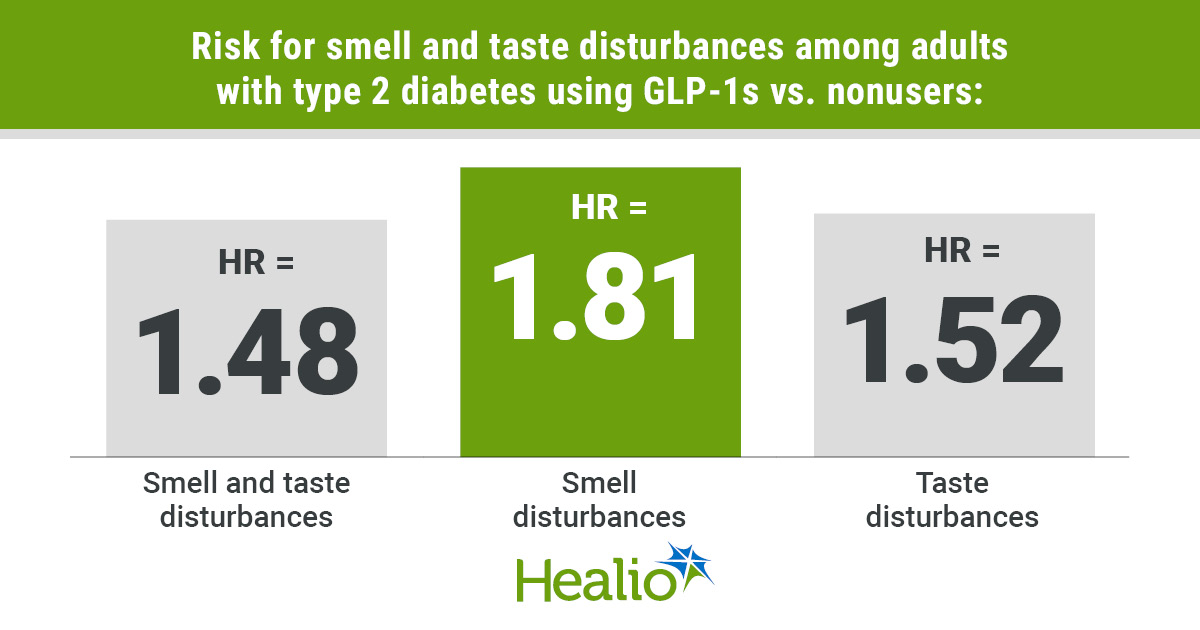
Compared with matched controls using other antidiabetic agents, GLP-1 medication users had a 48% increased risk of overall smell and taste disturbances over a 2-year follow-up period (HR 1.48, 95% CI 1.37-1.61), according to Nir Zontag, BSc, and Jonathan Zontag, BSc, both of the Hadassah Medical Center at Hebrew University in Jerusalem, Israel.
GLP-1 drug users had higher risks for both smell disturbances (HR 1.81, 95% CI 1.58-2.07), and taste disturbances (HR 1.52, 95% CI 1.35-1.71). However, these corresponded to relatively small absolute risk increases of 0.08% and 0.07%, respectively, the researchers reported in JAMA Otolaryngology-Head & Neck Surgery.