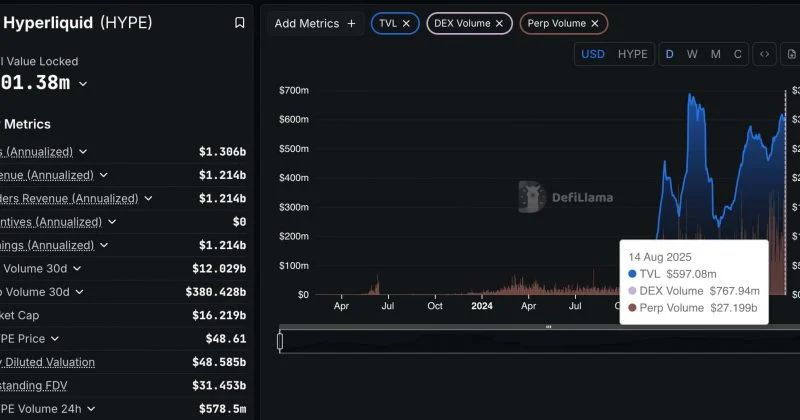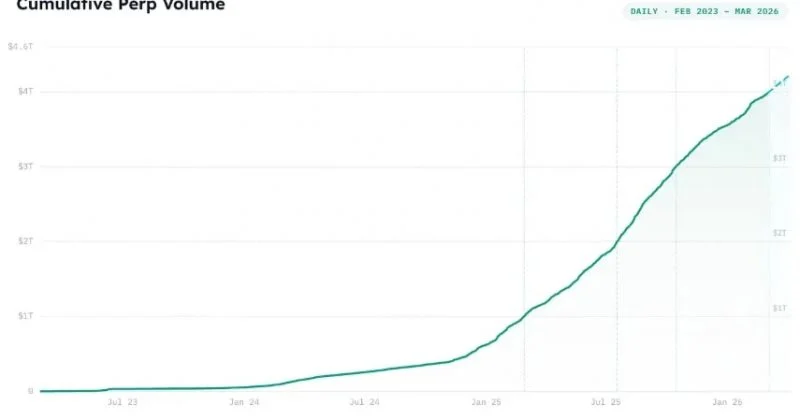
Somewhere between a DEX and a full-blown financial exchange, Hyperliquid has built something that most DeFi protocols only claim to be: the dominant venue for trading perpetual futures on-chain. At its peak in 2025, the platform captured more than 80% of decentralized perpetual trading volume. Hyperliquid’s share of on-chain perpetual futures volume sat at 36.4% in January 2026, then climbed to 44% by mid-2026, even as new competitors entered the space.
The scale of what Hyperliquid has actually built
Hyperliquid processed $633 billion in trading volume during Q1 2026 alone. Daily volume runs between $3 billion and $10 billion depending on market conditions. Cumulative lifetime volume crossed $4.726 trillion by June 2026.
The platform runs on its own Layer-1 blockchain, built on a consensus mechanism called HyperBFT. Collateral on the platform settles in USDC. The protocol offers leverage up to 40x across more than 300 markets. Those markets now extend beyond crypto perpetuals into commodities, indices, prediction markets, and real-world assets, all made possible through the platform’s HIP-4 framework.
Revenue, the HYPE token, and what traders are actually paying for