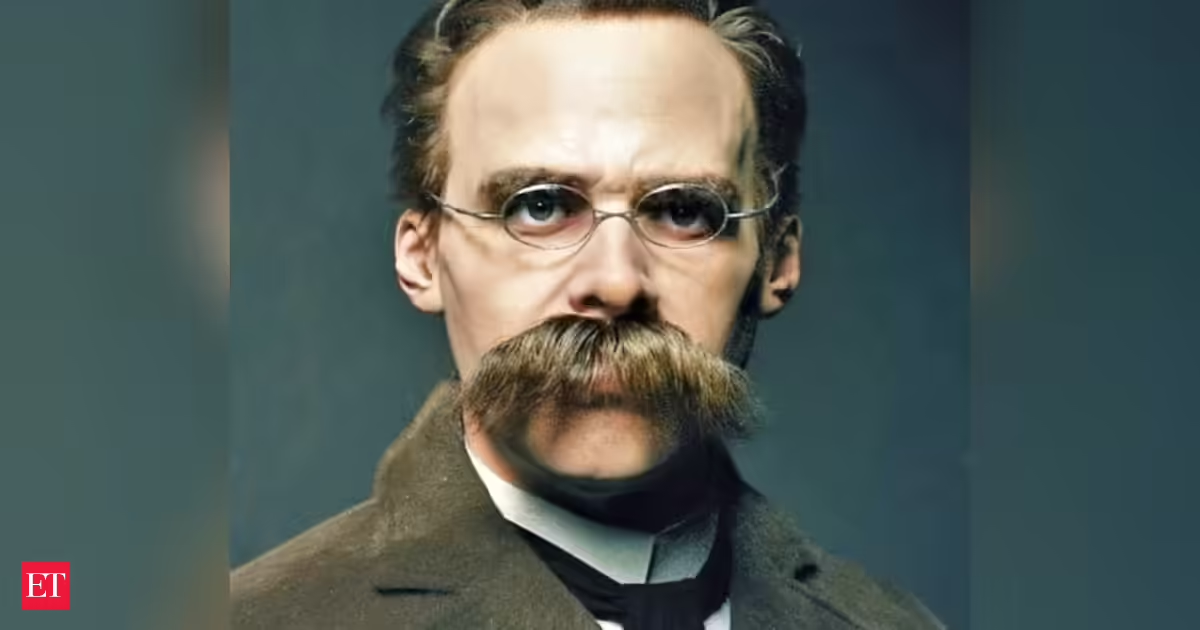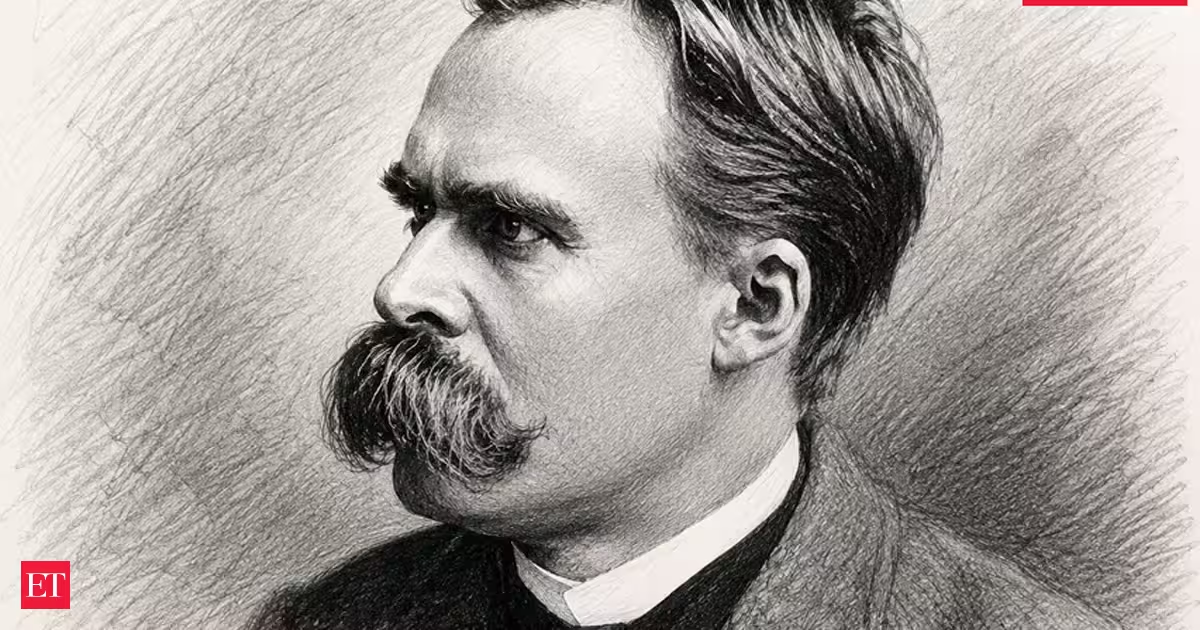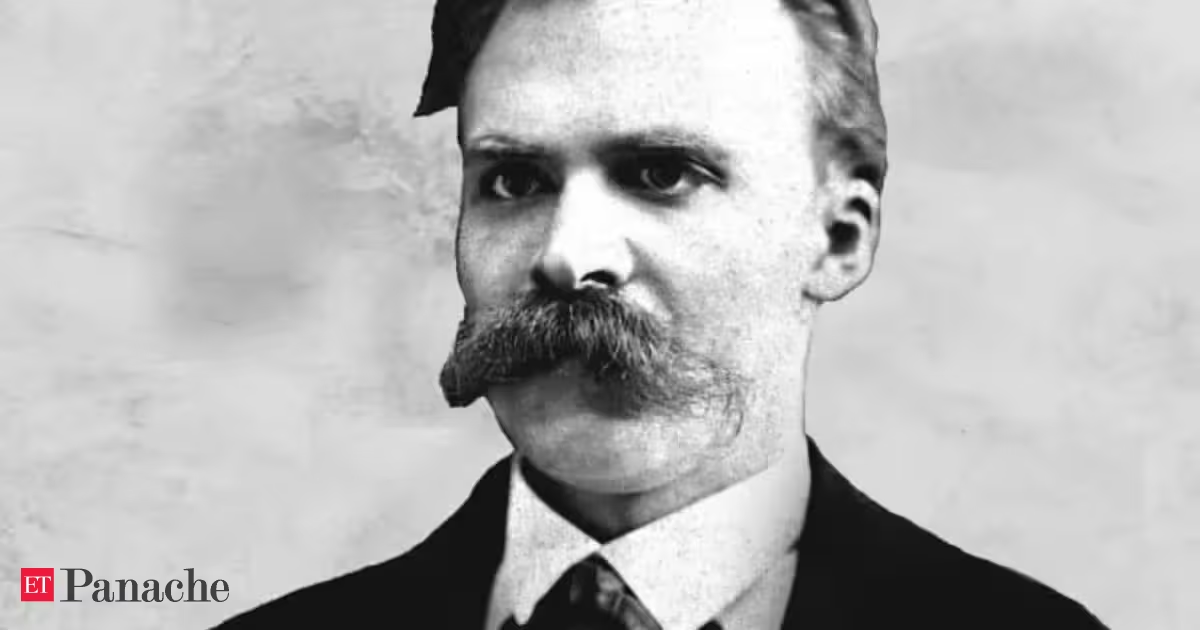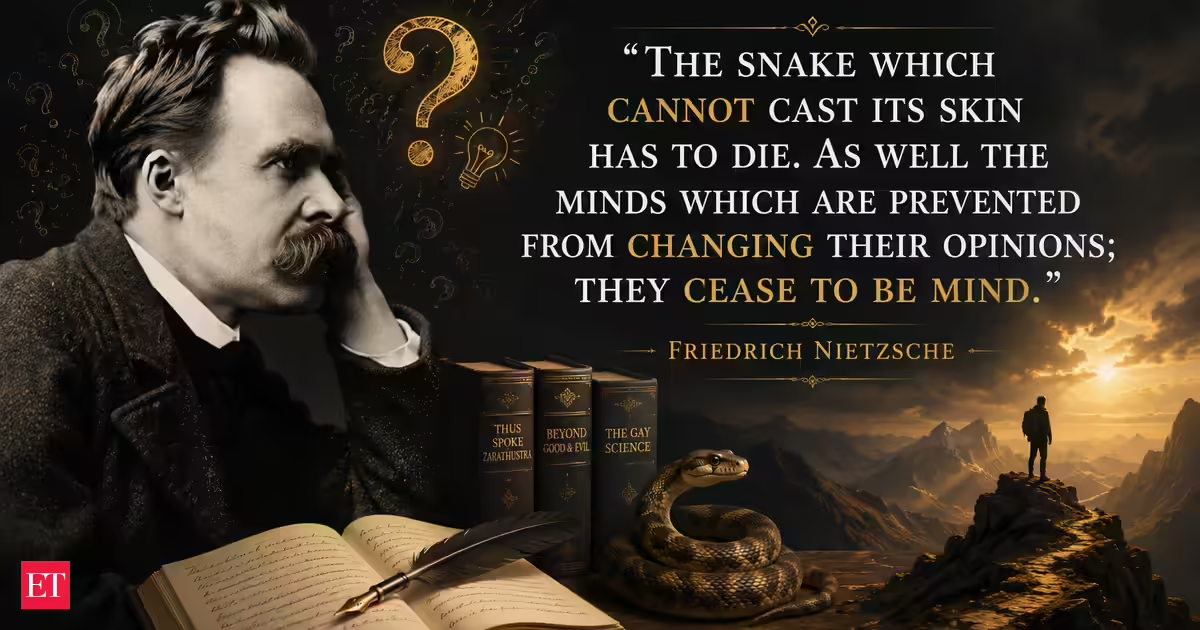
Friedrich Nietzsche's quote of the day: There's a particular kind of person who is very good at being wrong. Not wrong in small, correctable ways—wrong in ways that calcify over years, becoming architectural, load-bearing. They've built their entire sense of self on a set of beliefs, and somewhere along the way, the beliefs stopped being tools for understanding the world and became walls keeping it out. Nietzsche watched this happen everywhere. In universities. In churches. In the people he loved. And in 1881, somewhere in a notebook that wouldn't be widely read until after his death, he wrote the sentence that may be his most practically urgent: "The snake which cannot cast its skin has to die. As well the minds which are prevented from changing their opinions; they cease to be mind." It doesn't sound like philosophy. It sounds like a warning.Quote of the Day by Friedrich Nietzsche on changing your mind: What Did Nietzsche Actually Mean The serpent metaphor isn't decorative. Nietzsche chose it because snakes shed skin not as a cosmetic ritual but as a survival imperative. The old skin becomes a constraint. It stops fitting. If the animal cannot separate itself from what it has outgrown, it dies inside what used to protect it. He was describing human consciousness with biological precision. The mind, he argued, is not a fixed container for fixed truths. It is a living process. Opinions are the skin—not the self. But something goes wrong in humans that doesn't go wrong in snakes: we develop emotional attachment to our conclusions. We stop treating beliefs as hypotheses and start treating them as identity. Nietzsche had watched German intellectual culture become rigid with nationalism, rigid with religious certainty, rigid with academic hierarchy. He saw brilliant people becoming less intelligent over time—not because they stopped reading, but because they stopped being willing to be wrong. They had confused the accumulation of reinforced opinion with the development of genuine thought. That distinction matters more now than it ever has.The Psychology of Why Intelligent People Resist Changing Their Minds Here is the uncomfortable truth that neuroscience has been quietly assembling: the brain processes threats to strongly held beliefs in the same neural circuits it uses to process physical danger. Challenges to our worldview don't feel like invitations to learn. They feel, at a low neurological level, like attacks. This is why expertise can sometimes work against growth. The more invested someone becomes in a particular framework, the more neurologically costly it becomes to revise that framework. The intellectual pain of changing one's mind increases with the depth of one's knowledge. Specialists in any field—economics, medicine, physics, political science—are not immune to this. They are often more vulnerable to it. Psychologists call this belief perseverance. Once a person has publicly committed to a position, evidence against that position frequently strengthens the original belief rather than eroding it. This is counterintuitive but extensively documented. The mind does not simply update. It defends. Nietzsche understood this without the vocabulary of cognitive science. He understood it through observation—of himself, first of all. He famously broke from Wagner, broke from Schopenhauer, broke from his own earlier work. Each rupture was painful. Each rupture made him more himself.The Idea That Changed Everything About How We Understand Intelligence For most of recorded history, intelligence was treated as a kind of possession. You had it or you didn't. It was fixed, measurable, and ultimately hierarchical. That model has collapsed. What research across the last forty years has demonstrated—in education, in organizational behavior, in developmental psychology—is that the capacity to revise one's thinking is itself a cognitive skill, perhaps the most important one. Carol Dweck's work on growth mindset began as educational research and ended up revealing something about mental life more broadly: the belief that understanding can change is precisely what makes understanding change. Nietzsche framed this as a biological necessity. Modern science frames it as neuroplasticity. The language is different. The insight is the same. What makes this strange is how rarely we treat intellectual flexibility as a virtue worth practicing. We admire consistency. We reward people who don't change their minds. We call it conviction. We give it to politicians as a compliment. In reality, a person who holds exactly the same beliefs at fifty that they held at twenty has either been extraordinarily lucky in their early education, or extraordinarily resistant to everything life has tried to teach them.Why This Matters More Now Than Nietzsche Could Have Imagined In 1881, information moved slowly. Opinions calcified, but they calcified over decades. The world Nietzsche was writing in gave a person time, at least, to notice when their thinking had gone stiff. That grace period no longer exists. The pace at which circumstances change—technological, economic, political, scientific—means that frameworks that served someone well in 2015 may be actively misleading them in 2026. The expert who refuses to update is not simply standing still. They are moving backward relative to a world moving forward. This is the modern version of the snake that cannot shed its skin. It is not a dramatic failure. It looks like competence. It looks like confidence. It looks like someone who knows what they think. But underneath, the calcification has already begun.What Nietzsche Was Really Asking Us to Become The quote is often read as a meditation on open-mindedness—which is accurate but somewhat thin. What Nietzsche was describing is closer to intellectual courage. The willingness to look at an opinion you've held for years and ask whether it was always a belief or merely a habit dressed up as one. That question is harder than it sounds. Habits of thought are invisible from the inside. We don't experience them as choices. We experience them as clarity. The snake doesn't choose to shed. Biology compels it. Nietzsche's darkest implication is that humans have to choose to do what the snake does automatically—and most of us, most of the time, choose not to. We stay inside the old skin because it is familiar and because revision is uncomfortable and because the person we would become on the other side of a genuine change of mind is, in some small way, a stranger to us. The minds that keep shedding keep living. The ones that don't, he said, cease to be minds at all. He wasn't being dramatic. He was being precise.Friedrich Nietzsche (1844–1900) was a German philosopher, cultural critic, philologist, and one of the most influential thinkers in modern philosophy. His work challenged traditional ideas about morality, religion, truth, and human nature, encouraging people to question accepted beliefs and create their own values. Among his best-known concepts are the Übermensch (Overman), the will to power, self-overcoming, and the idea of eternal recurrence, all of which explore human potential, personal responsibility, and continuous growth. His major works include Thus Spoke Zarathustra, Beyond Good and Evil, On the Genealogy of Morality, The Gay Science, and Twilight of the Idols.
Quote of the day by Friedrich Nietzsche on fighting life's battles: "The snake which cannot cast its skin has to die. As well the minds which are..." - what can the visionary philosopher's snake metaphor teach us today? Inspiring life lessons on change, resilience, and personal growth
Quote of the Day by Friedrich Nietzsche: What if the greatest danger to our intellect lies not in ignorance but in the refusal to evolve? Friedrich Nietzsche, the provocative philosopher, once remarked, "The snake which cannot cast its skin has to die. As well the minds which are prevented from changing their opinions; they cease to be mind." This quote encapsulates a profound truth about human growth and adaptability, urging us to reflect on how vital change is in our lives.
1,155 words~5 min read