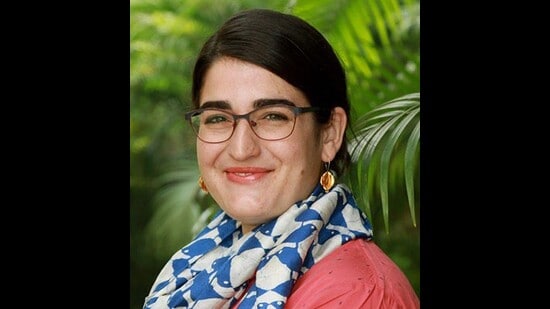
In Against Heritage, you break away from what you call the “yum yum mode” and happy nostalgia of the grandmother’s kitchen and produce a powerful treatise for our times. Please explain the thought process behind the book. Author Lily Kelting (Courtesy Flame University)In academic writing there’s often this emphasis on product over process; there’s an idea that the book should somehow arrive fully formed. But that’s not been my experience. This book also reflects my struggles, my thought process, emotional process and tears process! It’s been a very long, almost 15-year journey of putting this together and it also reflects my own journey around the world - living in the US, northern Europe and now in India for almost 10 years.That living has informed my thinking. Because when we’re talking about these complex issues, about history and heritage or food culture, it shouldn’t be nice and easy. This is the job of food studies as a discipline -- to create another way of talking about food that is not “yum-yum mode”. Culinary writer Anya von Bremzen used this phrase in an interview, and I thought it is such an easy three-word way to understand 99% of food media.You write that the millet movement has benefitted “elite Indians at the expense of the most marginal, small-scale farmers.” Are there parallels to this around the world? I think there are tons of other examples. The example of quinoa and the gentrification of indigenous South American foods is very strong. People are afraid millets will become like quinoa, where the farmers are not able to purchase the staple grain they produce. And they won’t be able to consume their traditional foods because it has been so gentrified and so urbanized. There’s another great book I am very inspired by called Eating NAFTA. The author Alyshia Galvez talks about Mexican corn in the same way, that now if you want a stone-ground corn tortilla you have to go to a Noma pop-up in Tulum, because, at home, people are eating heavily processed foods. She links this directly to trade – to NAFTA (North American Free Trade Agreement) – and that’s a very convincing argument.Part of the reason I wanted to write this book and intervene now is I feel like it’s not done yet. The story of the Indian food movement is still unfolding. That’s why I wanted to shout a bit and say it doesn’t have to be like quinoa or corn, we can still safeguard biodiversity and food sovereignty, rather than just creating nice products at fancy restaurants or for urban elites.In your exploration of food in southern United States, you talk of family heritage which has a “painful history”, where the body and food is a “monument” to human heritage (such as slavery). How do you unpack this nuance in a world where popular chains like McDonalds flattens every narrative? I think these are uncomfortable histories, so it becomes very important to look at them. I think there’s a double paradox, because people expect food to be nice and comforting; to think that we could use a tasting menu to tell the story of the transatlantic slave trade feels like a juxtaposition.But this is what chef Eric Adjepong did, to tell this story of the Middle Passage across the Atlantic. I’ve also seen this at Aragma, an ingredient-forward restaurant in Pune, where they use dagad phool in a dish to illustrate how climate catastrophe might limit our food choices in the future. If a fine dining restaurant can pose this kind of a nuanced critique then I’m very optimistic.About McDonald’s – well, it’s very tricky, like David and Goliath. We are very small in the face of corporations. But I don’t want to be so cynical. Because while the big corporations are flattening our narratives about food, there is so much good work being done now around food systems and food justice.A very sharp critique on class mechanisms in the west -- and race and caste by extension -- is where you write about other people’s labour being “the ultimate commodity”, where diners in a fancy restaurant are “eating time”. That’s so powerful. How does this play out in the Indian kitchen, where labour is practically romanticised?The way to be fancy in the Global North is to consume other people’s time.Whereas in an Indian context, it doesn’t even have that capital, because someone else’s time is so undervalued. And when I say someone else, of course, I mean a woman cooking, her labour is seen as having no economic value at all.So, I wonder how we can make a food sovereignty movement in this context? How can we celebrate these traditional foods without really pausing to celebrate the people who make them?I think also as a foreigner, as a kind of an insider outsider, I have a different perspective. I have learned to make chapatis and it’s hard. I have learnt to make dosa and to fill a modak.These are skills, not some easy thing. We’re all eating other people’s time all the time and we don’t even see it. That’s why I think the movie The Great Indian Kitchen was so important, because it was a representation of this work, showing the reality of the Indian kitchen.Does the whole concept of heritage rest on eating time? How do you see the tension between heritage making and women’s labour? It’s such a great question. Basically, there is this tension between wanting to safeguard heritage and the fact that a lot of heritage is an engine of inequality.So, I love this idea that heritage is a way to eat time.That’s actually true across all the case studies.There’s a lot of talk about friction in terms of AI and convenience culture. No woman is saying I want more friction, but then how do we safeguard culinary heritage? I think it’s about also telling the truer story like I say in the end [of the book] about my grandmother who stopped cooking. There are women out there who would rather not make a stone-ground chutney. The reason that they actually switch to the mixie is because it’s easier for them. And depending on the context, maybe these women are also doing all this agricultural labour, also invisiblized and unwaged. And they’re someone with their own hopes, dreams, aspirations. That’s where the book lands.When you take a spice like cardamon and its culinary history in the far north, you write that “centuries of history - histories of exploration, colonialism, enslavement - collide” Is that history acknowledged? If not, why? The strength of the Danish brand eliminates some of the harder conversations about the colonial histories or even the ongoing inequalities there. New Nordic food has become an official political program through the Nordic council of ministers so it’s been really effective cultural diplomacy. For the most part, the conversation about “Denmark was a colonial nation, you know” doesn’t happen.Could you talk about the reasons for the glaring absence of women in the “upper echelons of the food world”? In March 2026, there was an expose about abuse in Noma, Copenhagen (Michelin starred and ranked as the best restaurant in the world) and the response was huge! I think it was long overdue: it even came to light that the founder-chef Rene Redzepi had stabbed a staff in the leg with a fork. What was interesting to me was that the critique really was never framed explicitly around gender, it was mostly that it was a really toxic workplace.Fine dining and commercial kitchens are modelled on the brigade system from the 1800s, based on marshalling people together. This idea of the kitchen as a kind of a masculine space structured by hierarchy or inequality, means there’s someone at the top and the people below just shut up and listen. If you don’t, you get screamed at, hit or thrown out. This toxic masculinity [keeps women out]So then it becomes a question of how to reorient the kitchen.It’s 2026, we probably can get all the plates out on time to a high standard without doing this. There are feminist ways to run a kitchen. That’s why I mentioned Asma Khan and her work at Darjeeling Express in London.In India, you note that the “so-called Indian food movement too often valorizes traditional Indian foods without the people who produce it -- farmers and women (and women farmers). How do you then reposition heritage to include “women’s embodied culinary knowledge as science, as serious, and as valuable”? In the book, I talk about this movement which started in the 1970s, Wages for Housework, which was an activist project; but it’s also a theoretical project. These feminists in the 1970s were not economists. They were not asking the World Bank for their policy proposal to get a green light. What they were doing is kind of a more radical provocation towards revaluing.My writing is also aligned with, or in extension to, these kinds of radical movements from the 1960s and ’70s. What if every time I ate a plate of rice, I thought, wow, a woman farmer had to do an enormous amount of work to get this rice to me. And also, if it’s any kind of locally native rice, then there’s also the work of seed saving, that knowledge. If we just start to see this labour, maybe that is the beginning of valuing food and cooking differently.Why do you advocate your readers to become “culinary killjoys”? I added the toolkit with positive examples and steps for people to take because so many reviewers asked me what they should do. I took the term from Sarah Ahmed’s book that I read in graduate school. I actually really disliked it then! I love joy!But we’re now so disassociated from where our food comes from. We know to appreciate food, but not the art of making it.If you like Southern food then you’re ingesting the history of enslavement. And those yummy Swedish cardamom buns that we love? Real violence had to happen for that cardamom to get there. Colonialism contains economic violence and also epistemological violence, harm to knowledge systems and cultural systems.But I also hope that people are having joy, I hope they’re enjoying their food, which also means respecting what they’re eating enough to become curious about it.Aparna Karthikeyan is an independent journalist and author based in Chennai.
Lily Kelting: “There are feminist ways to run a kitchen”
The author of Against Heritage on the revival of traditional foods around the world since the year 2000, and the politics behind food production and consumption
1,730 words~8 min read