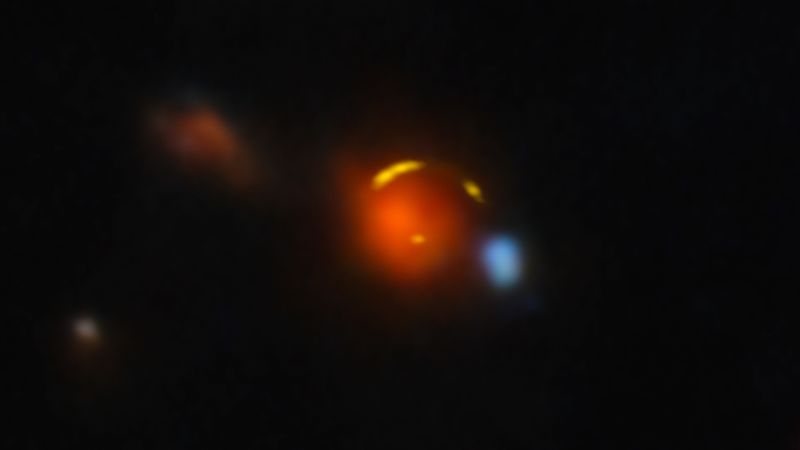
A distant star-forming galaxy nicknamed the “Shadow Blaster” could have sent a ghostly cosmic particle hurtling toward Earth.
Astronomers believe they have traced the particle‘s origin to 11 billion light-years away, marking a step forward in understanding the mysterious neutrinos.
Neutrinos are abundant across the universe, earning a reputation as ghost particles because they possess no electric charge, have little mass and don’t seem to interact with other types of matter.
Supernovae, stellar nuclear reactions and the breakdown of heavy particles can create neutrinos. But tracing exactly where neutrinos come from when detectors such as Antarctica’s IceCube Neutrino Observatory alert their presence has proven more difficult for astronomers.
“They rarely interact with matter, which is why they can travel across the universe almost undisturbed,” said Dr. Yuji Urata, researcher at Taiwan-based astronomical research firm MITOS Science Co. Ltd. “Even when IceCube detects a high-energy neutrino, the position on the sky often has an uncertainty region that is much larger than the size of a galaxy.”