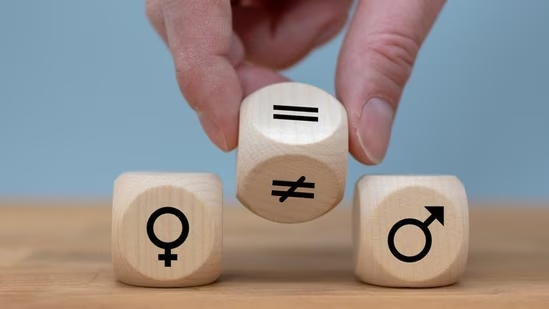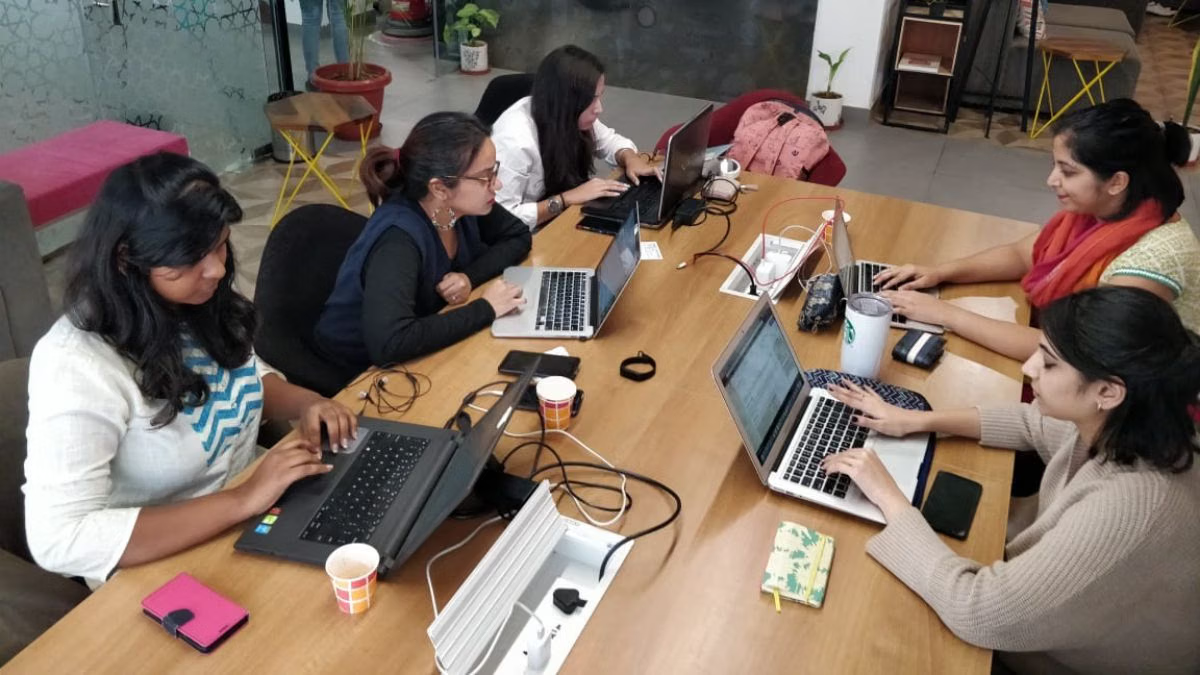
The place of women in society has improved in visible and important ways across the world, but the pace of change remains uneven and, in many places, disappointingly slow. From South Asia to Europe, from Africa to the Americas, the same tension persists: Laws and election pledges often speak the language of equality, while daily reality still reflects unequal pay, unpaid care burdens, violence, under-representation and limited economic power.Women empowerment (Voices of Youth)The question, then, is not whether women have progressed. They clearly have. The real question is whether political systems, especially during election cycles, are delivering durable change or merely recycling familiar promises. Too often, the answer is the latter.Across democratic systems, rights of women are now firmly embedded in constitutional language and statute. India guarantees equality and non-discrimination in its Constitution and has enacted major laws on domestic violence, sexual harassment, inheritance and maternity benefits. Similar legal architectures exist elsewhere: The UK has the Equality Act 2010, the US relies on a combination of constitutional protections and legislation such as Title VII and the Violence Against Women Act, and many European States have strong anti-discrimination and workplace equality regimes.Internationally, the Convention on the Elimination of All Forms of Discrimination against Women remains the central global framework for women’s equality. Yet legal recognition is only the starting point. A right written into law does not automatically become a right enjoyed in practice.This gap between text and lived experience is one of the defining features of women’s status worldwide. Laws may prohibit discrimination, but they cannot on their own dismantle entrenched social attitudes, weak enforcement systems or economic structures that keep women dependent.The most persistent inequalities are often the least visible. Women continue to perform the majority of unpaid care work in almost every society, whether in India, Japan, Brazil or the UK. They spend more time on childcare, elder care, cooking, cleaning and emotional labour, which limits their participation in paid employment, politics and public life.Even where women enter the workforce in large numbers, they are often concentrated in lower-paid, insecure or informal jobs. In many countries, the motherhood penalty remains stubborn. Women with children face slower wage growth, reduced promotion prospects and career interruptions that men are less likely to experience. Equal opportunity laws help, but they do not erase social expectations that continue to treat care as a natural duty of women.Violence is another stubborn global constant. Domestic abuse, workplace harassment, trafficking and coercion affect women in rich and poor countries alike. In some places, reporting mechanisms are stronger; in others, stigma and fear silence victims altogether. The pattern is similar: the law exists, but enforcement is uneven and social norms often shield the perpetrator.Election campaigns tend to magnify issues of women because women are both a large voting bloc and a symbolically powerful constituency. Political parties promise more safety, more jobs, more subsidies, more representation and more dignity. Some of these promises are meaningful. Others are designed mainly to attract votes.This pattern is not uniquely Indian. In the US, women’s rights are frequently central in presidential and state campaigns, yet progress on pay equity, reproductive autonomy and childcare remains politically contested. In the UK, parties regularly pledge improvements in women’s safety and family support, but delivery often depends on post-election budgets and administrative capacity. In many African and Latin American countries, campaign rhetoric around women’s empowerment can be even more ambitious than the policy follow-through.The problem is not that election promises are always false. It is that elections reward short-term messaging more than long-term reform. Real change usually requires patient institution-building, cross-party consensus, sustained funding and a willingness to confront powerful social interests. That is much harder than making a promise on the campaign trail.Despite the gaps, there are clear examples of progress that should not be dismissed. Political quotas and reservations have improved women’s representation in several countries. Rwanda is often cited as the world’s strongest example, with women forming a majority in parliament. In Latin America and parts of Europe, quota systems and party rules have also pushed more women into legislatures, cabinets and local government.Representation matters because women in office can change the policy agenda. They often draw attention to childcare, maternal health, domestic violence, education, sanitation and social protection, issues that are frequently treated as secondary in male-dominated systems. Even where progress is imperfect, more women in decision-making roles tends to make institutions more responsive to everyday social needs.Legal reform has also had real effects. Inheritance rights, workplace protections and anti-harassment rules have helped many women claim property, challenge abuse and enter the formal economy. In countries where enforcement is serious, the difference is not abstract. It is felt in wages, mobility, safety and bargaining power inside the home.Still, the limits of legal reform are obvious. Many women across the world remain trapped between formal rights and informal exclusion. A woman may be legally protected against discrimination but still face bias in hiring. She may have equal inheritance rights but still be pressured into surrendering property. She may be entitled to safety but still fear reporting violence because institutions are slow, biased or indifferent.This is why elections can never be the whole story. They may create pressure for reform, but they cannot substitute for administration, education, economic policy and cultural change. The most effective countries are not necessarily those with the most eloquent political speeches, but those with strong systems: accessible courts, affordable childcare, decent public transport, school retention, equal pay enforcement and dependable welfare delivery.In other words, the real measure of progress is not whether women are mentioned in manifestos, but whether institutions change how they are treated.So, will women’s positions improve after elections? Sometimes, yes, but only if the promises survive contact with government machinery. Otherwise, elections become little more than a periodic ritual in which gender equality is celebrated in speeches and deferred in practice.The deeper lesson from India and other countries is that women’s advancement is always multi-layered. Law matters. Representation matters. Welfare matters. But none of these works in isolation. Social attitudes, household power, labour markets and political accountability all shape the outcome.The political class across democracies understands that women matter. The harder task is proving it after the campaign ends. Until that happens, election rhetoric will continue to outpace lived reality, and the promise of equality will remain unfinished.(The views expressed are personal)This article is authored by Ananya Raj Kakoti, scholar, international relations, Jawaharlal Nehru University, New Delhi.
Women, power and the politics of promise
This article is authored by Ananya Raj Kakoti, scholar, international relations, Jawaharlal Nehru University, New Delhi.
1,072 words~5 min read