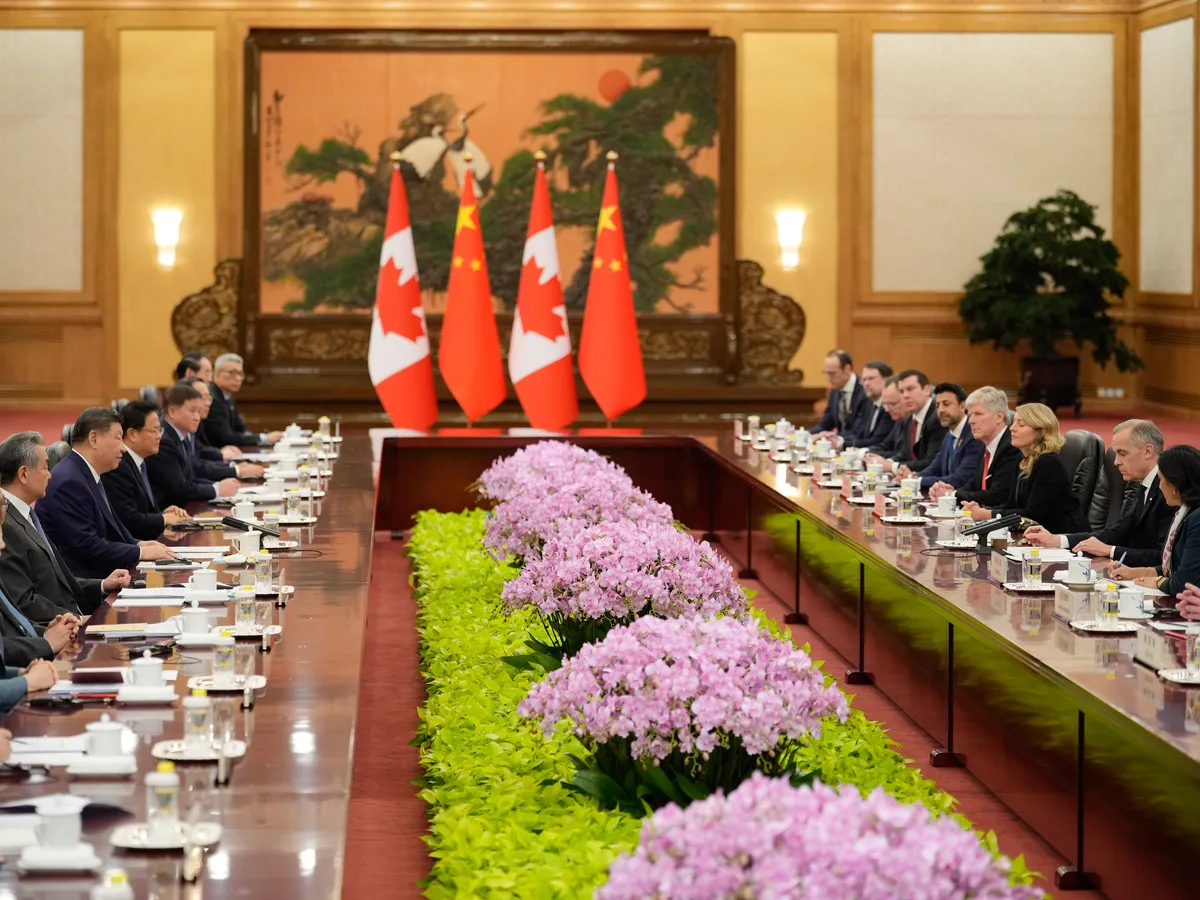
Skip to Content Subscribe Our Offers My Account Manage My Subscriptions FAQ Newsletters Canada Canadian True Crime Canadian Politics Health World Israel & Middle East Financial Post NP Comment Longreads Puzzmo Diversions Comics NP News Quiz New York Times Crossword Horoscopes Life Eating & Drinking Style Sponsored Play for Ontario Travel Travel Canada Travel USA Travel International Cruises Travel Essentials Culture Books Celebrity Movies Music Theatre Television Business Essentials Advice Lives Told Tails Told Shopping Buy Canadian Home Living Outdoor Living Kitchen & Dining Tech Style & Beauty Personal Care Entertainment & Hobbies Gift Guide Travel Guide Amazon Prime Day Deals Savings National Post Store More Sports Hockey Baseball Basketball Football Soccer Golf Tennis Driving Vehicle Research Reviews News Gear Guide Obituaries Place an Obituary Place an In Memoriam Classifieds Place an Ad Celebrations Working Business Ads Archives Healthing Epaper Manage Print Subscription Profile Settings My Subscriptions Saved Articles My Offers Newsletters Customer Service FAQ Newsletters Canada World Financial Post NP Comment Longreads Puzzmo Diversions Life Shopping Epaper Manage Print Subscription HomeNP CommentTerry Glavin: Beijing offers a poisoned chalice. Carney shouldn't drink from itWe're embroiled in a hybrid war with ChinaLast updated Jun 26, 2026 You can save this article by registering for free here. Or sign-in if you have an account.Chinese President Xi Jinping (3rd-L) and Canada's Prime Minister Mark Carney (2nd-R) meet at the Great Hall of the People on January 16, 2026 in Beijing, China. Photo by Vincent Thian - Pool/Getty ImagesIt’s a war that’s underway everywhere, all the time. It’s being waged by Beijing and Moscow. It’s a hybrid war that confounds western intelligence agencies and transcends borders. Like conventional warfare, it involves mobilizations and sophisticated operations and devastating weaponry that lays waste to entire industries.Enjoy the latest local, national and international news.Exclusive articles by Conrad Black, Barbara Kay and others. Plus, special edition NP Platformed and First Reading newsletters and virtual events.Unlimited online access to National Post.National Post ePaper, an electronic replica of the print edition to view on any device, share and comment on.Daily puzzles including the New York Times Crossword.Support local journalism.Enjoy the latest local, national and international news.Exclusive articles by Conrad Black, Barbara Kay and others. Plus, special edition NP Platformed and First Reading newsletters and virtual events.Unlimited online access to National Post.National Post ePaper, an electronic replica of the print edition to view on any device, share and comment on.Daily puzzles including the New York Times Crossword.Support local journalism.Create an account or sign in to continue with your reading experience.Access articles from across Canada with one account.Share your thoughts and join the conversation in the comments.Enjoy additional articles per month.Get email updates from your favourite authors.Create an account or sign in to continue with your reading experience.Access articles from across Canada with one accountShare your thoughts and join the conversation in the commentsEnjoy additional articles per monthGet email updates from your favourite authorsSign In or Create an AccountorThe war relies on command structures that establish tactical objectives in pursuit of strategic dominance by means of espionage, sabotage, intellectual property theft and the targeted flooding of western markets with heavily subsidized exports. The phenomenon defies description without resort to a lexicon that is only barely intelligible within conventional analyses of international conflict, statecraft and diplomacy: spearphishing, troll farms, botnets and cyber kill chains. Spamouflage, Dragonbridge, Salt Typhoon and Raptor Train.Wholly new reality-distorting artificial intelligence manipulations are carried out at a global scale in tandem with primitive trench warfare in Ukraine of a kind unknown since the First World War, while at the same time, satellite-guided drone technology is rendering conventional arsenals of tanks, bombers and fighter jets obsolete.This newsletter from NP Comment tackles the topics you care about. (Subscriber-exclusive edition on Fridays)By signing up you consent to receive the above newsletter from Postmedia Network Inc.We encountered an issue signing you up. Please try againCompromised global supply chains, high-finance interdependency and digital interconnectivity have obscured the distinctions between the interests of the United Nations police-state bloc and the NATO capitals, and between the public interest and the interests of trade-reliant global corporations and the compliant politicians they champion. There’s no Berlin Wall anymore.While the Five Eyes intelligence agencies do their best to keep up, the rapid acceleration of the Beijing-Moscow assault on the NATO countries has been midwifed by the Trump administration’s abdication of the United States’ traditional role as the democratic world’s primary defensive backstop. NATO disunity and a leadership vacuum in Europe have only deepened the West’s incoherence.An analysis undertaken by the 38-member Organisation for Economic Co-operation and Development published earlier this month found that nearly 60 percent of the global market gains made by Chinese corporations since 2005 are attributable to state subsidies.Some European manufacturers appear to be finally willing to put up a fight — the European Union has proposed a “Made in the EU” Industrial Accelerator Act. Others, like the Mercedes-Benz corporation, now partly owned by Chinese carmakers, lean towards the accommodationist approach adopted by Mark Carney’s Liberal government in Ottawa. Prime Minister Carney has invested much of the Liberals’ political capital in the “strategic partnership” he entered into with Beijing in January.The Ottawa-Beijing partnership consists of a series of agreements and promises, beginning with Ottawa’s guarantee to allow the import of low-tariff Chinese electric vehicles into Canada, starting with a quota of 49,000 EVs a year. The deal is opposed by the three largest U.S. automakers in Canada on the grounds that the annual quota represents nearly a third of EV sales in Canada last year and the deal “puts the North American auto supply chain at risk.” Japanese automakers in Canada have expressed similar concerns.Making things especially awkward, Industry Minister Mélanie Joly has specifically invited the Chinese EV giant BYD to invest in Canada. Earlier this month, the Pentagon placed BYD on a blacklist of Chinese tech firms linked to China’s military.Even more awkward is the memorandum of understanding in the “strategic partnership” package that binds the Royal Canadian Mounted Police to collaborate with China’s all-powerful Ministry of Public Security (MPS). The MOU follows on a collaboration from 25 years ago that fell apart owing to allegations of tortured witnesses and fabricated corruption charges. The RCMP-MPS agreement remains secret, despite Opposition efforts in the House of Commons to subject its contents to the light of day.The RCMP’s partner in Beijing’s Ministry of Public Security is a key agency in the hybrid war Beijing is waging against western democracies. The MPS has been specifically implicated in clandestine interference operations in Canada.In 2023, the U.S. Justice Department identified 40 Chinese nationals deployed by an MPS task force known as the 912 Special Projects Working Group to establish an underground “police station” in New York to harass dissidents and run an elaborate social-media disinformation operation. Thirty-four of them were charged with conspiracy to transmit interstate threats and conspiracy to commit interstate harassment.The “troll farm” masked the MPS agents’ identities to appear as though they were American citizens and harassed critics of China online, dubbed Spamouflage.Around the same time, Canadian intelligence sources confirmed that several similar “police stations” had been established in the Greater Toronto Area, Montreal and suburban Vancouver. No charges have been laid in Canada. The long-running scandal involving the Chinese Communist Party’s interference in Canada’s 2019 and 2021 federal elections was investigated by the Hogue inquiry into foreign interference and led to the 2024 Foreign Influence Transparency and Accountability Act. But the foreign influence registry still hasn’t been established.It is not known just how long Beijing’s Spamouflage operation has been running. It was first detected in Canada in 2023. Last year, the election-monitoring Rapid Response Mechanism group reported that the operation had returned, using a variety of tactics “to intimidate, belittle, and harass individuals based in Canada who are critical of the PRC.” The operation included the production of videos on YouTube and Instagram, “doctored through artificial intelligence (AI), and the release of private information about targeted individuals without their consent (‘doxing’).”It isn’t just the massive scale of these operations and the unfamiliar nomenclature that keeps the Beijing-Moscow hybrid warfare operations just beyond the public field of vision. It’s the pace of the strategy’s expansion and its deep integration into Beijing’s entire complex of surveillance, social control, foreign policy and trade policy.In 2017, Xi Jinping’s increasingly totalitarian regime enacted the National Intelligence Law, compelling all Chinese companies, Chinese citizens and ethnic Chinese everywhere to cooperate with Beijing’s intelligence agencies on command. The move turned out to be self-defeating, in the way that any engagement with “national champion” conglomerates like Huawei was immediately understood to be a security risk. But the same year that the National Intelligence Law came into effect, Xi formulated China’s Integrated National Strategic System and Capabilities (INSSC) doctrine. After years of planning and refinement — and after years of disarray in the democratic west — the Communist Party’s central committee politburo was sufficiently emboldened to codify the INSSC.The new and improved blueprint formalizes the People’s Republic of China as a “military-civil fusion” of the Chinese state and nominally private companies and institutions that requires military and civilian planning, coordination, policy alignment and resource-sharing. It calls for peacetime-wartime integration as a central purpose of the Communist Party’s 15th five-year plan, for 2026-30. And Beijing’s peace-war integration has dramatically ramped up China’s hybrid-warfare collaborations with Russia in targeting Japan, South Korea, Australia and Taiwan.The Trump administration has rendered the United States largely irrelevant in this new theatre of operations. Dozens of U.S.-backed academic and civil-society organizations with a focus on Beijing’s human rights abuses and the persecution of Tibetans, Uyghurs, Hong Kongers, journalists and civil rights activists had their funding cut within days of Trump’s return to the White House on Jan. 20 last year.The tariff war the Trump administration immediately launched against China ended in a draw, if not an outright American defeat, as Beijing demonstrated that it could sustain its global exports sufficiently without any access to American markets. Just as the Carney government has returned Canadian policy to the exuberant enthusiasm for China that marked the early years of Justin Trudeau’s “postnational” government, the Trump administration has lately turned the American clock back a quarter of a century.The Brookings Institution scholar Jonathan A. Czin, former National Security Council director and former senior Central Intelligence Agency analyst, says Trump’s recent summit in Beijing was almost entirely devoted to trade and commerce, “conspicuously neglecting any of the many security issues that bedevil the relationship.”Writing in the journal Foreign Affairs, Czin describes Trump’s deal-making for a joint board of trade and a board of investment as “a throwback to the bygone era of engagement and economic dialogues that the first Trump administration ended.” Beijing convinced Washington to focus on “constructive strategic stability,” and Trump’s acquiescence has given the impression that the U.S. is buying stability with the currency of accommodation at the expense of U.S. allies and partners in the region that are “on the receiving end of China’s growing might, most notably Japan and Taiwan.”In these ways, when it comes to China, Trump and Carney, ordinarily depicted as polar opposites, are on the same page.While the Trump administration had pledged to greenlight the sale of $14 billion in armaments to Taiwan, after his return from Beijing in May, where Xi implored him to think twice about the deal, Trump told Fox News’ Bret Baier: “I’m holding that in abeyance and it depends on China. It’s a very good negotiating chip for us, frankly. It’s a lot of weapons.”Meanwhile, the hybrid war goes on.Over the past five years, the social media giant Meta has taken down thousands of accounts associated with covert Chinese and Russian disinformation operations. Google had already shut down 100,000 accounts by the time of the Spamouflage arrests in New York, and Elon Musk’s X, formerly Twitter, has blocked hundreds of thousands of accounts linked to Chinese state agencies.On July 1, China’s new “Ethnic Unity” law comes into effect. It’s a comprehensive, enforcement-heavy statute aimed at shoring up the domination of the Mandarin-speaking majority Han Chinese over Tibetans, Uyghurs, Hui, Mongolian and other minorities whose homelands ended up within the borders of the People’s Republic after 1949. The law’s Article 63 stipulates that organizations and individuals outside Chinese territory that commit “acts aimed at the PRC that undermine ethnic unity and progress or create ethnic division” will be targeted by the law.The walls are closing in on dissident Chinese expatriates: to criticize China’s government is to expose your parents back in China to the loss of their pensions, your siblings could lose their jobs and your children could be barred from university. If you’re targeted as a foreign adversary you risk being subjected to malicious, covert operations run by Chinese law enforcement of the kind a February Open AI threat report described as a well-resourced, meticulously orchestrated strategy targeting Japanese Prime Minister Sanae Takaichi. That operation involved 35 fake X accounts and nine channels on the microblogging site Tumblr. In the case of the Madrid-based human rights organization Safeguard Defenders, the organization’s external liaison for the Inter-Parliamentary Alliance on China, Laura Harth, was targeted in an elaborate Chinese-run “deepfake” pornography smear.In April, the International Consortium of Investigative Journalists and the University of Toronto’s Citizen Lab published their investigation of an elaborate operation employing fake journalists to target the ICIJ as punishment for a 2025 exposé of the Chinese regime’s threats, coercion and intimidation of overseas regime critics. The Chinese operatives were assigned to carry out a wide-ranging scheme to steal private information from Uyghur, Tibetan, Taiwanese and Hong Kong diaspora activists, as well as from reporters who focus on activities involving those targeted groups.Last September, armed Russian drones entered Polish airspace. For the first time since the Second World War, Poland scrambled its air force. Polish fighter jets shot down the drones. Then more Russian drones were spotted in the sky over Romania, and a few days later, drone incursions caused several Danish airports to shut down. Japan, meanwhile, is launching an emergency audit of its thousands of uninhabited islands out of fears of Chinese buyers quietly buying properties close to its military hubs. The operation follows land acquisitions by Chinese nationals in strategic maritime zones in Okinawa and Yamaguchi Prefecture.In Early June, the Five Eyes powers — the United Kingdom, the U.S., Australia, Canada and New Zealand — warned of an “aggressive” online recruitment strategy involving Chinese military spies masquerading as agents for private businesses or thinktanks, reaching out to foreign policy or defense analysts on the social media site LinkedIn, offering lucrative contracts for “non-public” information.Margaret McCuaig Johnston, a former assistant deputy minister with Natural Resources Canada and former member of the Canada-China Joint Committee on Science and Technology, warns that Ottawa’s “strategic partnership” with China threatens to turn Canadian innovation in technology into a national-security liability.“The new strategic partnership is exposing our technology as never before,” she told me. Any collaborative arrangements with Xi Jinping’s newly aggressive regime run the risk of Canada losing its edge in sensitive technologies like photonics, owing to Beijing’s abuse of joint ventures. Beijing is already using Huawei to persuade Canadian academics to set up companies to funnel Canadian intellectual property to China. “We need to develop, very quickly, a much more defensive strategy to ensure that our innovations aren’t going out the back door to China through contracts, joint ventures and other mechanisms.“Any research even tangentially related to the defence sector will be targeted by Beijing. Our government will need to communicate to Canadian researchers that their knowledge and skills are needed and will be funded here in Canada as we ramp up our defence capacity. They should not be attracted by offers of easy money from Chinese sources.”Former diplomat Charles Burton, Canada’s preeminent scholar on China and a senior fellow at Sinopsis, a China-focused think tank based in Prague, says the hour is much later than most Canadians realize.Burton says Canada is a “bellwether” country in Beijing’s subversion of developed economies. Before Carney’s election, Canada was already the most deeply compromised member of the G7, and since January’s Canada-China strategic partnership was declared, the Chinese Communist Party’s influence operations in this country have expanded exponentially, Burton told me.“It has been driven by a combination of enhanced resources dedicated to Canadian subversion by Beijing, alongside fortification of the CCP’s proxies in Canada, in sync with a strongly renewed mobilization of captured Canadian co-opted elites.” What’s most concerning about Canada’s rush into Beijing’s embrace is the weaponization of Canadian outrage over Trump’s bellicosity and his threats aimed at America’s closest allies.“By exploiting Canadians’ natural anger over Washington’s betrayal, the CCP have successfully overseen a campaign of calculated deceit. It’s a classic deflection tactic: by keeping the public’s focus squarely on American betrayal, they effectvely defuse and neutralize mainstream concerns about the PRC’s own escalating campaign of subversion, espionage, and transnational repression in Canada.”National Post Join the Conversation This website uses cookies to personalize your content (including ads), and allows us to analyze our traffic. Read more about cookies here. By continuing to use our site, you agree to our Terms of Use and Privacy Policy.
Terry Glavin: Beijing offers a poisoned chalice. Carney shouldn't drink from it
We're embroiled in a hybrid war with China
2,850 words~13 min read