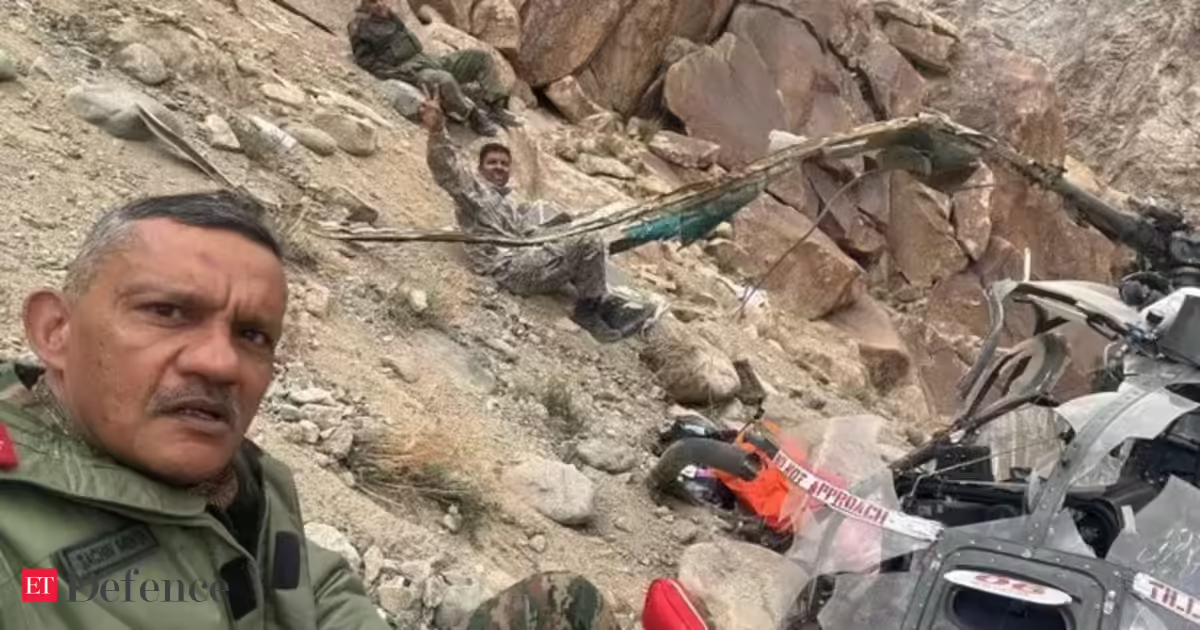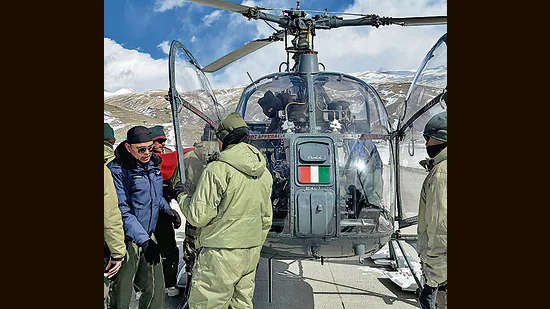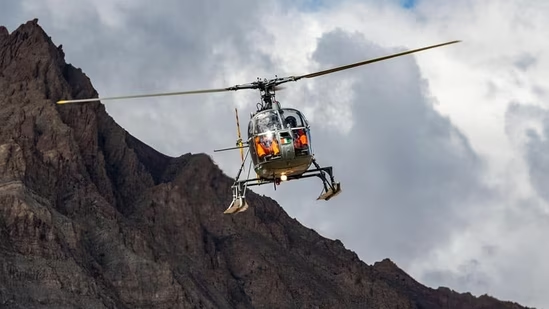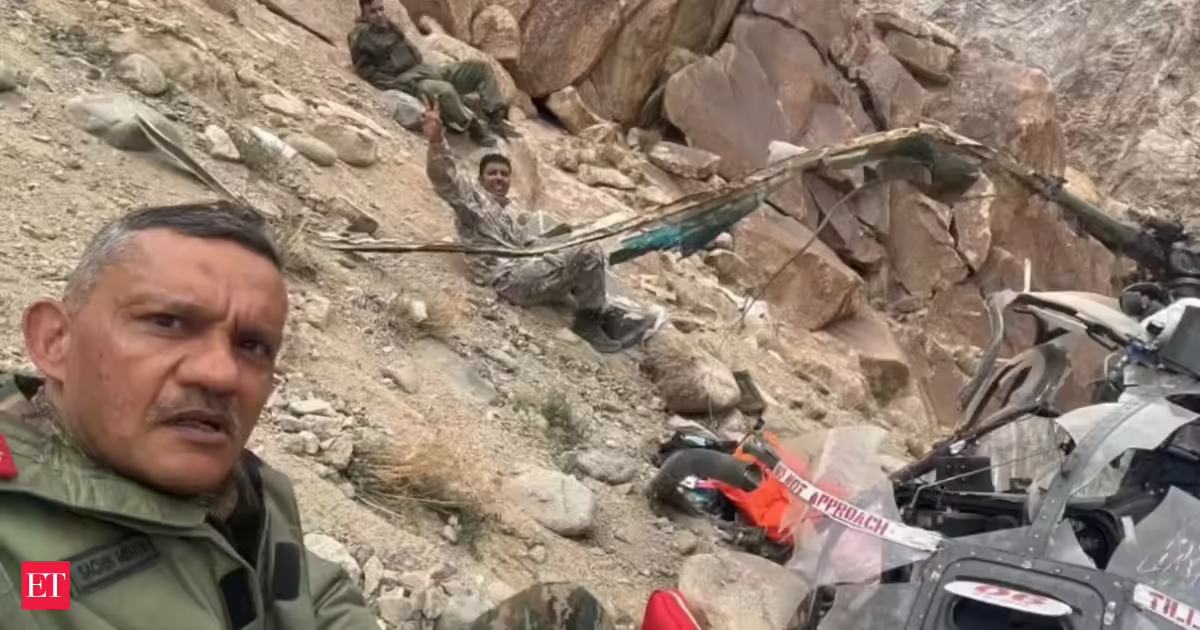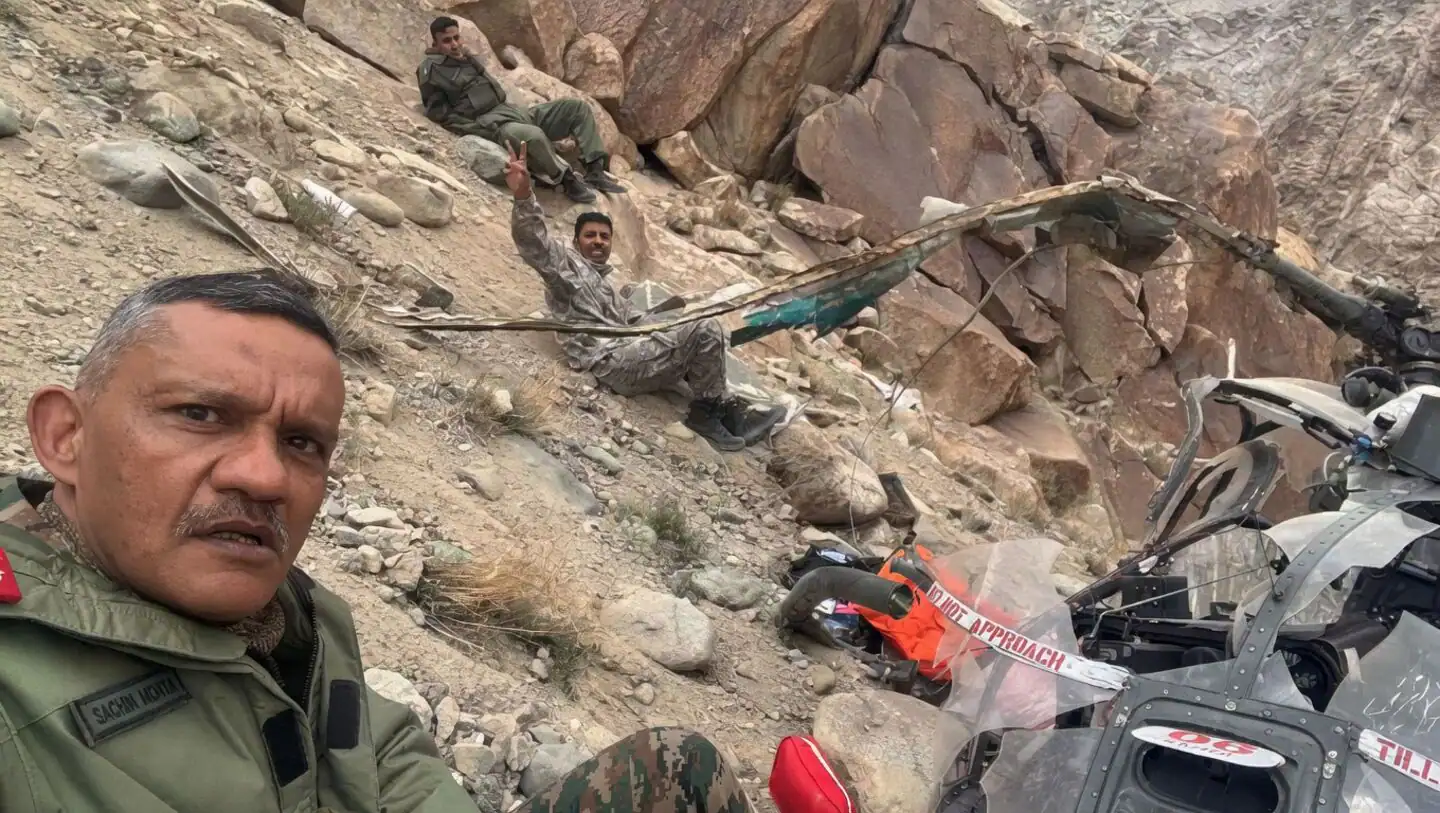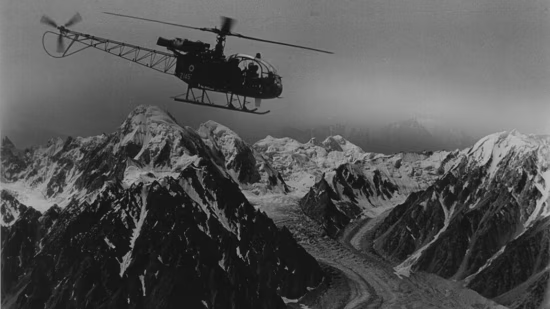
A May 20 crash in Ladakh has put India's oldest helicopters under scrutiny. But, for now, in Ladakh's high peaks, there is simply no substitute. The Indian Army's Cheetal helicopters have kept flying daily sorties over Ladakh's high passes and the Siachen glacier even as investigators probe a suspected transmission failure that may have brought one of them down near Leh's Tangtse on May 20. Two pilots and a Major General survived with minor injuries.The Cheetah helicopter in Ladakh in 1996 (HT Archive)HT reported on Friday that officials say the Army will identify the exact component before corrective steps are ordered.The crash and the decision to keep the rest of the fleet airborne through the inquiry appears to be an extension of a dilemma that has shadowed the forces for decades.India's Cheetah, Chetak and Cheetal helicopters – ageing and due to be replaced for decades, remain the mainstay of forces' observation and transportation needs in some of the high-altitude areas they serve.The Army's far heavier Advanced Light Helicopter (ALH) Dhruv cannot be used for front-line duty in the Ladakh mountains, leaving the lighter Cheetals (maximum takeoff weight 1,950 kg) — prized for their power-to-weight ratio — as the default choice for the Leh-based HQ 14 Corps, which alone operates around 25 of them.Also read: Indian Army’s Cheetal helicopters keep flying in Ladakh amid failure probeFrom a French design to India's workhorsesThe Chetak (2,200kg) is a licence-built version of the French Aérospatiale SA 316B Alouette III. And the Cheetah was derived from Aérospatiale SA 315B Lama.The Lama was engineered specifically for 'hot and high' conditions by combining the lighter airframe of the Alouette II to the more powerful engine and rotor of Alouette III. This was done after the Indian forces found that the standard Alouette III could not perform reliably enough in the Himalayas.Hindustan Aeronautics Limited (HAL) signed an agreement with the French firm Sud-Aviation — now part of Airbus — to manufacture the Chetak around 1962, eight years before it partnered with Aerospatiale in 1970 to produce the Cheetah.The first entirely built in India Cheetah was delivered in 1976-77. HAL has, between the two types, licence-produced 625 Cheetah and Chetak helicopters for the Air Force, Navy, Army, Coast Guard, state governments, civilian operators and export customers, though it no longer builds new ones and is now limited to carrying out maintenance and repairs of the machines.The company later developed the Cheetal — a mid-life upgrade fitted with the powerful, fuel-efficient TM333-2M2 engine and an automatic back-up engine control system. The Cheetal project began about 25 years ago specifically to enhance high-altitude performance, improve maintainability and provide safer, more reliable operations as the original Cheetahs aged.Cheetah choppers in Ladakh (HT Archive)Also read: Chopper crash near Leh: Injured Major General poses, pilot flashes 'victory' sign in viral selfieWhy the forces still depend on themThe Chetak became a multi-role platform flown by all three services — for liaison, training, casualty evacuation and naval utility duties — while the Cheetah earned a reputation for high-altitude flying .The helicopters' light weight is their chief asset. Where the heavier ALH Dhruv cannot be deployed for front-line Ladakh duty, the Cheetal's power-to-weight ratio keeps it viable at altitudes where thinner air saps the lift of larger helicopters.Both types are also rugged and comparatively simple to maintain.Old machines, mounting riskThe toll of age is visible in the numbers. Of the roughly 190 Cheetah and Chetak helicopters operated by the Army Aviation Corps, over two dozen are in maintenance at any given time. The Air Force faces a similar predicament with its 120 Cheetah and Chetak.Across both services, a majority of the fleet is over three decades old.Experts say sourcing spares for such old airframes is more difficult, maintenance hours per flying hours are high, and the pool of technicians qualified to service them is dwindling too."Besides improved engines and transmission systems, choppers in this day and age need upgraded avionics, and safety features such as early warning systems in cases of technical issues," a retired army aviation officer told HT.Also read: India advances deal for 114 Rafale fighters from FranceDecades of false startsPlans to retire the Cheetah and Chetak are also decades old.HAL conceived the ALH in the 1970s as a 2,500kg single-engine helicopter, which was meant to replace the Cheetah and Chetak fleet. But as user requirements evolved, the helicopter grew into the 5,500 kg twin-engine Dhruv, whose size and weight made it unsuitable for high-altitude flying.In 2007, a tender to procure 197 Reconnaissance and Surveillance Helicopters (RSH) was cancelled over allegations of irregularities. A second tender, floated in 2008 and contested between Eurocopter (now Airbus) and Russia's Kamov, ran through years of field evaluation trials before being scrapped in 2014 amidst corruption allegations and a policy pivot to 'Make in India'.A 2015 inter-government agreement with Russia to manufacture 200 Kamov Ka-226T helicopters also did not go ahead due to disagreements over technology transfer and indigenous content.A Chetak adorned for a Republic Day parade. (HT Archive)The road aheadThe Indian Army will begin phasing out the Cheetah and Chetak fleet within a year or two, replacing them over the next eight to 10 years with Light Utility Helicopters as part of its modernisation drive.The plan involves inducting locally produced LUHs while leasing similar helicopters as a stopgap to meet immediate requirements. The army has put its overall new-helicopter requirement at around 250.Separately, the defence ministry revived the long-stalled RSH programme in August 2025, issuing a request for information for 200 new helicopters — 120 for the Army and 80 for the Air Force. A formal request for proposal is expected by early 2027.Until the forces get new helicopters, the Cheetah, Chetak and Cheetal — variants of a helicopter family that once flew prime minister Lal Bahadur Shastri — will keep doing what they have done for six decades.Prerna Madan leads the explainers and immersives team at Hindustan Times, bringing more than eight years of editorial experience across India's three largest English-language newsrooms — Hindustan Times, The Times of India and The Indian Express. Her career spans the full range of modern news journalism: digital-first production, print news desks covering metro, national, and front-page, and editorial decision-making at the planning and commissioning stage. From managing coverage of Assembly elections and the Union Budget to steering the reporting, editing and production of in-depth reporting into the Delhi-NCR’s pressing issues, Prerna has honed journalistic storytelling that spans genres, topics and formats. Running through her current work is a facility for complexity — translating consequential, difficult material in the fields of policy, science, environment and politics into rigorous, accessible journalism that sets out to answer two critical questions: why it matters, and what happens now. Prerna holds a degree in English Literature from the University of Delhi and a postgraduate diploma from the Indian Institute of Mass Communication.Read More
Six decades old & irreplaceable: Why Cheetah, Cheetal & Chetak continue to fly
A May 20 crash in Ladakh has put India's oldest helicopters under scrutiny. But, for now, in Ladakh's high peaks, there is simply no substitute. | India News
1,138 words~5 min read