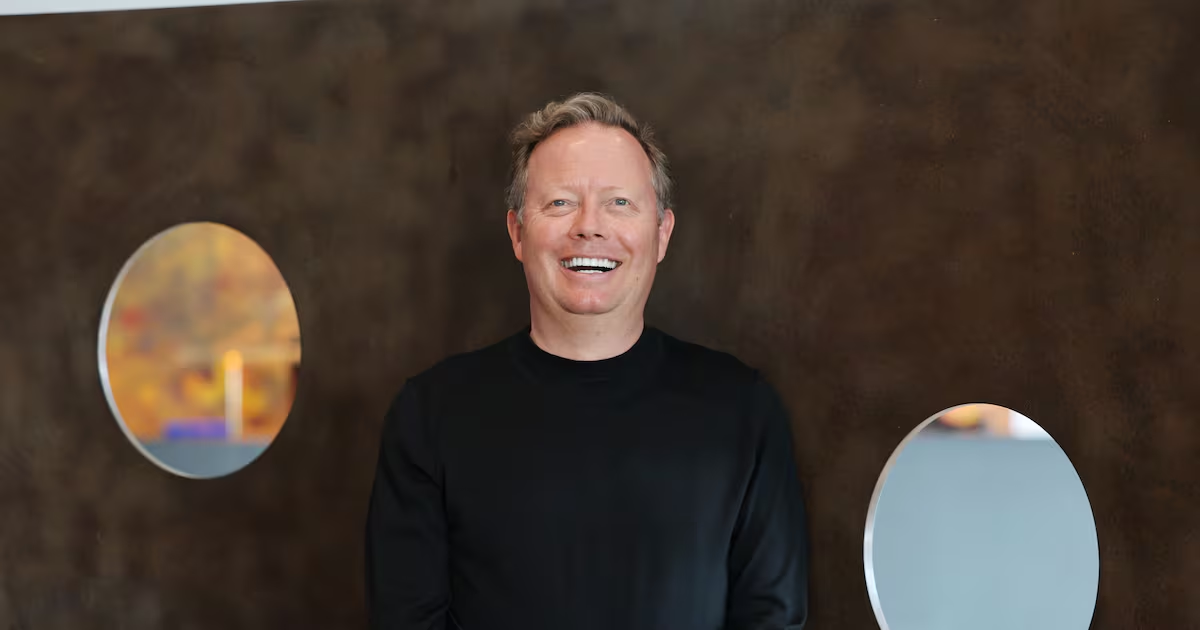
“Twenty minutes ago,” a mildly exasperated Donat Rétif, chief executive of online travel agent Loveholidays, says in exaggeration when asked when his plane touched down at Dublin Airport.“It was unfortunately delayed. The bags were not loaded. The pilot said the weather was good. You will be there on time – blah, blah, blah – but there was a problem with the luggage. There was no explanation beyond that.”Did they not know they had the chief executive of a major travel agent on board? “I never tell them that,” he says, laughing. “It is the best way to see what they are doing well and what they are not doing well.”He’s in Ireland this week to mark a decade of business here for Loveholidays. It has grown quickly over that period and now claims to be the largest online travel agent on the island. It has sent more than three million Irish abroad over that period, including 700,000 last year alone.The company, which specialises in trips to the Mediterranean and Canary Islands, uses agile technology to expand its reach, boasting an inventory of more than 35,000 hotels. Its business model is to be a one-stop-shop for package holidays.Puerto de la Cruz, Tenerife, where Loveholidays does a lot of its business The London-based group is not publicly listed, but reportedly saw pretax profits rise by a fifth to £67.6 million (€78.4 million) on sales of £284 million in the year to October 2024. Plans to float on the stock market are well in train and it is estimated to be worth somewhere north of £1 billion.Curiously, Rétif (55), sitting comfortably now in a room in the Spencer Hotel, Dublin, on the banks of the Liffey, did not set foot on an aircraft until he was 20, having grown up in a small mining town in the south of Belgium.Initially, he dreamed of becoming a footballer, playing in the national team in the number 10 role – the creative engine of the team – up to the age of 16, but was not good enough to make the cut.Has he been watching the World Cup? “Oh, yes,” he says. “But our golden generation is like me – it’s old. The new generation is coming but it’s not there yet. I don’t think it’s going to be a good World Cup for Belgium.“As long as the French don’t win – as a Belgian guy – I am happy. France is a big country. They are very arrogant. They think the rest of the world is second fiddle. We’re this small country on their side, so any country can win but not the French.”Having moved on from football, Rétif decided to concentrate on his studies, and here he excelled. “It gave me a path to leave my native village,” he says. “It was one of the three poorest areas in Europe. Unemployment is about 38-39 per cent.“Travel was less common then. I come from a very poor background. I didn’t travel because we didn’t have the means to travel. I had this dream in my head of leaving the country and discovering the world.“Because I was not too bad at school, I had the opportunity to study in Canada, which was the first time I was on a plane. I love my home, but when I came back I knew for sure I would not stay where I was.”After his studies, he began his working life in telecoms, including a spell with communications giant Verizon in and around the time of the 9/11 terror attacks, holding jobs in Canada and on the west coast of the US.Hijacked United Airlines flight 175 flies towards the World Trade Center twin towers shortly before hitting the south tower on September 11th, 2001. Photograph: Sean Adair/Reuters “I was an early 30s Belgian guy speaking funny English,” he says. “The economy had completely collapsed. People were very fearful. They didn’t travel and were holding on to their money.”He returned to Belgium when his father was diagnosed with colon cancer at 56-years-old and given six months to live. “I took my bag and I came back – I had to help my mother,” he says, adding that his father made a full recovery.From there, he led a company in Belgium that published the equivalent of the Yellow Pages business directory. More recently, he was chief executive of MeteoGroup, which uses advanced technology to predict weather patterns.“It was interesting because 50 per cent of the economic world is impacted by weather: agriculture, energy, offshore, insurance,” he says. “How many beers people drink depends on whether it is hot or cold, and what the weather is like.“We developed the best software and algorithm for weather prediction. You can’t dig oil without having at least two official weather forecasts because it is so dangerous, so that’s what we were doing. If you watch the BBC weather forecast, it is still powered by MeteoGroup.”Then one day Rétif got a phone call from a headhunter friend of his who told him about Loveholidays.“It was a small company and until that point I had only worked for big companies,” he says. “I was told it was a gem of a company in London, but I thought the name of the company was a bit funny already.“I asked a few people had they heard of it. Most said, ‘No’. I went on the website and I didn’t like it too much. I said to the guys, ‘I’m used to big, international companies and this is a little UK-only travel business, did you get it wrong?’“They told me to go and meet the founder. I absolutely loved him. He was the complete opposite to me. Physically, he was a small chubby guy. He is very charismatic and entrepreneurial with 1,000 ideas a minute.“The meeting was meant to last half-an-hour to get to know each other. I think we stayed two hours talking about football and everything else. “Once I delved a little more deeply and realised the power of the business and the technology I felt it was something we could build and decided to join. I grow businesses. That’s what I know. I’m not a founder. I don’t have those qualities.”Three months later, the world – and in particular the world of travel – ground to a halt as the Covid-19 virus spread around the globe.“No more bookings, and we did not know long it was to last,” he says. “The first two years I was in London were tough. I was alone in my little flat on the fourth floor and all we did at the time was process refunds, chasing airlines to get people’s money back.”The departures area of terminal once at Dublin Airport during the Covid-19 pandemic. Photograph: Alan Betson
Loveholidays CEO: ‘Ryanair thought all online travel agencies were pirates. But not us’
Donat Rétif did not fly on an aeroplane until he was 20 – now he runs a package holiday firm worth €1bn-plus
2,637 words~12 min read