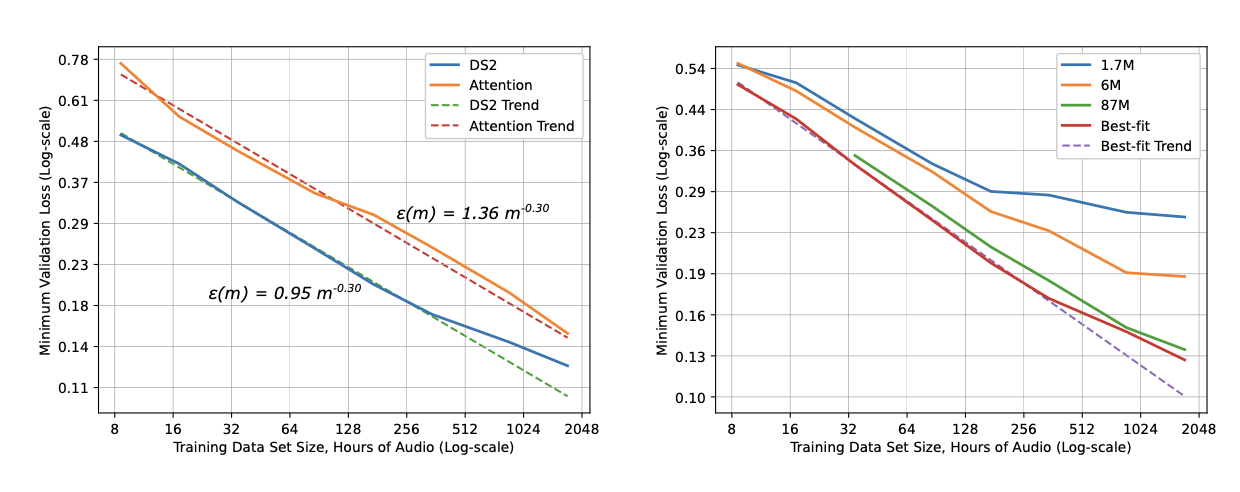
Scaling laws are one of the most critical empirical findings in deep learning. The observation is simple in form: the training loss $L$ decreases predictably as we scale up model size $N$, dataset size $D$, and compute $C$, following a power-law curve, which appears as a straight line on a log-log plot. We can view scaling laws as a framework for describing the relationship between compute, loss, model size and data; at its core, it is about how to allocate precious compute optimally between $N$ and $D$.
This predictability makes scaling laws highly valuable in practice. A common workflow is to fit scaling laws on a handful of small runs and then extrapolate to estimate the token and compute requirements for larger models.
Symbol
Note
$N$