view more
Assessing the clinical skills of medical students before they enter real-world patient care is a critical component of medical education. While medical training provides students with essential knowledge, it is equally important to ensure they can apply that knowledge safely and effectively in clinical settings. To evaluate this readiness, medical schools widely use the Objective Structured Clinical Examination (OSCE), a competency-based assessment that measures practical skills, communication, professionalism, and clinical decision-making through standardized clinical scenarios.
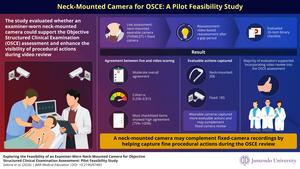
Despite its value, the OSCE is resource intensive, requiring trained evaluators, support staff, and substantial logistical coordination to maintain assessment quality. Video recording is often used to support documentation and post-examination review, but conventional fixed cameras can struggle to capture fine procedural details because of limited viewing angles, distance from the examinee, and visual obstructions. To address these challenges, researchers in Japan investigated whether an examiner-worn, neck-mounted camera (THINKLET) could supplement the observation and review of clinical skills during OSCE assessments. Assistant Professor Miwa Sekine explains, “We investigated whether this camera could help evaluators confirm fine procedural skills in OSCE assessments and facilitate post-examination review.” The study was published in JMIR Medical Education on May 27, 2026.