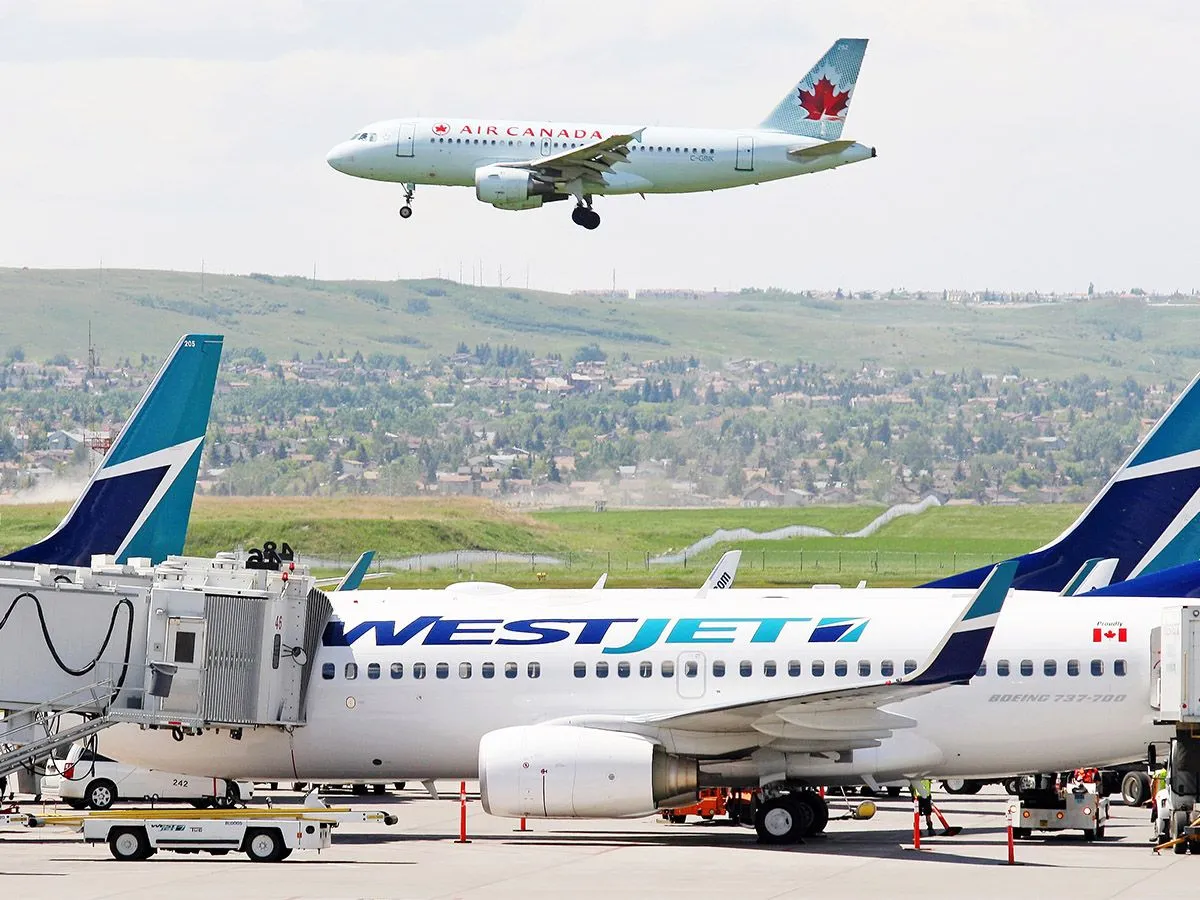
Skip to Content News Archives Economy Energy Oil & Gas Renewables Electric Vehicles Mining Commodities Agriculture Real Estate Mortgages Mortgage Rates Finance Banking Insurance Fintech Cryptocurrency Work Wealth Smart Money Wealth Management Investor Personal Finance Family Finance Retirement Taxes High Net Worth FP Comment Executive Women Puzzmo Newsletters Financial Times Business Essentials More Innovation Information Technology FP500 Podcasts Small Business Lives Told Tails Told Shopping Financial Post Store Obituaries Place a Notice Advertising Advertising With Us Advertising Solutions Postmedia Ad Manager Sponsorship Requests Classifieds Place a Classifieds ad Working Profile Settings My Subscriptions Saved Articles My Offers Newsletters Customer Service FAQ News Economy Energy Mining Real Estate Finance Work Wealth Investor FP Comment Executive Women Puzzmo Newsletters Financial Times Business Essentials HomeTransportationAirlinesCanadians may pay hundreds more for summer vacation flights, despite falling oil pricesAirlines unlikely to pump the brakes on added levies for jet fuel, as strong travel demand pushes ticket prices upward, industry watchers sayLast updated 1 hour ago You can save this article by registering for free here. Or sign-in if you have an account.An Air Canada plane flies over a WestJet plane parked on the tarmac at the Calgary International Airport in this file photo from 2008. Dean Bicknell/Postmedia fileSubscribe now to read the latest news in your city and across Canada.Exclusive articles from Barbara Shecter, Joe O'Connor, Gabriel Friedman, and others.Daily content from Financial Times, the world's leading global business publication.Unlimited online access to read articles from Financial Post, National Post and 15 news sites across Canada with one account.National Post ePaper, an electronic replica of the print edition to view on any device, share and comment on.Daily puzzles, including the New York Times Crossword.Subscribe now to read the latest news in your city and across Canada.Exclusive articles from Barbara Shecter, Joe O'Connor, Gabriel Friedman and others.Daily content from Financial Times, the world's leading global business publication.Unlimited online access to read articles from Financial Post, National Post and 15 news sites across Canada with one account.National Post ePaper, an electronic replica of the print edition to view on any device, share and comment on.Daily puzzles, including the New York Times Crossword.Create an account or sign in to continue with your reading experience.Access articles from across Canada with one account.Share your thoughts and join the conversation in the comments.Enjoy additional articles per month.Get email updates from your favourite authors.Create an account or sign in to continue with your reading experience.Access articles from across Canada with one accountShare your thoughts and join the conversation in the commentsEnjoy additional articles per monthGet email updates from your favourite authorsSign In or Create an AccountorMost Canadian airlines continue to tack on extra fees — sometimes hundreds of dollars — for jet fuel, even after North American oil prices dropped by more than 30 per cent in less than a month.Some industry watchers say the increased fares are likely here to stay — for now.“Airlines obviously want to have the lowest fares that they can just to compete,” Chris Murray, an analyst with ATB Cormark Capital Markets, said in an interview. “But at the same time, they have to cover their costs.”In North America, the cost of jet fuel remains about 32 per cent higher than last year, according to data from the International Air Transport Association.Get the latest headlines, breaking news and columns.By signing up you consent to receive the above newsletter from Postmedia Network Inc.A welcome email is on its way. If you don't see it, please check your junk folder.The next issue of Top Stories will soon be in your inbox.We encountered an issue signing you up. Please try againBut last week, global jet fuel prices fell sharply on the back of a potential peace deal in the Middle East that allowed for energy to start flowing again through the crucial Strait of Hormuz.“As the price of fuel comes down, (airlines) will bring fares down accordingly,” Murray said, stopping short of putting a specific timeline on that drop.Many airlines across Canada imposed fuel surcharges and began hiking fares when oil spiked earlier this year. And, in May, WestJet Airlines Ltd. chief executive Alexis von Hoensbroech said the country’s second-largest player wasn’t done lifting rates.The Financial Post, in collaboration with the Calgary Herald, examined several domestic and international flights and found no evidence that airlines have removed surcharges from ticket prices — though some are dialing them back.In an emailed statement, WestJet said it reduced fees on some of the tickets it sells. The company said its fuel surcharge on companion vouchers — a perk for WestJet credit-card holders — will drop from $60 to $40 per round-trip or one-way fare. Surcharges remain in place for other fares.“This adjustment reflects a recent movement in fuel costs and the airline’s ongoing effort to balance affordability with the realities of the current operating environment,” a WestJet spokesperson wrote, noting surcharges could go down — or up again — depending on fuel prices.Toronto-based Porter Airlines Ltd. said it never implemented a surcharge on standard flight bookings; instead, the carrier applied an extra levy to the bill of those paying for flights with rewards points, a small number of travellers.On Tuesday, Porter cut the fee for those travellers in half — down to $20 — even while jet fuel prices remain higher than last year.“This was always intended to be a temporary measure, so we are fulfilling our promise by moving toward removing the fee entirely,” a Porter spokesperson said in an email, adding the airline would make more adjustments if conditions change.Customers flying with many of Canada’s carriers still have to dole out extra — sometimes hundreds of dollars more — mostly due to sky-high fuel costs.For domestic flights, Canada’s two largest airlines — Air Canada and WestJet — had the highest surcharges at $90 for a round-trip from Calgary to Toronto. Air Canada did not respond to multiple requests for comment.Still, Canadians hoping to hop across the pond this summer will face higher prices, as round-trip flights from Calgary to London could carry a surcharge of more than $800 with Air Canada, and above $600 for WestJet.“It (costs) some insane number to put gas in a plane to fly to London,” Murray said. “It really just comes down to fuel consumption.”Air Canada’s bookings page shows what it calls a “carrier surcharge,” which the airline says is meant to “partially offset certain volatile, fluctuating operating costs and fees, and certain fare premiums during peak travel periods.” That same page also notes charges may change depending on the itinerary.Low-cost carrier Flair Airlines Ltd. tacks on a $40 fee for the Calgary-Toronto round-trip, citing the same surcharge.In a statement, Flair said it constantly reviews its prices in response to fuel costs, and will “continue to adjust pricing as appropriate.” A Flair Airlines Boeing 737 lands at Calgary International Airport on Jan. 6, 2025. Gavin Young/PostmediaWestJet calls its added fee an air transportation charge or “other ATC” and doesn’t explicitly define it on its bookings page. However, another page defines it similarly to both Air Canada and Flair.While no airline explicitly mentions fuel in its definition of the surcharge, Murray said that’s what they’re talking about for the most part. Air traffic fees and other time-based costs that change may also be a factor.“Certain operating costs will fluctuate,” Murray said. “Fuel is the biggest one, by far.”Strong travel demand is expected to continue into the summer, and that, combined with fuel surcharges, leads to flight costs varying wildly, according to Murray.“If you try to buy a ticket this morning and look at the same ticket this afternoon, it may have changed price,” he said.Still, the exact cost that fuel adds to tickets is difficult to quantify because some airlines may be increasing the price of seats, baggage or other services, according to Murray.“As fuel comes down, you’ve got some healthy competitive tension happening between the airlines,” Murray said. “I don’t think anyone’s unnecessarily keeping prices high.”But John Gradek, an aviation expert from McGill University in Montreal, argued that once ticket prices go up, they don’t come down very quickly or frequently.“Canadians are still buying tickets; the flights are full, even at those high prices,” Gradek said, “(Airlines’) mindset says, why should I discount the price if the demand is so strong?”Gradek added that there’s still a lot of uncertainty for jet fuel prices due to the Strait of Hormuz, a shipping corridor for one-fifth of the world’s oil that only reopened recently after being effectively shut for months.“We’re kind of sitting on pins and needles trying to figure out how this is going to evolve,” Gradek said, adding that some refineries in the Middle East may need months — or more than a year — to repair damage from the war.“We’re not out of the woods yet.”This story is part of Energy Aftershocks, a project by the Financial Post, in partnership with the Calgary Herald, Edmonton Journal, Saskatoon StarPhoenix and Vancouver Sun, that focuses on the ongoing fallout of the conflict in the Middle East. Watch this space for more stories about how the energy shock is echoing throughout Canada. Join the Conversation This website uses cookies to personalize your content (including ads), and allows us to analyze our traffic. Read more about cookies here. By continuing to use our site, you agree to our Terms of Use and Privacy Policy.
Canadians may pay hundreds more for summer vacation flights, despite falling oil prices
Most Canadian airlines continue to tack on extra fees — sometimes hundreds of dollars — for jet fuel, even as oil prices fall.
1,555 words~7 min read