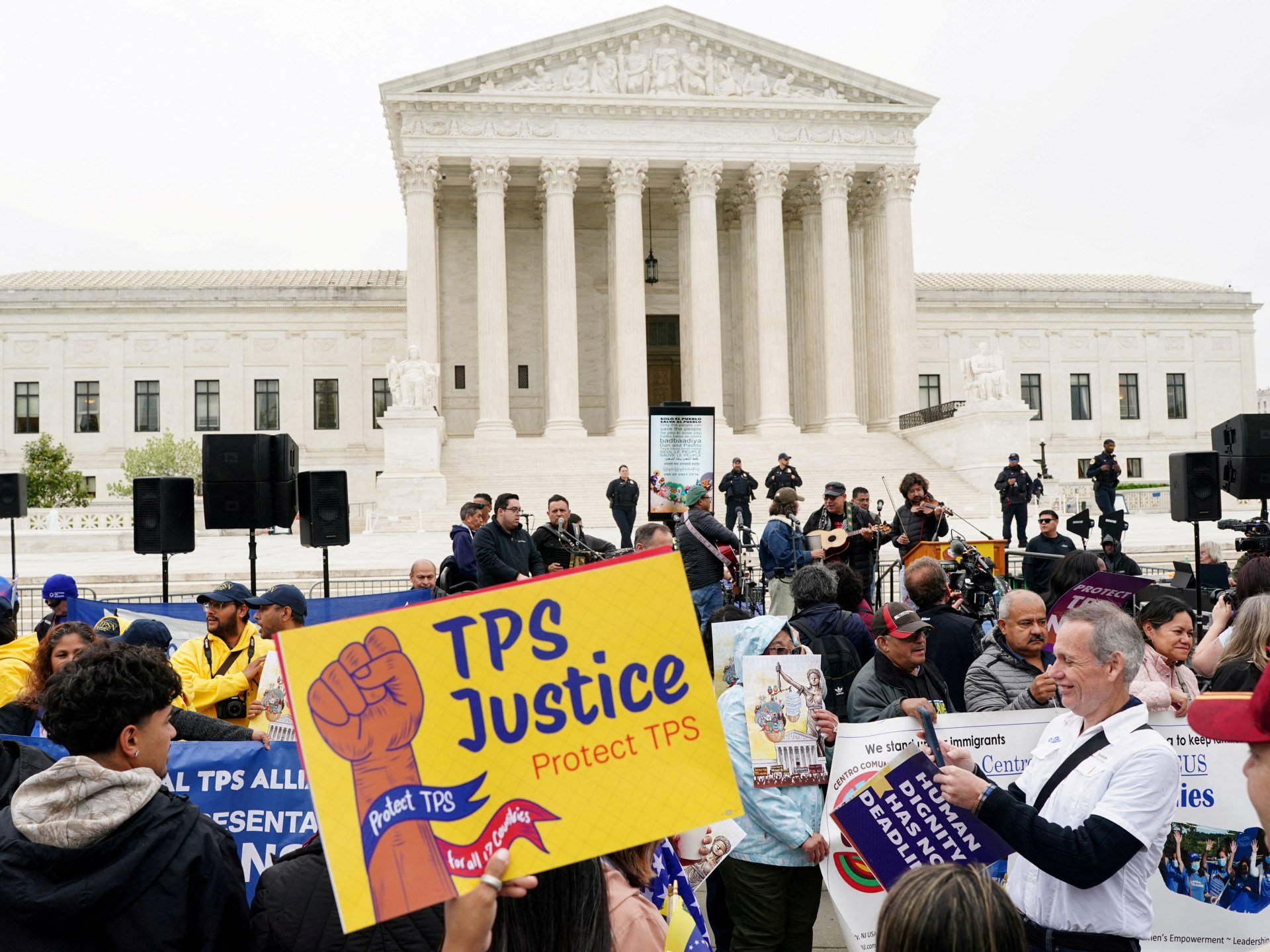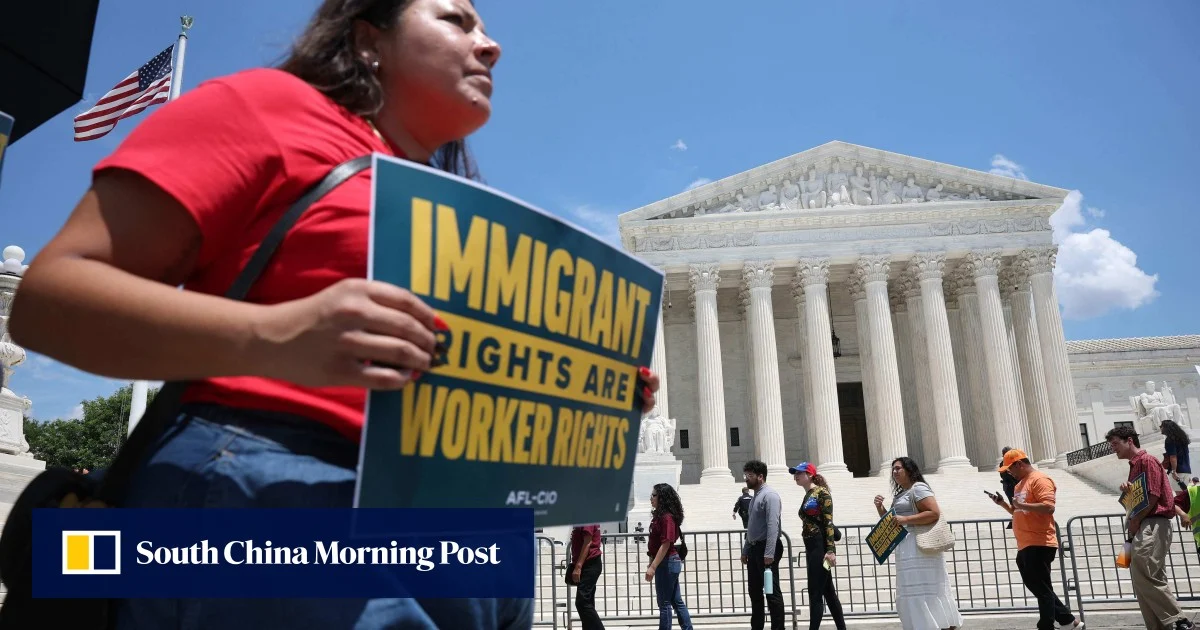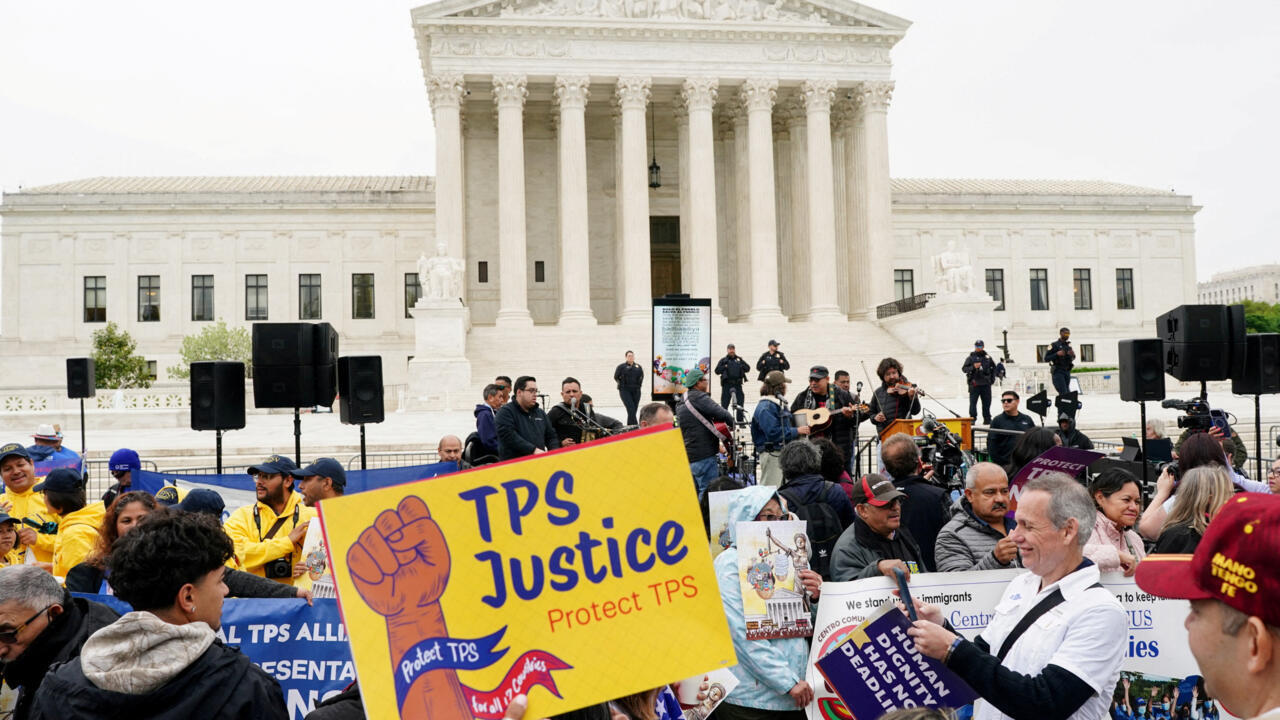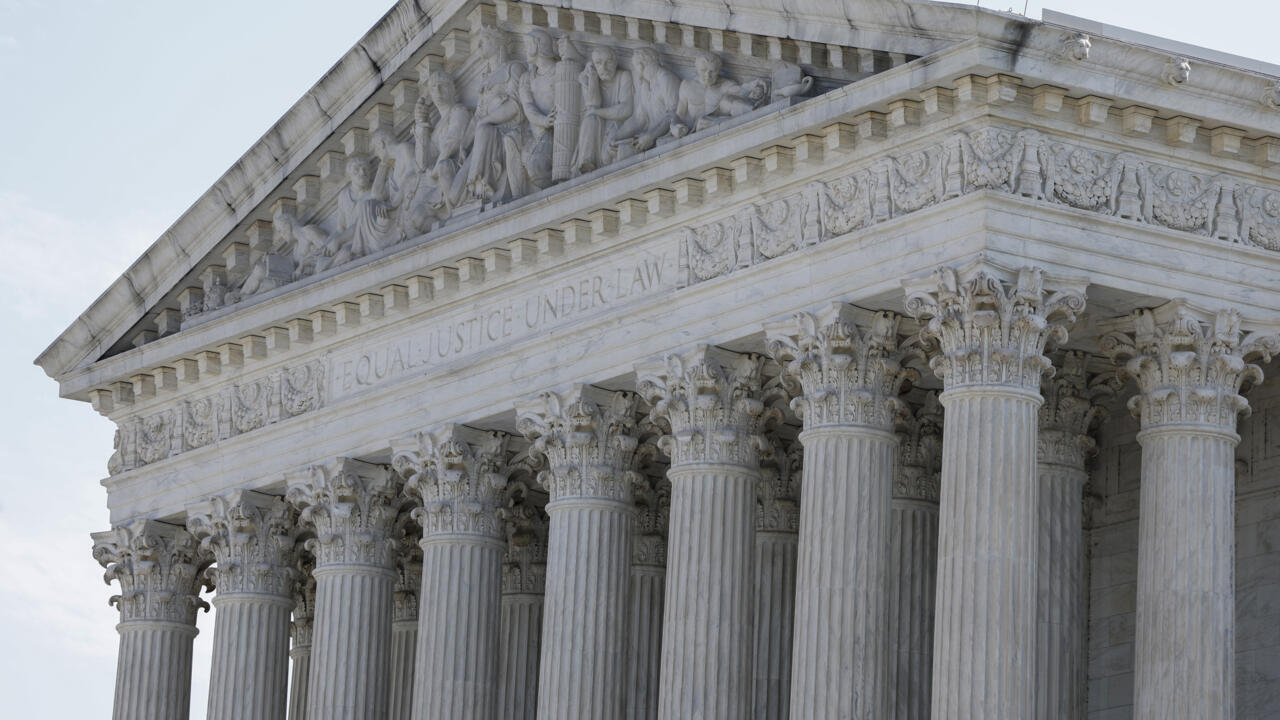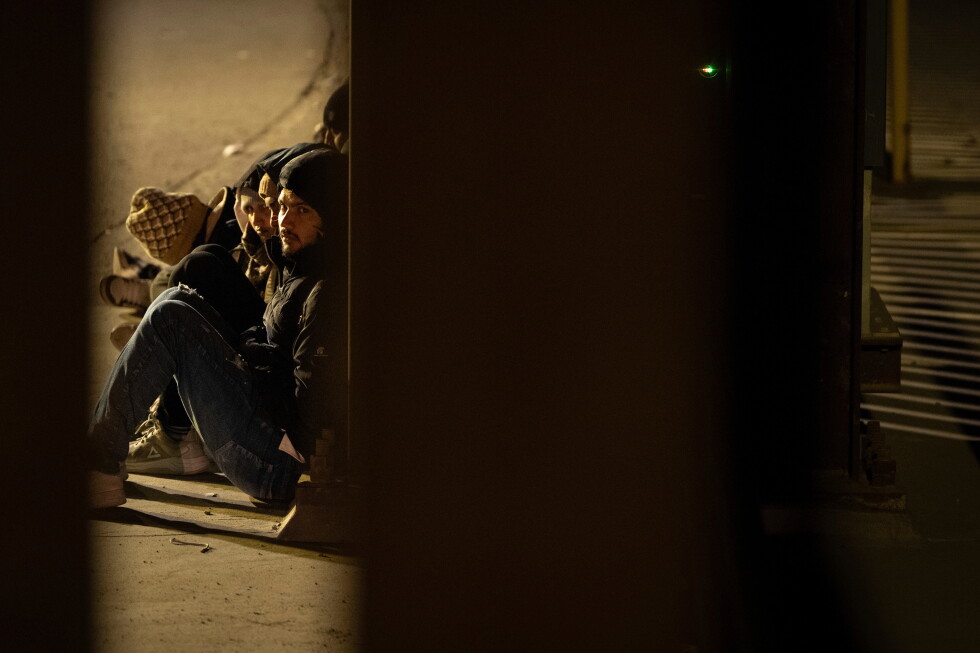
From 40m agoSupreme court clears way for Trump administration to turn back asylum seekers at US-Mexico borderThe supreme court has cleared the way for the Trump administration to potentially revive an immigration policy once used to turn back migrants seeking asylum at the US-Mexico border.The justices overturned a lower court order blocking the practice that limited the number of people who could apply for asylum each day under the Obama administration and during Donald Trump’s first term.Advocates said the tactic created a humanitarian crisis as thousands of people settled in unsafe makeshift shelters to await their turn. The Trump administration said it was necessary to deal with an increase of asylum seekers at the border.The policy isn’t in place now, though authorities have imposed other restrictions on asylum seekers.Aerial view of a US Border Patrol pickup next to Trump’s border wall being constructed at the US-Mexico border in Santa Teresa, New Mexico, US, as seen from Ciudad Juarez, Chihuahua state, Mexico on 14 January 2026. Photograph: Hérika Martínez/AFP/Getty ImagesThe administration argues that metering is a critical tool that’s been used by presidents of both parties and should stay available. Federal attorneys say people turned away at the border could come back later, though lines were thousands of people long when the policy was in place before.Under federal law, migrants who arrive in the US must be able to apply for asylum and be screened for fear of persecution in their home countries.The justice department argued that people stopped by authorities haven’t arrived, so immigration agents don’t have to let them apply.But attorneys for people seeking asylum say the law has long meant anyone arriving at a port of entry should be screened, and blocking arrivals disregards the nation’s ideals.Metering was first used during the Obama administration when large numbers of Haitians appeared at the main crossing to San Diego from Tijuana, Mexico. It was expanded to all border crossings from Mexico during Trump’s first term in the White House.It ended in 2020 when the government introduced greater restrictions during the coronavirus pandemic, and Joe Biden formally rescinded it in 2021.The same year, a California-based federal judge found that metering violated the asylum-seekers rights and the law requiring screening. A divided appeals court panel affirmed the ruling but nearly half of judges on the full San Francisco-based court voted to rehear it, a strong signal that might have caught the attention of the supreme court.Key events6m agoSupreme court rules in favor of former Monsanto company in pesticide case29m agoSupreme court allows Trump administration to end legal protections for Haitians and Syrians40m agoSupreme court clears way for Trump administration to turn back asylum seekers at US-Mexico border48m agoSupreme court strikes down Hawaii's gun restrictions in major second amendment ruling1h agoUS judge blocks Trump's mail-in voting executive order1h agoSupreme court to release opinions with high-stakes cases still to be decided3h agoTrump to meet House speaker amid showdown on Capitol HillSupreme court rules in favor of former Monsanto company in pesticide caseCarey GillamThe supreme court has ruled in favor of the former Monsanto company in a closely watched case that limits the way for people to sue pesticide companies for alleged illnesses or injuries.The decision was made in a 7-2 vote, with Justice Brett Kavanaugh offering the majority opinion and Justice Jackson writing the dissenting opinion, joined by Justice Neil Gorsuch.The case, Monsanto v Durnell, specifically dealt with the question of whether a federal law that gives the Environmental Protection Agency (EPA) regulatory authority over pesticides preempts state claims that a company failed to warn users of certain product risks when the EPA itself has not required such warnings.In its ruling, the court said the EPA controls pesticide labels to ensure nationwide uniformity, and because the agency evaluated Roundup and decided a cancer warning was unnecessary, state-level lawsuits demanding such a warning conflict with federal law.The case at the heart of the decision deals with Monsanto’s glyphosate – a weedkilling chemical used in the popular Roundup brand and numerous other herbicide products sold by the former Monsanto company, which is now owned by Germany’s Bayer.The chemical has been scientifically linked to cancer in multiple studies, and was classified a probable human carcinogen by an arm of the World Health Organization in 2015.Bayer has spent the last decade fighting more than 100,000 lawsuits filed by people who developed non-Hodgkin lymphoma they blamed on exposure to the glyphosate weedkillers, and the company has paid out billions of dollars in jury awards and settlements. All of the cases include allegations that the company failed to warn that glyphosate could cause cancer.Bayer maintains that its products don’t cause cancer, and also asserts that under the Federal Insecticide, Fungicide and Rodenticide Act (Fifra), the EPA is the key authority for determining if its product necessitated a cancer warning. The EPA has not required such a warning and has taken the position that glyphosate is “unlikely” to be carcinogenic, so the company cannot be held liable for failing to warn, according to Bayer’s argument.The court’s decision means the failure-to-warn claims included in several thousand lawsuits pending against Monsanto cannot go forward.Similarly, thousands of such claims pending against pesticide maker Syngenta cannot proceed. In the Syngenta cases, plaintiffs allege they developed Parkinson’s disease due to exposure to the company’s paraquat weed killer. Syngenta maintains that the evidence linking paraquat to Parkinson’s disease is “fragmentary” and “inconclusive”.Maanvi SinghThe vote was 6-3, with conservative justices Samuel Alito, John Roberts, Clarence Thomas, Neil Gorsuch, Brett Kavanaugh and Amy Coney Barrett concurring. The court’s liberal justices Elena Kagan, Ketanji Brown Jackson, and Sonia Sotomayor all dissented, with the latter penning a biting 35-page long dissent – notably almost twice as long as the Alito majority opinion.US immigration law entitles migrants arriving in the US to seek asylum; the supreme court case hinged on what, exactly, it means to “arrive in”. When the court considered the case in March, chief justice Roberts and justice Barrett appeared to agree with the Trump administration’s argument – that to “arrive” in the US is to fully set food on US soil. If a migrant is turned back before they are able to cross the border, they are not entitled to asylum, the administration held.Though much of the supreme court oral arguments about the case centered on the question about what it means to “arrive” in the US and whether the administration is entitled to deny asylum by preventing arrival, the court’s liberal justices also grappled with what it would mean to essentially end the proactive of providing asylum at the US border.Justice Sotomayor compared the practice of turning away asylum seekers to the tragedy of the St Louis, a passenger ship with Jewish refugees that was turned away from the US right before the second world war. About half the passengers who were returned to western European countries were trapped and killed when Germany invaded.In Alito’s opinion, he wrote: “In ordinary speech, no one would say that a person ‘arrives in’ a place ... before the person enters that place.”Sotomayor pushed back strongly in her dissent, explaining the dire consequences of the decision, noting that the government may now circumvent a vast range of laws protecting asylum-seekers by simply blocking their entry at the border.She wrote:
Supreme court allows Trump administration to end legal protections for Haitians and Syrians amid slew of big decisions – live
Justices rule on TPS; officials’ ability to turn migrants away at the US southern border, a major gun rights case in Hawaii and lawsuits against a weedkiller
3,989 words~18 min read