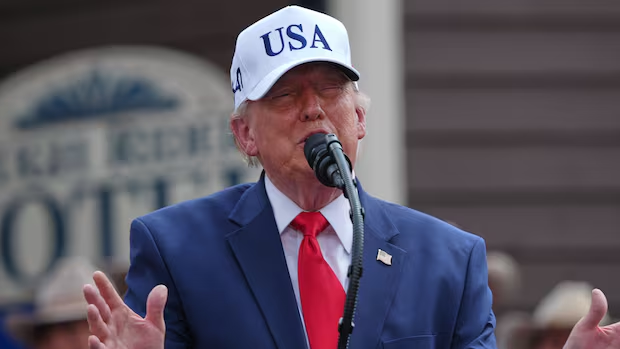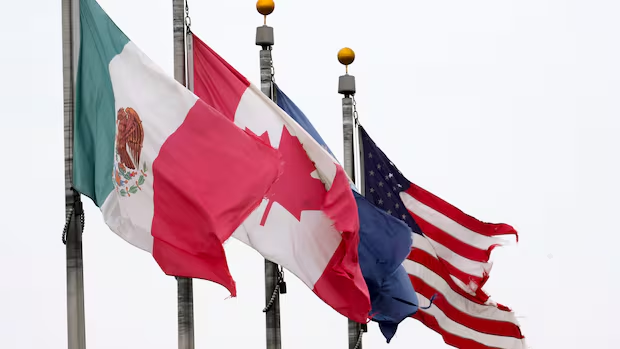
WorldWhatever disparaging things U.S. President Donald Trump says in public about the trade deal he negotiated with Canada and Mexico in his first term, key players in the well-connected agricultural lobby in Washington are confident the agreement will survive.Trump administration seeking changes as Canada-U.S.-Mexico trade deal faces July 1 reviewMike Crawley · CBC News · Posted: Jun 25, 2026 4:00 AM EDT | Last Updated: 1 hour agoListen to this articleEstimated 5 minutesThe audio version of this article is generated by AI-based technology. Mispronunciations can occur. We are working with our partners to continually review and improve the results.Carrots are harvested in October 2025, in Saint-Michel, Que., at Mas & Fils Jardiniers, a fourth-generation family-run vegetable business specializing in growing carrots, leeks and beets, supplied to Canada and the U.S. (Christinne Muschi/The Canadian Press)Whatever disparaging things U.S. President Donald Trump may now say about the trade deal he negotiated with Canada and Mexico during his first term, key players in Washington's well-connected agricultural lobby are confident the agreement will live on.Trump has recently described the Canada-U.S.-Mexico Agreement (CUSMA) as irrelevant, claimed the U.S. would be better off without it and suggested the deal's best feature is the ability to terminate it. Despite that, leaders of the U.S. agriculture industry — a sector strongly in favour of CUSMA — aren't worried about the trade deal's future as it heads into a joint review on July 1. The message from agriculture insiders at a conference in Washington, D.C., on Wednesday was that the agreement has delivered widespread benefits to U.S. farmers, the food-processing industry and consumers. They believe the deal Trump signed his first term has been far too successful for him to tear up in his second. Two conference speakers were members of the U.S. negotiating team during the talks that led to the agreement's signing in 2018. The agreement is known in the U.S. as USMCA. Darci Vetter is vice-president of public affairs for Driscoll's, a major fruit production company. She served as chief agricultural negotiator in the office of the U.S. Trade Representative from 2014 to 2017. (Mike Crawley/CBC)Darci Vetter, now vice-president of public affairs for Driscoll's, one of North America's largest fruit producers, was chief agricultural negotiator in the Office of the U.S. Trade Representative from 2014 to 2017 under the Obama administration. "I'm actually quite confident and very optimistic that at the end of this, we will still have a USMCA," Vetter told CBC News in an interview. 'Could be a bumpy ride'"For all of the bluster and the questioning of the agreement, you have industries across all three countries that are already highly integrated and are very committed to making this work," Vetter said. Canada and Mexico are the only countries granted broad exemptions from Trump's global tariffs, which Vetter attributes to the strength of CUSMA. AnalysisTrump wants CUSMA to expire 'immediately.' Here's the reality behind his takes on the trade dealHowever, she warns that the path to a renegotiated deal won't likely be smooth or easy. "I think it could be a bumpy ride," Vetter said. "I don't think we should underestimate the extent to which the president himself questions trade relationships and trade agreements, and I think some of his concerns are sincere. But I do think at the end of the day, we will still wind up with an agreement." John Bode is president and chief executive officer of the Corn Refiners Association, the trade association that represents the corn milling industry in the U.S. (Mike Crawley/CBC)CUSMA remains in force until 2036 unless one of the countries gives six months' notice of withdrawal. It's unclear whether Trump has the power to pull the U.S. out of the deal without the backing of Congress. While Canada and Mexico have said they want the agreement extended beyond 2036, the Trump administration is using the joint review as an opportunity to renegotiate some of CUSMA's terms. The U.S. has held two rounds of formal negotiations with Mexico and has another scheduled for mid-July. Meanwhile, Canada's negotiations with the U.S. are lagging, although Canada-U.S. Trade Minister Dominic LeBlanc has met twice this month with U.S. Trade Representative Jamieson Greer. 'Evidence is so compelling'Injecting uncertainty into the talks is part of the negotiating process, said John Bode, president and CEO of the U.S. Corn Refiners Association. "I am confident that USMCA will continue," Bode told CBC News. "The evidence is so compelling that this agreement is to the benefit of North Americans, whether in Canada, the U.S. or Mexico, and it would be bad for all of us for it to fall apart," said BodeGregg Doud, president and CEO of the U.S. National Milk Producers Federation, was chief agricultural negotiator for the U.S. in Trump's first term. (Mike Crawley/CBC)Gregg Doud, who served as the U.S. chief agricultural negotiator for nearly three years during Trump's first term, also expressed strong support for CUSMA. Doud, now the president and chief executive of the National Milk Producers Federation, praised the deal as the "gold standard" for trade agreements worldwide. "This is the template. We're really not going to deviate from that going forward," Doud told the conference, organized by the Center for Strategic and International Studies think tank. He singled out CUSMA's mechanism for resolving trade disputes between the three countries as a major improvement over its predecessor, the North American Free Trade Agreement (NAFTA). "You can always make it better," Doud said. "But it is so much better than what it was before." WATCH | Canada prepares for a summer of talks on CUSMA:Carney’s trade team braces for a CUSMA summerJune 21|Duration 1:54Canadian trade officials have agreed to meet with U.S. and Mexico counterparts on July 1 to negotiate signing an extension of the Canada-United States-Mexico Agreement (CUSMA) as U.S. President Donald Trump continues to cast doubt on the future of the trade agreement.Doud said the U.S. will want to discuss access to Canada's dairy market. He also pointed to concerns that other countries, such as China, are unfairly benefitting from the trade deal by sending products into the U.S. tariff-free through Mexico.However, he gave no indication that the Trump administration really wants to abandon CUSMA. Mexico, Canada have formed a common front on CUSMA talks, says Sheinbaum1st trilateral meeting for CUSMA review happening July 1Still, after his panel discussion, Doud was reluctant to answer questions from CBC News about Trump's current attitude toward the agreement he signed back in 2018. "I'm not going to get into that. You'll have to ask him," Doud said when asked why the president keeps disparaging CUSMA.But should people be worried about the future of the agreement? Doud paused for a few seconds before replying: "It's all a negotiation."ABOUT THE AUTHORMike Crawley is a correspondent for CBC News, based in Washington. He began his career as a newspaper reporter in B.C., spent six years as a freelance journalist in various parts of Africa, then joined the CBC in 2005. Mike reported on Ontario politics for 15 years. He was born and raised in Saint John, N.B.Follow Mike Crawley on X
Despite Trump's threats, U.S. agriculture leaders believe CUSMA will survive | CBC News
Whatever disparaging things U.S. President Donald Trump says in public about the trade deal he negotiated with Canada and Mexico in his first term, key players in the well-connected agricultural lobby in Washington are confident the agreement will survive.
1,176 words~5 min read