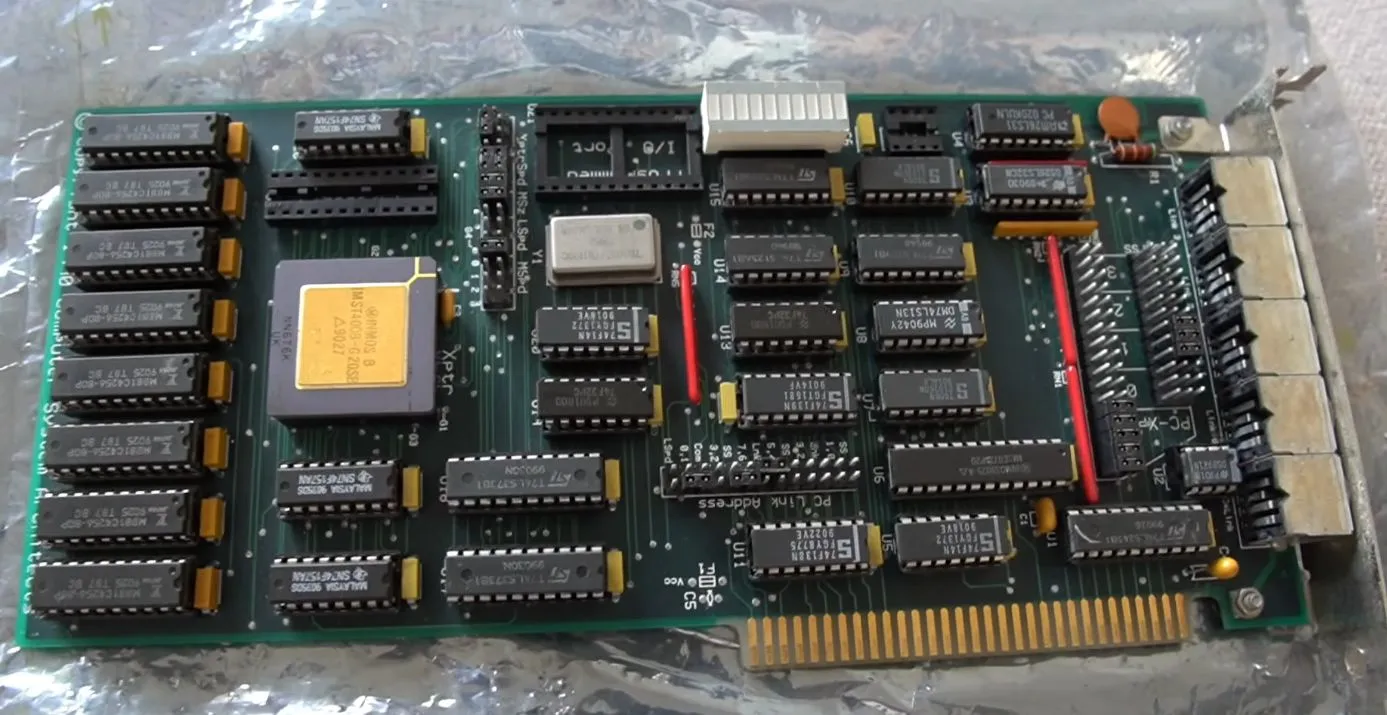
A long time before Beowulf clusters wired up with commodity Ethernet hardware became a hobbyist thing and a running joke, the transputer took a swing at a very similar architecture. This used stand-alone computers that were networked together with other transputer systems, to achieve task-level parallelism. For some people like [Lance Harvie] this is the kind of hardware that he used during his university years for a project, with him not only still having that hardware, but also recently adding to this collection with a recent eBay purchase.
The transputer story is a fascinating one, forming a major part of the UK’s semiconductor industry during the 1980s, creating a strong legacy as the computer industry awkwardly tried to figure out what types of parallelism to target. Whereas the industry largely moved to instruction-level (superscalar) parallelism alongside tightly coupled task-level parallelism along with multiple CPU cores on a single die, one could consider today’s supercomputer clusters to be one example of the transputer legacy.
[Lance]’s university-era board features the T400, which he shows off while recalling programming it in the Occam language. He’s currently looking for an ISA-to-USB adapter to be able to use it again with a modern PC. While searching around, he came across an EBay listing for a four-processor board, containing four T425s. These are significantly more powerful and also can use external memory, unlike the T400.