Skip to content
GQINewsNews Archive 2025News Archive 2024News Archive 2023News Archive 2022News Archive 2021News Archive 2020News Archive 2019News Archive 2018News Archive 2015-2017AnalysisQnalysisPlayersPublic CompaniesPrivate/Startup CompaniesUniversitiesGovernment/Non-ProfitVenture CapitalVenture Capital – Sorted by Quantum CompanyResourcesConferencesToolsOther Websites and Industry AssociationsEducationBooksScorecardsGate Level Software PlatformsIBM Qiskit, Rigetti Forest, Microsoft QDK, Project QReview of the Cirq Quantum Software FrameworkQubit Implementation DashboardQubit CountQubit QualityQubit TechnologySoftware/Startup PartnersCloud Platform Hardware PartnersPodcastsAboutQCR Alerts Sign-Up FormAdvertising InquiriesQCR in the NewsContactPrivacy PolicyMembership
FPGA-Based Hardware Architecture for Real-Time Decoding of Quantum LDPC Codes Using GARI
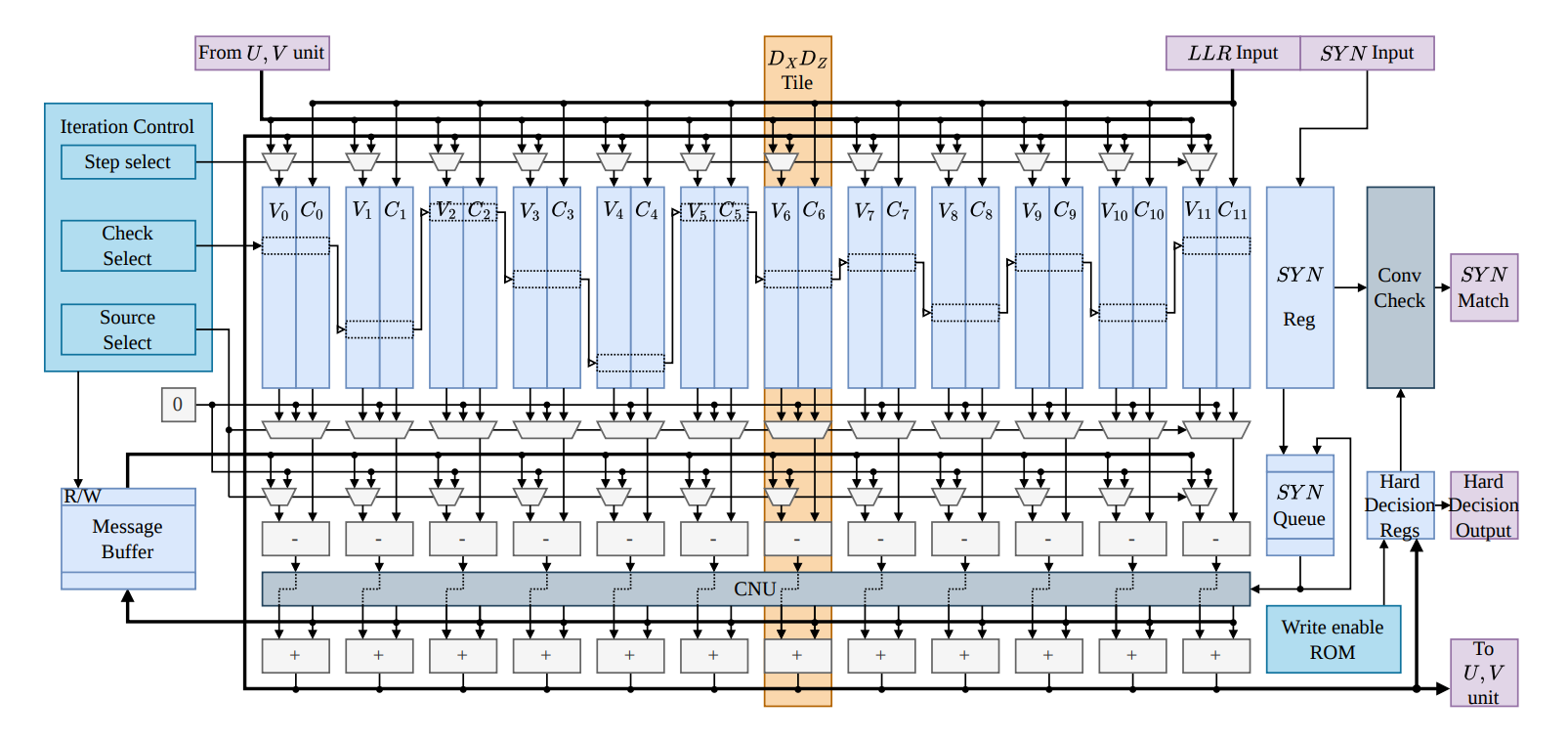
The architecture for the DX, DZ decoder. Memory elements shown in blue (light for RAM, dark for ROM). I/O in purple. Sub-modules in gray.
Researchers from the IMDEA Software Institute, Nokia Bell Labs, the Complutense University of Madrid, Aalto University, and Quobly have developed an FPGA-based hardware architecture for the real-time decoding of quantum LDPC codes. Published on ArXiv, the design manages correlated error arrays within a structural layout optimized for latency, physical area, and power consumption. The architecture utilizes targeted resource reuse loops rather than unrestricted hardware parallelization to process complex multi-qubit syndromic dependencies, addressing classical computational processing bottlenecks that challenge the physical scaling of the quantum error correction (QEC) layer.