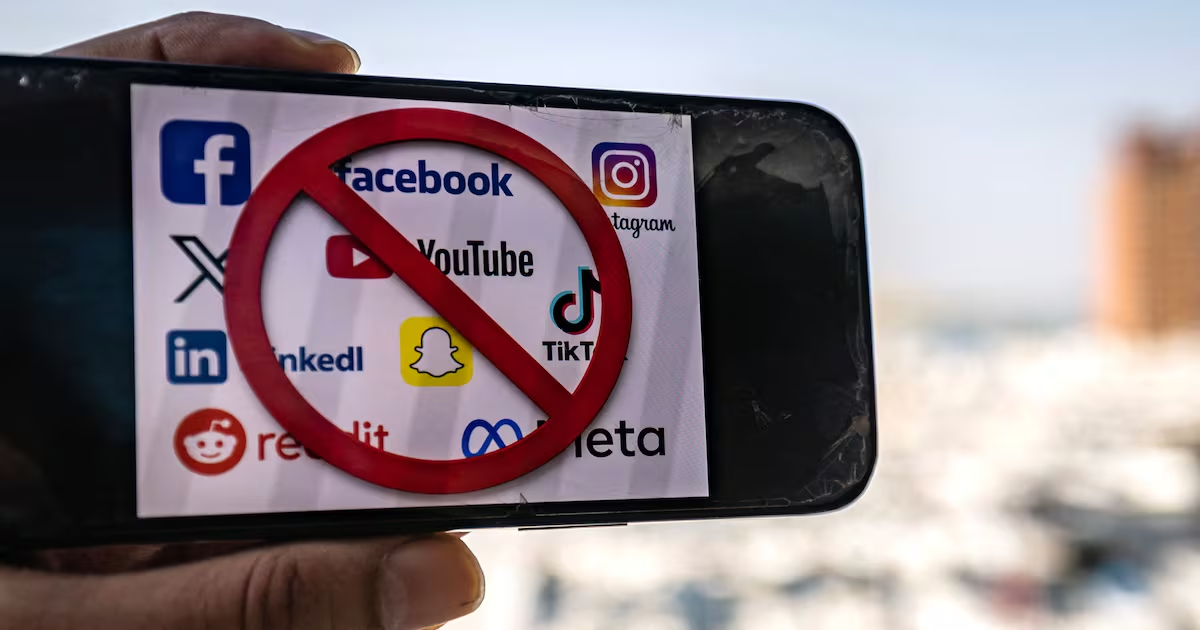
Skip to Content Subscribe Our Offers My Account Manage My Subscriptions FAQ Newsletters Canada Canadian True Crime Canadian Politics Health World Israel & Middle East Financial Post NP Comment Longreads Puzzmo Diversions Comics NP News Quiz New York Times Crossword Horoscopes Life Eating & Drinking Style Sponsored Play for Ontario Travel Travel Canada Travel USA Travel International Cruises Travel Essentials Culture Books Celebrity Movies Music Theatre Television Business Essentials Advice Lives Told Tails Told Shopping Buy Canadian Home Living Outdoor Living Kitchen & Dining Tech Style & Beauty Personal Care Entertainment & Hobbies Gift Guide Travel Guide Amazon Prime Day Deals Savings National Post Store More Sports Hockey Baseball Basketball Football Soccer Golf Tennis Driving Vehicle Research Reviews News Gear Guide Obituaries Place an Obituary Place an In Memoriam Classifieds Place an Ad Celebrations Working Business Ads Archives Healthing Epaper Manage Print Subscription Profile Settings My Subscriptions Saved Articles My Offers Newsletters Customer Service FAQ Newsletters Canada World Financial Post NP Comment Longreads Puzzmo Diversions Life Shopping Epaper Manage Print Subscription HomeNewsWorldAustralia's social media ban for children has little effect, study findsUnderage users have been dodging the restrictions by using accounts registered to older people, setting up fake accounts, or by logging into private browsersAuthor of the article: You can save this article by registering for free here. Or sign-in if you have an account.There is strong global interest in whether Australia's laws could provide a blueprint for how to rein in increasingly powerful tech giants. Photo by William Wesf/AFP via Getty Images/FileAustralia’s social media ban for under 16s has had little impact on teenagers’ scrolling habits, researchers said Thursday in one of the first evaluations of the world-leading measures.Enjoy the latest local, national and international news.Exclusive articles by Conrad Black, Barbara Kay and others. Plus, special edition NP Platformed and First Reading newsletters and virtual events.Unlimited online access to National Post.National Post ePaper, an electronic replica of the print edition to view on any device, share and comment on.Daily puzzles including the New York Times Crossword.Support local journalism.Enjoy the latest local, national and international news.Exclusive articles by Conrad Black, Barbara Kay and others. Plus, special edition NP Platformed and First Reading newsletters and virtual events.Unlimited online access to National Post.National Post ePaper, an electronic replica of the print edition to view on any device, share and comment on.Daily puzzles including the New York Times Crossword.Support local journalism.Create an account or sign in to continue with your reading experience.Access articles from across Canada with one account.Share your thoughts and join the conversation in the comments.Enjoy additional articles per month.Get email updates from your favourite authors.Create an account or sign in to continue with your reading experience.Access articles from across Canada with one accountShare your thoughts and join the conversation in the commentsEnjoy additional articles per monthGet email updates from your favourite authorsSign In or Create an AccountorAustralia in December banned under 16s from the likes of Facebook, Instagram and TikTok, in a crackdown designed to protect children from online bullying and “predatory algorithms”.But there is little evidence to suggest teenagers have turned away from social media as a consequence, a team of Australia-based researchers found in a peer-reviewed study published by the British Medical Journal.Get a dash of perspective along with the trending news of the day in a very readable format.By signing up you consent to receive the above newsletter from Postmedia Network Inc.A welcome email is on its way. If you don't see it, please check your junk folder.The next issue of NP Posted will soon be in your inbox.We encountered an issue signing you up. Please try againUnderage users have been dodging the restrictions by using accounts registered to older people, setting up fake accounts, or by logging into private browsers.“We found insufficient evidence to conclude that exposure to the Act had any early substantial effects on social media use among adolescents aged under 16,” the researchers wrote.There is strong global interest in whether Australia’s laws could provide a blueprint for how to rein in increasingly powerful tech giants.A growing mass of nations have either introduced or are mulling similar bans — including the United Kingdom, Indonesia, the UAE and New Zealand.The researchers surveyed more than 400 young social media users immediately before the restrictions came into effect, and again three months after.There was little change for users aged 12-13, a slight decrease for the 14-15 age group, and an increase in use for those aged 16 and older.“The findings suggest that the period immediately after the introduction of the act was characterised by limited implementation, incomplete compliance, and substantial circumvention of social media restrictions.”Tech companies face fines of up to Aus$49.5 million (US$34 million) if they fail to show meaningful efforts to weed out underage users.Australia in March accused Facebook, TikTok and YouTube of failing to meet their obligations.“Australia’s world-leading social media laws are not failing. But big tech is failing to obey the laws,” Communications Minister Anika Wells said at the time.“None of this is impossible. None of this is even difficult for big tech, who are innovative billion-dollar companies.”The nation’s eSafety Commission separately flagged “significant concerns” about Facebook, Instagram, Snapchat, TikTok and YouTube.A growing body of research suggests too much time online is taking a toll on teen well-being, and Australia’s ban has been hailed as a godsend for parents sick of seeing children glued to their phones.Although platforms have pledged to abide by the laws, they have warned the measures could instead push teenagers into dark, unregulated corners of the internet.Social media companies bear the sole responsibility for checking that Australia-based users are 16 or older, and must prove they have taken “reasonable steps” to weed out young teenagers.Some platforms are using AI tools to estimate ages based on photos, while users can also choose to prove their age by uploading a government ID.Our website is the place for the latest breaking news, exclusive scoops, longreads and provocative commentary. Please bookmark nationalpost.com and sign up for our daily newsletter, Posted, here. Join the Conversation This website uses cookies to personalize your content (including ads), and allows us to analyze our traffic. Read more about cookies here. By continuing to use our site, you agree to our Terms of Use and Privacy Policy.
Australia's social media ban for children has little effect, study finds
Underage users have been dodging the ban by using accounts registered to older people, setting up fake accounts, or by logging into private browsers
1,039 words~5 min read