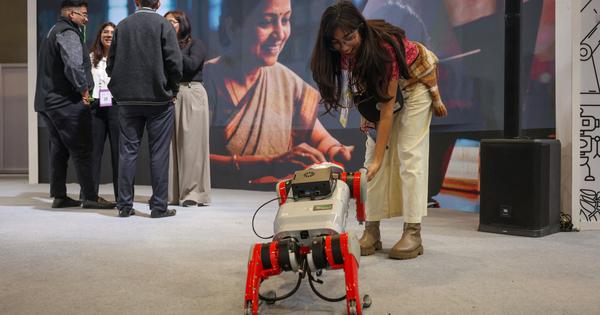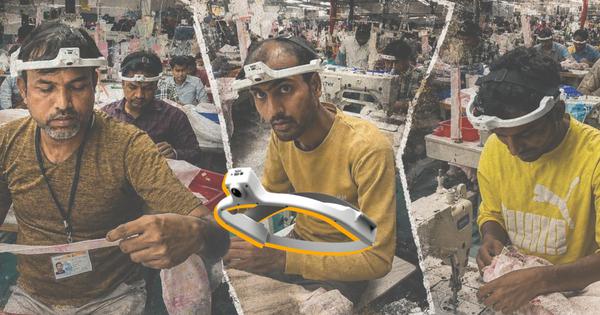
India is responsible for about 36 per cent of the world’s image and video labelling, hosts the largest workforce on the planet, and supports the biggest tech firms
| Photo Credit:
Mukesh Kumar Jwala
There is a revealing moment in Aranya Sahay’s critically acclaimed film Humans in the Loop, set among data-labelling workers in rural Jharkhand. Nehma, an Adivasi woman, is told to label caterpillars as pests so that a farming machine can learn to target them. She refuses. Having spent her life near the forest, she understands what the instruction overlooks: these caterpillars only eat the decaying parts of a plant. They save the crop, not destroy it. This scene captures a truth we often overlook: Artificial Intelligence does not understand or perceive the world on its own. It sees the world through the eyes of countless people like her, whose labour quietly shapes the intelligence we increasingly rely on.This hidden human labour is an essential pillar of the AI economy, and India contributes more of it than almost any other country. The work has a plain name, data annotation, and a repetitive nature often involving drawing boxes around pedestrians in dashcam footage, transcribing speech, tagging tumours in medical images, hour after hour. Yet, this is the raw material from which every AI model is created. India is responsible for about 36 per cent of the world’s image and video labelling, hosts the largest workforce on the planet, and supports the biggest tech firms. The work now also reaches small towns and villages, impacting the lives of people who had few other options.However, India is not the only player. China handles about a tenth of the global workload, treating it as a serious industrial infrastructure and organising it into dedicated labelling centres. Chinese analysts report a shortfall of tens of millions of workers. This work has also spread to the Philippines, Kenya, Rwanda, and Eastern Europe. Africa is the fastest-growing frontier, expected to create well over a million jobs. A further cluster has emerged in Latin America, notably in countries facing real challenges, such as Venezuela, Colombia, and Peru. The pattern is clear, this work goes where people are capable, available, and, most importantly, affordable. Here lies an uncomfortable truth that often goes unnoticed. Despite its scale, much of it goes through informal digital platforms, and it does not show up properly in trade statistics. Instead, it gets lumped under a vague “computer and related services” category, rather than being identified for what it is: one of the country’s real, fast-growing exports.How vulnerable the upper levels of the AI industry became evident when Anthropic’s two most capable models, Mythos 5 and Fable 5, were suddenly cut off from international users for national-security reasons, just days after their launch. Models that received huge attention went dark within hours. This episode matters less than what it exposed: the prized components of the AI stack, namely, the frontier models, advanced chips, and associated regulations, can be disabled by decisions made far away. India recognises this predicament and is right to invest in its own models and chip industry. However, there is a third essential aspect, simpler and already in its possession, that deserves equal attention: the data that every model, whether domestic or foreign, must learn from. This layer resides here, shaped by the judgment of the country’s own people, and no external order can turn it off.Whether this becomes real bargaining power with technology giants depends on choices yet to be made. As long as the work remains informal and hidden, those who do it have little leverage and no incentive to step into the open. A traceable dataset, consented to and created by fairly treated workers, should not be bargained down to the last rupee. It is a premium product that the world lacks, and the country that labels the world’s data carefully will find that it holds a quiet but significant asset. India has an opportunity to become not just the world’s AI workshop, but also a model for fair digital work. The new labour codes, which extend minimum wage protections to all workers and bring gig and platform workers within the protection of the law, are an important step in that direction. Yet laws alone are not enough.Many data annotators around the world still earn very low wages, and workers on pay-per-task platforms often fall below a living wage once unpaid training and idle time are considered. In India too, experiences vary widely, from stable salaried jobs to precarious microwork. Whether a job empowers someone or wears them down should not depend on the luck of the employer they find. Getting these right matters beyond wages. Data annotation can create flexible work opportunities for women, especially in smaller towns and rural areas where formal jobs are scarce. Supported by fair standards and opportunities to grow, this hidden workforce could become an engine of more inclusive growth and higher female labour force participation.The next wave of AIWhat lies ahead is even more consequential because the next wave of AI is physical. Robots learn by observing people, and the market for humanoid machines is forecast to grow from $6.24 billion in 2026 to $165.13 billion by 2034, according to Fortune Business Insights, with Goldman Sachs projecting over 1.4 million units shipped by 2035. Each of those machines must be trained on human demonstrations. This is harder, more complex and better-paid work than simple tagging. Robotics data, unlike text, demand human reviewers with genuine physical intuition. It is precisely the kind of grounded, hands-on judgment in which India’s annotation workforce already has depth. The country can supply it as anonymous, disposable labour, or as the work of a recognised, well-treated and skilled workforce. The difference is worth a great deal in both commercial and human terms.Three steps can set India on this path.First, count the work. A national survey can tell us who these workers are, what they earn, and how their skills are evolving. Second, name it. Data services should be recognised as a distinct export category in trade negotiations and economic statistics, so that the sector is visible, valued, and actively supported. Third, protect those who do it. Working with industry, India can build a framework for fair pay, certification, and pathways into higher value work, building on the opening provided by the new labour codes. Done well, this opens a route into the middle class for hundreds of thousands who have few others offering a digital complement to the manufacturing jobs the country is working to create, and one that plays to India’s strengths.The writer is an IAS officer. Views are personalPublished on June 25, 2026