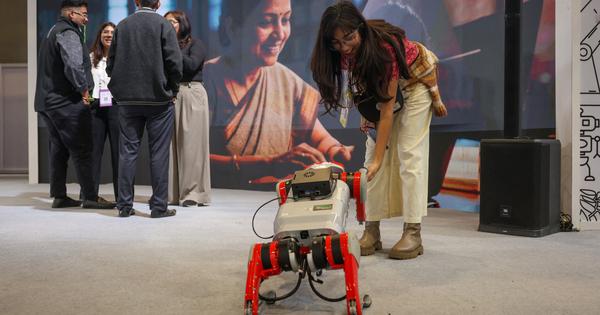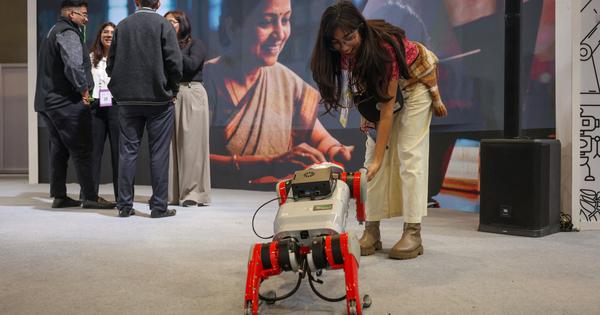
“AI is like a child” reads the slogan painted across the fading walls of the data annotation centre in the movie Humans in the Loop (2025), written and directed by Aranya Sahay. Inside, rows of workers sit quietly before glowing screens, creating boxes, outlining figures, and annotating labels in images and videos, one by one turning the world into data points.Through these scenes, the film offers a quiet but powerful account of the lives of data labelers and data annotators – the deliberately invisibilised, precariously employed workers whose labor powers global AI systems. The film does an exemplary job of shifting our attention from high-profile Silicon Valley offices to the scant infrastructures of annotation centres in rural and semi-urban regions of countries like India, where workers, sitting on uncomfortable chairs and hunched over old monitors, do the painstaking task of labeling data for hours on end.Through protagonist Nehma, an Adivasi single mother from a remote village in Jharkhand, the film unsettles our imaginations of the “tech worker”. Nehma does not match the familiar image of a coder or an engineer, and yet she painstakingly annotates low-resolution images and poor-quality videos, translating her situated knowledge into machine-readable categories.In one instance, her knowledge of plants helps her identify the subtle difference between a ginger and a turmeric root. This difference is important because the latter, as another annotator in the film points out, is used by “white people to make something called a turmeric latte.” Through Nehma, the film reveals how our everyday encounters with AI are entangled with those of others that we may never know.One of the film’s central motifs is the recurring claim that “AI is like a child.” I meditate on the metaphor because, beyond the film, it has gained wide currency and become a legitimate, even preferable, way to explain the complexities of AI systems such as Large Language Models. From UX designers in technology companies and CTO’s of AI startups to academic research, the metaphor “AI is like a child” is invoked to suggest that AI systems are in a nascent stage and must be carefully “taught” right from wrong, with users and developers patiently guiding them toward proper “behaviour.”In this framing, errors are interpreted as developmental stages rather than technical failures. Even in upstream data-annotation tasks, as shown in Humans in the Loop, the phrase is constantly repeated, either as messages painted on the walls or echoed by the line supervisor. In doing so, it lends workers’ tasks a sense of moral purpose, casting them as meaningful, nurturing labour within an environment otherwise defined by repetition and strain.Not unlike other forms of gig-work, this metaphor also functions in a familiar strategy of extracting precariously employed workers’ labour, compliance, and loyalty by making them feel like they belong, and are playing an important part in the creation of something bigger and more important than the tasks would at first seem.A visitor takes selfies with a humanoid robot from Unitree Robotics at ImagiNxt 2026, in Mumbai in May. Credit: AFP.Childlike ‘innocence’Yet, the metaphor “AI is like a child” performs a broader conceptual move. To say that “AI is like a child” is to anthropomorphise, to attribute human qualities to what is, in fact, a machinic and infrastructural system. The metaphor suggests that just like human babies, AI can be “taught” to “think” like humans.This anthropomorphisation has been problematised by ethicists of technology who have articulated how this human-like characterisation adds to the hype of AI that further adds mysticism and mythicises and not only exaggerates AI’s capabilities but also diverts attention from the material and infrastructural realities of AI that operates at a planetary scale: lithium mining, semiconductor manufacturing, data extraction, data labeling, model testing, etc. More importantly, this anthropomorphisation takes us farther away from the fact that there is no one definition of AI and, at best, it’s an umbrella term for different technologies.Furthermore, when AI is rendered childlike, it appears innocent, developmental, even inevitable and is often misleading. AI doesn’t simply “grow” with training, rather its interface and outputs are the results of deliberate design choices and corporate priority.As scholars in Science and Technology Studies might put it, the narrative reifies AI and grants it an apparent autonomy, as though it were capable of charting its own trajectory once properly nurtured. OpenAI’s recent move to integrate product advertisements in ChatGPT’s generative output is a reminder that LLMs are not creative tools or “digital beings.” Rather, they are commercial products, embedded in platform economies and oriented toward profit. These corporate entanglements are exactly what the performative language of “AI is like a child” obscures. In scratching the surface, we’re also forced to (re)consider what learning means. AI models rely on statistical optimisation, reinforcement signals, and pattern extraction from datasets. Human learning, by contrast, is interpretive, embodied, and intentional; it involves perception, meaning-making, emotion, and context that also resides in mistakes, heartbreaks, and dejections.But the phrase “AI is like a child” does more than anthropomorphise machinic forms – the performative language also gives the illusion of democratising AI, a tool that can be created for the people, by the people. The flip side of comparing AI to a child is also comparing data labeling and AI model training to parenting or teaching, and by extension data labelers and annotators as doing the parenting work, almost as if they had any say in the process of AI design.In most cases, workers performing data labeling are not even informed about the parent companies that employ them or the AI systems that will ultimately be trained on the datasets they prepare. And yet, the phrase makes AI seem like a democratic technology that can be co-owned, co-designed, or controlled by publics and communities. It legitimises the belief that if trained well, AI will benefit everyone. Just like the human and planetary costs of AI remain obfuscated in this narrative, so do the supposed benefits of these technologies to society, which are often assumed rather than demonstrated. Much like the term “AI” itself, the assumed benefits of AI are elastic and function as, in Lucy Suchman’s description, a floating signifier – a term that means everything and nothing, all at once.This photograph taken on January 16, 2026 shows an AI data labeller working on her computer in a rented room for her work-from-home setup in Ranchi. Credit: AFP.Depoliticising AIHowever, even a basic material analysis of AI systems, one that is attentive to the planetary costs, labour exploitation, and the ever-expanding data extraction, quickly unsettles the fantasy of universal benefits. Given this material reality, AI’s gains can perhaps never be distributed equally; some people and places will always form the AI pipeline and would remain in the backyard of AI development.If AI is framed as a child, then some childlike qualities like innocence and earnestness are attributed to it and, by extension, it becomes deserving of patience and care rather than scrutiny. This association is perhaps the true danger of the oversimplified metaphor, as it depoliticises AI by displacing accountability. Rather than being grounded in the present, it keeps us focused on an imagined, utopian future. The metaphor and its underlying assumptions shift AI, and the corporate entities responsible for designing these systems, from governance and regulation and mitigating harms to the domain of care, nurture, and patience. The regulatory mechanism, ethical consideration, and accountability processes then seem almost like a cruel punishment.The appeal of the “AI is like a child” narrative lies in its simplicity. Never before have such large segments of the world’s population directly interfaced with technological systems as complex as LLMs. In that sense, the metaphor does the work of translation. In a world where access to basic education, healthcare, clean water, and fresh air remains highly unequal, such oversimplified narratives step-in, in lieu of complex abstractions of weights, tokens, prediction, probability, and modeling. Thinking back to Nehma and the approximately 430 million data labelers and annotators across the world, the metaphor perhaps serves to help workers make sense of their own tedious, repetitive labor. The phrase almost manufactures their consent to labor for a highly abstract, multi-layered, inscrutable set of systems such as AI.The reality remains that AI systems and their applications are highly complex and opaque. Simplistic metaphors risk depoliticising as they smooth over opacity, hide corporate design choices, and make concentrated corporate power seem both neutral and inevitable. Yet the strength of a metaphor lies precisely in its simplicity. Metaphors work through strategic omission and enable us to grasp the unfamiliar.Describing AI as a child makes the process intuitively legible to non-technical audiences, perhaps even emotionally comforting. The question, then, is not whether to abandon the metaphor, but which simplifications we are willing to live with. A good metaphor omits what is incidental while preserving what is consequential.If the language of “teaching” AI imports care while obscuring optimisation, invokes relationality while obscuring asymmetrical power relationships, and suggests moral development while obscuring corporate control, then its omissions are not neutral. The task is not to eliminate simplification, but to develop forms of translation that remain legible without displacing questions of labor, responsibility, and governance that clarify rather than conceal the politics of AI.Anubha Singh is a Postdoctoral Fellow in the Science, Technology, and Society program at Vassar College. She is currently writing a book about AgTech in smallholder agriculture in India. The author would like to thank Sam Ankenbauer for his thoughtful feedback.This article was first published on India in Transition, a publication of the Center for the Advanced Study of India, University of Pennsylvania.
‘AI is like a child’ narrative dangerously obscures technology’s real-world implications
Such framing depoliticises AI and displaces attention from profit-focused decisions and corporate accountability for the environment and labour.
1,600 words~7 min read