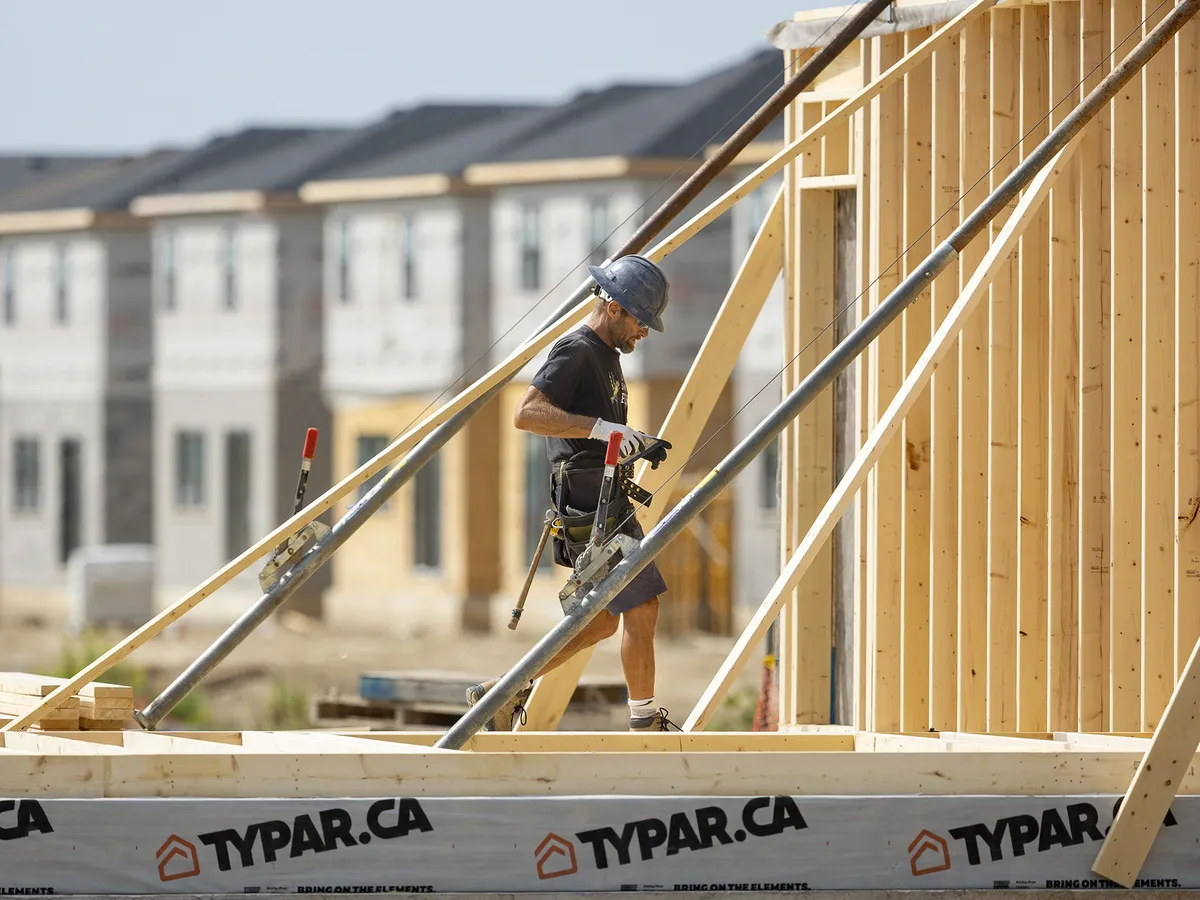
Skip to Content News Archives Economy Energy Oil & Gas Renewables Electric Vehicles Mining Commodities Agriculture Real Estate Mortgages Mortgage Rates Finance Banking Insurance Fintech Cryptocurrency Work Wealth Smart Money Wealth Management Investor Personal Finance Family Finance Retirement Taxes High Net Worth FP Comment Executive Women Puzzmo Newsletters Financial Times Business Essentials More Innovation Information Technology FP500 Podcasts Small Business Lives Told Tails Told Shopping Financial Post Store Obituaries Place a Notice Advertising Advertising With Us Advertising Solutions Postmedia Ad Manager Sponsorship Requests Classifieds Place a Classifieds ad Working Profile Settings My Subscriptions Saved Articles My Offers Newsletters Customer Service FAQ News Economy Energy Mining Real Estate Finance Work Wealth Investor FP Comment Executive Women Puzzmo Newsletters Financial Times Business Essentials HomeNewsReal EstateWhy housing construction is soaring in London while Toronto stallsNew data show a widening gap between housing markets in the GTA and Southwestern OntarioLast updated 1 hour ago You can save this article by registering for free here. Or sign-in if you have an account.Jamie Daugharty of Willow Bridge Construction works on framing a new house near Wharncliffe Road South in London. Photo by Mike Hensen/PostmediaLondon may be only a two-hour drive from Toronto, but the two cities might as well be worlds apart when it comes to home construction so far this year.Subscribe now to read the latest news in your city and across Canada.Exclusive articles from Barbara Shecter, Joe O'Connor, Gabriel Friedman, and others.Daily content from Financial Times, the world's leading global business publication.Unlimited online access to read articles from Financial Post, National Post and 15 news sites across Canada with one account.National Post ePaper, an electronic replica of the print edition to view on any device, share and comment on.Daily puzzles, including the New York Times Crossword.Subscribe now to read the latest news in your city and across Canada.Exclusive articles from Barbara Shecter, Joe O'Connor, Gabriel Friedman and others.Daily content from Financial Times, the world's leading global business publication.Unlimited online access to read articles from Financial Post, National Post and 15 news sites across Canada with one account.National Post ePaper, an electronic replica of the print edition to view on any device, share and comment on.Daily puzzles, including the New York Times Crossword.Create an account or sign in to continue with your reading experience.Access articles from across Canada with one account.Share your thoughts and join the conversation in the comments.Enjoy additional articles per month.Get email updates from your favourite authors.Create an account or sign in to continue with your reading experience.Access articles from across Canada with one accountShare your thoughts and join the conversation in the commentsEnjoy additional articles per monthGet email updates from your favourite authorsSign In or Create an AccountorBoosted largely by rental apartment construction, London is one of a handful of Southwestern Ontario cities posting massive year-over-year increases in housing starts so far in 2026, sharply contrasting with the more subdued pace of construction in the Greater Toronto Area (GTA).The London area has recorded 2,096 housing starts through May, almost a fourfold increase from the same period in 2025 and the second-best start for home construction in the past decade, according to the latest data from Canada Mortgage and Housing Corp. (CMHC).SUBSCRIBER EXCLUSIVE: FP West: Energy Insider brings you behind the oilpatch’s closed doors with exclusive insights from insiders every Wednesday morning.By signing up you consent to receive the above newsletter from Postmedia Network Inc.A welcome email is on its way. If you don't see it, please check your junk folder.The next issue of FP West: Energy Insider will soon be in your inbox.We encountered an issue signing you up. Please try againLondon isn’t the only city in Ontario experiencing a housing construction boom. Housing starts are up 106 per cent in the Kitchener-Cambridge-Waterloo region, 67 per cent in Guelph and 45 per cent in Windsor.The GTA, which includes communities such as Scarborough, North York and Mississauga, has built more homes than all those cities combined, but housing starts are up only two per cent compared to the same period in 2025, CMHC said.Anthony Passarelli, CMHC’s lead economist for Southwestern Ontario, chalks up the big discrepancy to the collapse of Toronto’s condo market, brought about by higher interest rates, an oversupply of units and weaker demand amid slower population growth and economic uncertainty.“That condo apartment market has dried up in terms of construction activity,” he said. “There has been some pivoting to rental, but it doesn’t make up for the shortfall. The purpose-built rental stock is starting to rise, but it’s not necessarily replacing all those condos that are not being built now.”Mississauga recorded starts for nearly 1,200 condo units in the first five months of last year, but only 13 this year, according to CMHC.The numbers also plummeted in the City of Toronto, which recorded 24 condo starts through May, down from 1,071 during the same period in 2025. It was a similar story in Etobicoke, which has not recorded a single condo start this year, compared to 215 during the same period last year.Unlike the GTA, the condo market in Southwestern Ontario hasn’t developed to the same extent, and the vast majority of high-rises are built with renters, not buyers, in mind, largely shielding the region from the dynamics unfolding closer to Toronto, Passarelli said.Part of that stems from the relative affordability communities farther from Toronto’s orbit still enjoy, he said.“The entry-level home to own in the GTA is a condo apartment. That’s the first step on the property ladder,” he said. “Contrasting it with southwestern Ontario, it’s still probably a townhouse.”At the same time, many developers have pivoted to purpose-built rental projects, with Ottawa and Queen’s Park offering incentives and demand for single-family homes remaining weak.Passarelli also said construction activity is likely to remain strong in Southwestern Ontario through 2026, though housing starts may be front-loaded in some communities, which could result in starts for the year evening out.Mike Moffatt, founding director of the Place Centre economic think tank at the University of Ottawa, said the large year-over-year increases in Southwestern Ontario communities could be partly due to a “particularly weak” start to the construction market in 2025.“But there’s definitely more to it,” he said.Though rental units make up a large share of new housing starts, he said the ground-oriented segment of the market, comprising both single-family homes and townhouses, is also picking up in parts of the region thanks to the removal of the HST on new home sales.“It’s playing more in Southwestern Ontario simply because land costs in the GTA and Hamilton area are just too high,” Moffatt said. “We’re going to continue to see families move out of the GTA and to Southwestern Ontario simply because that type of home has been almost impossible to get at an attainable price in both the 416 and 905.”Though the numbers may seem solid on the surface, there are signs of caution in the better-performing markets.For example, developers in the Kitchener-Cambridge-Waterloo region are grappling with a “de facto freeze” on new development and building permits as the region deals with water-capacity issues, said Joseph Puopolo, a developer and member of the Waterloo Region Home Builders’ Association.“You have some market-based housing that can go ahead based upon previous permissions . . . but new people looking for draft plans for a subdivision or other high-rise projects have been unable to pull a building permit in the Waterloo region,” he said.Though the Region of Waterloo is expected to start increasing water capacity in September, allowing some projects to move forward, Puopolo said the holdup is already causing some developers to shelve projects or put them on hold, which could affect future housing supply.“Hopefully, it won’t persist much longer, but if it does persist, we’re going to get an availability tightening in roughly 18 months to two years, when we’re going to go from a situation of a huge amount of supply to a very tight supply, and that’s a concern,” he said.Moffatt also said that in places such as London, where construction in the single-family-home segment remains weak, it could also lead to a run-up in prices as pent-up demand from buyers grows while supply remains below what’s needed.“In the medium to long term, ground-oriented ownership homes are going to have the strongest demand going forward,” he said. “It’s certainly possible that we enter a cycle like the one 10 or 12 years ago, where prices are going up seven or eight per cent a year, at a time when incomes and inflation are closer to a two to three per cent increase.” Join the Conversation This website uses cookies to personalize your content (including ads), and allows us to analyze our traffic. Read more about cookies here. By continuing to use our site, you agree to our Terms of Use and Privacy Policy.
Why housing construction is soaring in London while Toronto stalls
New CMHC data show housing starts soaring in London while Toronto’s condo market struggles, widening Ontario’s housing divide.
1,463 words~7 min read