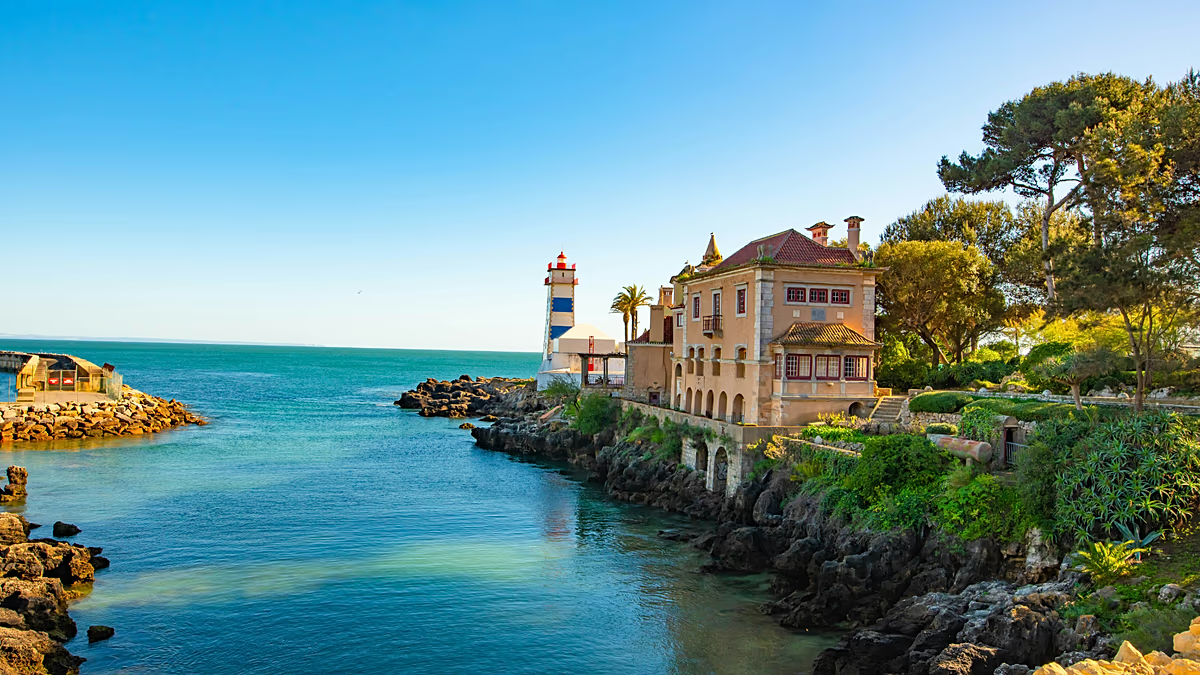
Cascais Bay, Portugal—Is the country's golden visa program still as attractive?gettyLooking to move to Europe? The Portugal golden visa program is not the cheapest entry point, but there aren’t many remaining across the EU, and it still has certain attractions despite recent legal changes and prospective lawsuits. Here’s what to know.The Portugal Golden Visa Program—Beloved By Americans?Portugal's golden visa program was created in 2012 and has since raised more than €7 billion for the Portuguese economy, issuing 17,700 golden visas, 60% of these to families, not just individuals.Over the past few years, demand has increased, particularly among Americans, who accounted for the largest share of golden visa investors in 2024, followed by Chinese and Russian investors. In 2024, the program saw a 72% year-on-year increase in demand compared with 2023.Portugal ranks 7th on the 2026 Global Peace Index list of the Safest Countries in the World, and Portugal also has a low physical presence requirement, with golden visa holders needing to spend just 7 days a year in the country. This means that from day one, investors and their families have visa-free movement throughout the Schengen area, which comprises the 27 EU member states plus Switzerland, Norway, Liechtenstein, and Iceland.One of the biggest issues with the Portugal golden visa program has been the long processing times, although these are improving. New figures from Portugal’s Agency for Integration, Migration and Asylum (AIMA) suggest that hundreds of thousands of pending cases have now been moved forward through the system.Impact of Portugal’s Changes To Its Nationality Law On Its Golden Visa ProgramOne of the biggest issues, however, is the recent change to Portugal's nationality law, which now requires 10 years of residency rather than 5 before applying for citizenship. The policy change was taken as a direct response to the increased number of foreign-born individuals living in Portugal, the cost-of-living crisis, and the growing inability of locals to afford housing, particularly in Porto and Lisbon. This demographic now accounts for about 15% of the total domestic population, a threefold expansion since 2019.Crucially, permanent residency is still possible after five years of legal residency. It's just that, applying for nationality and having a European passport, the timeline has changed.As a result, there have been clear signs that demand has been cooling ever since the law was enacted. Bloomberg reports that about 40 investors have withdrawn their money since the start of 2026—amounting to roughly €20 million in investment—and that lawyers are preparing to sue the government on behalf of 500 golden visa holders, on the basis, according to their lawyer, that the golden visa program had been deceptive. The argument is that investors who might have been just months away from citizenship under the old rules now must wait 5 or more years. The argument runs that just isn't how a credible jurisdiction treats people who followed program rules in good faith.Portugal requires a €500,000 investment in funds, but another route through its golden visa program is a cultural heritage donation, where golden visa applicants can donate €250,000 or €200,000 in low-density areas and receive the same residence permit. It is non-refundable and goes towards archeology museum preservation or art and film projects. This route saw a 165% increase throughout 2024 after the real estate option was removed.Bloomberg also states that the financial fallout from the change in the nationality law has extended beyond investment funds, with museums and other cultural institutions accustomed to receiving donations through the program seeing a sharp decline.In turn, some American investors are questioning whether other golden visa programs in Europe could be a viable alternative. Say, Italy. Portugal’s minimal stay requirement could be offset by Italy's tax incentives—both have clear lifestyle appeal. Italy offers faster application processing and more investment options. It includes startups, companies, and bonds, but it has stricter stay requirements in the country and doesn't offer the broader family-inclusion rules available in Portugal. Conversely, Italy has a lower investment threshold of €250,000, while Portugal requires a minimum of €500,000 in fund investment.The Portugal Golden Visa Program Might Benefit From The Changes3 Comma Capital makes the point, however, that Portugal’s golden visa program is actually still one of the best around, particularly as the most sophisticated investors are not interested in buying ‘speed,’ which is fundamentally the biggest difference since the nationality law changed.From day one, you still get legal European residency. You have the right to visa-free travel within the Schengen area. You can access high-quality healthcare and education, and you have the right to live and work in Portugal. And crucially, you still only need to spend seven days per year in the country to meet the physical presence requirement—this isn't matched anywhere else in Europe.Plus, you may need to wait 10 years now before you can apply for citizenship, but crucially, you can obtain permanent residency after 5 years—this more than achieves most practical aims in terms of security, mobility rights, access to education and healthcare, etc.In addition, this loss of speed may push the Portuguese image away from a ‘fast-track residency’ and toward greater respect in international migration and jurisdiction—something people want in a new home for their investment and families. Ultimately, it just depends on what you’re looking for and will probably come down to individual circumstances.Portugalist also reiterates the golden rule of relocating to Europe—"nowhere is the same to live in as it is to vacation in. A fortnight in Santorini and a winter in a Greek bureaucratic queue are different countries.” Be sure to look for on-the-ground advice to help you compare options.MORE FROM FORBESForbesMore Americans, Especially Women, See Europe As A Plan BBy Alex LedsomForbesThe 10 Safest Countries In The World, Per 2026 Global Peace IndexBy Alex LedsomForbes"One Journey, One Ticket"—The EU Unveils Cross-Border Train Travel PlanBy Alex Ledsom
Is Portugal's Golden Visa Still The EU Benchmark Or Losing Its Edge?
Portugal's golden visa is a favorite for Americans looking to move/invest in Europe, but the nationality law changes makes it a different proposition. Here's what to know.
961 words~4 min read