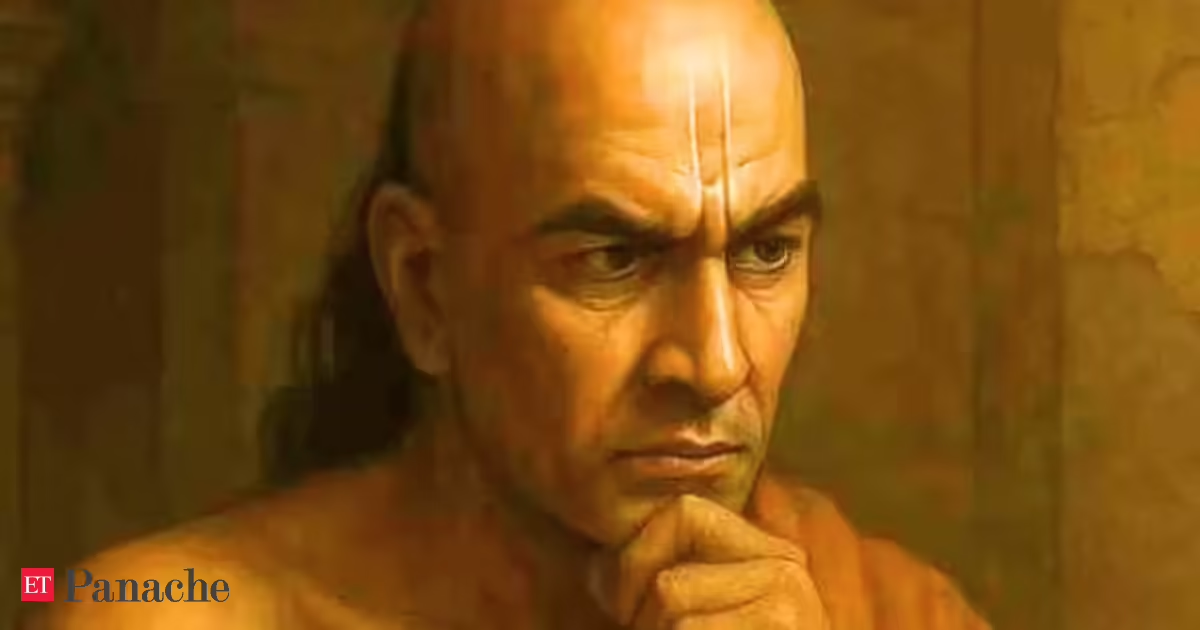
Across cultures and generations, proverbs have served as simple but powerful reminders about how people should approach life. India, with its long tradition of philosophy and literature, has produced countless sayings that continue to remain relevant even today. Many of these teachings were written centuries ago, yet they still speak directly to modern problems involving education, decision-making, and personal growth. One such Sanskrit proverb focuses on the importance of wisdom and practical understanding over the mere possession of knowledge."Of what use is a book of knowledge to a person who lacks their own common sense? What can a mirror do for someone who is completely devoid of eyesight?"The first part of the proverb points to an important truth that many people overlook. Books, teachers, courses, and guidance can provide information, but they cannot automatically create understanding. A person may have access to the best education in the world, yet if they do not think independently or apply what they learn in real situations, that knowledge remains unused. The verse suggests that learning is valuable only when it is combined with judgment and awareness.The second part uses a simple image to make the lesson even clearer. A mirror can help a person see their reflection, but it becomes useless if the person cannot see at all. In the same way, knowledge and instruction are tools. Their value depends on whether someone has the ability and willingness to make use of them. Without that inner capacity, even the most useful resources can fail to make a difference.A Lesson Rooted in Ancient Indian ThoughtThis famous Sanskrit verse is a traditional Subhashita, or wise saying, that is widely associated with Chanakya, also known as Kautilya, the renowned strategist, philosopher, and advisor. The proverb appears in historical compilations including the Chanakya Niti and the Hitopadesha. The Hitopadesha, a collection of moral stories and teachings compiled by Pandit Narayana, records the verse in Book 3, Verse 121.Because the saying comes from ancient literary traditions rather than a single speech or event, it is difficult to assign it to one specific moment in history. Scholars generally connect it to the intellectual traditions that developed in ancient India between the era of Chanakya, around the 4th century BCE, and later compilations that preserved such teachings for future generations.What makes the proverb notable is its straightforward language. Unlike lengthy philosophical discussions, it delivers a complete lesson in just a few lines. That simplicity is one reason why it has survived for centuries and continues to be quoted today.Why This Proverb Still Matters TodayThe message of the verse feels particularly relevant in a time when information is available everywhere. People can access online courses, tutorials, books, podcasts, and expert advice with just a few clicks. Yet having access to information does not automatically lead to better decisions.Many people have experienced situations where someone possesses impressive qualifications but struggles with practical problem-solving. On the other hand, there are individuals with fewer formal credentials who demonstrate strong judgment and adaptability in difficult situations. The proverb highlights this difference between possessing knowledge and knowing how to use it.The lesson applies in workplaces as well. Employees often receive training, manuals, and guidance from experienced colleagues. However, success frequently depends on whether they can interpret that information, think critically, and adapt it to changing circumstances. The same principle can be seen in business, education, and everyday life.The Importance of Inner ClarityOne of the deeper ideas behind the proverb is the concept of inner clarity. Ancient Indian philosophy often emphasized self-awareness as a foundation for growth. External tools can help a person move forward, but they cannot replace personal understanding.The verse suggests that individuals should not rely entirely on outside sources to solve their problems. Reading books, seeking advice, and learning from experts are valuable steps, but they must be supported by reflection and independent thinking. When people develop their own judgment, they become better equipped to benefit from the knowledge available to them.This does not mean that education is unimportant. Rather, the proverb argues that education reaches its full value only when it is paired with wisdom. Knowledge provides information, while wisdom helps determine how and when that information should be used.
Proverb of the day from India: 'Of what use is a book of knowledge to a person who lacks their own common sense? What can a mirror do for someone...' An ancient saying teaches why knowledge alone is not enough to succeed in life
Today's proverb from India highlights the difference between possessing knowledge and understanding how to use it. The ancient Sanskrit verse teaches that books, education, and guidance have little value if a person lacks wisdom, judgment, and self-awareness. Traditionally attributed to Chanakya and recorded in texts such as the Hitopadesha and Chanakya Niti, the proverb remains relevant today, reminding people that true learning comes from combining knowledge with practical common sense.
697 words~3 min read