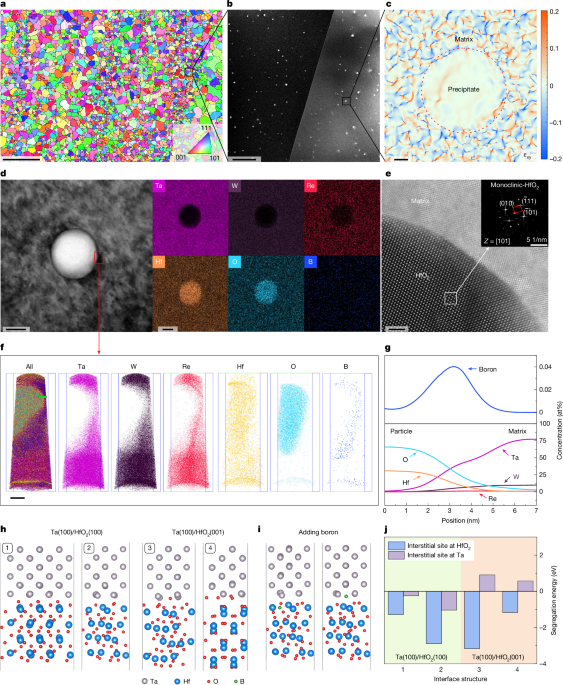
MainThe demand for ultrahigh-temperature alloys has grown significantly in recent years, especially in hypersonic vehicles and new-generation nuclear reactors1,2,3. The temperatures encountered (for example, for the operating temperature of heat-end components) often go beyond 2,000 °C, well above the melting point Tm of nickel-based superalloys6, rendering conventional high-temperature alloys unusable. As is well-known, when the working temperature reaches above approximately 0.6Tm, the mechanical strength drops sharply due to thermally driven microstructural evolution7,8, such that most strengthening mechanisms that function well at room temperature become inapplicable. As such, at present there is virtually no satisfactory candidate to fill the blank for load-bearing metallic alloys in the 2,000–2,400 °C regime to maintain structural and geometrical integrity. Note here that ceramics and intermetallic compounds are out of the question, because a prerequisite here is that the material must also offer ample ductility for easy shaping to process complex-shaped components at temperatures near room temperature. This proposition is extremely challenging for refractory alloys as well9,10,11. For example, the recently emerged NbMoTaW refractory multi-principal-element alloys (MPEAs) present zero tensile ductility at room temperature, and high yield strength was reported only with compression tests at ultrahigh temperatures12. As such, the materials selection repertoire has to exclude all alloys (and even elemental W) that appear brittle at room temperature.We are then left with only one option, namely, acquiring high-temperature strength by adding merely a small volume fraction of second-phase dispersions (ceramic or intermetallic compound particles) into a room-temperature-ductile metal matrix. For example, carbides and nitrides have been used because of their high melting point compared with oxides used in dispersion-strengthened alloys. Considerable research had been carried out by NASA six decades ago13,14, to develop carbide-strengthened Ta alloys such as T-222, Astar-811C, which achieved a good balance of high-temperature strength, low-temperature ductility and weldability on a commercial basis15. There are, however, three bottleneck issues. First, the carbide particles are prone to Ostwald ripening at >2,000 °C. Second, large carbide particles tend to segregate at grain boundaries in the Ta matrix. Third, due to the increased solubility of C in Ta at ultrahigh temperatures, some carbide particles even partially dissolve into the matrix. All these undermine the ability of the dispersions to sustain strength at ultrahigh temperatures. For example, the tensile strength in T-222 alloys drops to below 100 MPa at 1,926 °C (ref. 15). In general, dispersion-strengthened alloys often suffer from inhomogeneous particle distribution and incoherent precipitate–matrix interfaces16,17,18.Here, we show that these obstacles can be overcome using a boron-intervened in situ oxidation strategy to directly fabricate a bulk Ta-based refractory alloy with boron-stabilized oxide particles dispersed uniformly in the grain interior. A schematic of the fabrication process and microstructural evolution of the alloy is shown in Extended Data Fig. 1. Our new design starts from a body-centred-cubic (bcc) Ta-12W-1Re (in weight ratio) base alloy. A small concentration of HfB2 (0.4 wt%) was intentionally added to the refractory matrix. Because oxygen (O) solutes, which are inevitably present as impurities in the refractory alloy, possess a highly negative formation enthalpy with group IV element Hf and its boride (see Supplementary Table 1), the selective oxidation reaction of O with HfB2 forms HfO2 oxide particles19. The oxygen thus takes Hf away from B, locking down Hf but freeing up B. This conversion to the highly stable HfO2 removes the dissolution threat at all temperatures19. It also favourably influences the location and dimensions of the resultant HfO2 dispersions. Specifically, B is known to diffuse faster than O towards the interfaces and grain boundaries, and the aggregation of B there reduces grain boundary oxygen embrittlement in refractory metals20, as the B solutes take away the sites that could serve as favourable locations for oxide formation. As a result, the oxide particles form uniformly, rather than preferentially at grain boundaries. This is the first benefit of introducing HfB2. Second, B atoms leaving the particles also tend to aggregate at the interface between the oxide nanoparticle and the matrix, preventing excessive growth of the former. This B intervention thus restricts the oxide particles to the nanometre scale and ensures their uniform distribution throughout the matrix. As such, in contrast to conventional ceramic particles, the B-stabilized oxide particles exhibit excellent thermal stability without the rapid coarsening that degrades high-temperature mechanical properties. Hereafter, the new Ta alloys created by this modified oxide-dispersion strengthening (ODS) route are abbreviated as B-ODS alloys. They exhibit excellent tensile properties not only at ambient conditions but, more importantly, at extreme temperatures up to 2,400 °C, outperforming by far all the previously reported conventional refractory alloys and refractory MPEAs. A comprehensive comparison of our B-ODS Ta alloys with the traditional ones previously developed by NASA is presented in Supplementary Note 1.MicrostructureThe as-cast alloy contains a high density of homogeneously dispersed B-wrapped HfO2 particles. After annealing at 1800 °C for an hour, the hot-deformed (rolled or extruded) sample completes full recrystallization. The inverse pole figure diagram shows that our B-ODS Ta-based alloy processed as such consists of uniform equi-axed grains without obvious texture, as shown in Fig. 1a. In comparison to the Ta-12W-1Re base alloy, the average grain size was reduced from 49 μm to 14 μm in our B-ODS Ta-12W-1Re alloy (Supplementary Fig. 1). We examined the pole figures of {100}, {110} and {111} (Extended Data Fig. 2). The pole distributions of all three orientations are nearly uniform, with no apparent sharp peaks or continuous fibre bands. The transmission electron microscopy (TEM) image shows that the precipitated HfO2 particles have an average diameter of approximately 50 nm and distribute uniformly inside the interior of the grains (Fig. 1b). For the Ta-12W-1Re-0.4Hf sample without B, HfO2 particles grow to a larger size with diameter of approximately 200–300 nm and predominantly segregate at the grain boundaries (Supplementary Fig. 2). These results demonstrate that both the size and distribution of HfO2 particles are optimized through the addition of boron. The volume fraction of the B-stabilized HfO2 precipitates is estimated to be around 0.6% through quantitative metallography analysis for regions containing more than 1,000 particles (Supplementary Fig. 3). The geometric phase analysis (GPA) was performed to show the strain distribution in various nanoparticles (Supplementary Fig. 4); a representative GPA map is shown in Fig. 1c. As there is no fixed crystallographic orientation match between the precipitate and the matrix, the magnitude of GPA strain varies for each particle.Fig. 1: Microstructure of B-stabilized HfO2 dispersion-strengthened Ta-12W-1Re refractory alloy.a, EBSD inverse pole figure of the alloy. b, TEM image of nanoparticles dispersed near a grain boundary. c, GPA analysis of precipitate and matrix. d, EDS mapping illustrating the element distribution. e, IDPC image at the interface between the precipitate and the matrix. The inset shows the FFT result of the precipitate, identified as HfO2 with the monoclinic structure. f, 3D-APT atomic map showing element distribution near the precipitate–matrix interface, for the location indicated by the red box in d. g, Proximity histogram across precipitate–matrix interface, as marked by the light green line in f. The concentration of B atoms shows a peak near the interface. h, Two differently oriented interfaces between bcc Ta and monoclinic HfO2 were constructed as Ta(100)/HfO2(100) and Ta(100)/HfO2(001). For each orientation, the most stable two configurations are obtained by interface structure search, labelled 1–4. i, Interstitial sites for B in HfO2 and Ta near a Ta(100)/HfO2(100) interface. Ta, Hf, O and B atoms are colour-coded by grey, blue, red and green spheres, respectively. j, Segregation energies of B at the four Ta/HfO2 interfaces. Scale bars, 100 μm (a); 500 nm (b); 5 nm (c); 20 nm (d, left and right; f); 2 nm (e).The energy dispersive spectroscopy (EDS) scanning mapping taken with the bright field scanning (BF-S) observation shows that the matrix consists of Ta, W, Re and Hf, whereas the particle shows a pronounced enrichment of Hf and O (Fig. 1d). We also present the atomic-resolution high-angle annular dark field (HAADF)-STEM image and corresponding EDS maps for both the matrix and particles (Supplementary Fig. 5). The integrated differential phase contrast (IDPC) image characterizes the interface between the precipitate and the matrix (Fig. 1e). Fast Fourier transform (FFT) analysis indicates that the particles are HfO2 with a monoclinic structure (Supplementary Fig. 6). To further investigate the distribution of B atoms, a sample was extracted near the HfO2–matrix interface using the focused ion beam, as highlighted in Fig. 1d (red box). The three-dimensional atom probe tomography (3D-APT) analysis shows a concentration peak of B at the interface (Fig. 1f). Line scanning along the light green bar marked in Fig. 1f indicates that the stoichiometry of Hf to O in the nanoparticle approaches 1:2 (Fig. 1g). All these results confirm that a new B-stabilized oxide is formed, with the core being HfO2 and the outer layer enriched in B. Apart from this preferential accumulation of B at the precipitate–matrix interface, there is also a distinct segregation of B atoms at grain boundaries, which may help stabilize the grain size, whereas O concentration decreases simultaneously (see 3D-APT analysis in Supplementary Fig. 7). This demonstrates that B atoms could effectively hinder the formation of oxide particles at grain boundary locations.We carried out density functional theory calculations to understand the energetics of B segregation at the interface in our alloys. We constructed the most stable two configurations through interface structure optimization for each Ta(100)/HfO2(100) and Ta(100)/HfO2(001) orientation (Fig. 1h). B atoms were placed at the interstitial sites of both Ta and HfO2 for these four interfaces (see the typical atomic configurations in Fig. 1i). The lowest-energy configurations were selected to calculate the segregation energies (Fig. 1j). Consistent with experimental observations, B atoms preferentially locate at the Ta/HfO2 interface, where the segregation energies are more negative, thus strengthening the interface and setting up the B-enriched-zone enclosing the HfO2 particles. As the segregation energy is significantly lower at the interstitial sites of HfO2, the most stable sites for B are close to the HfO2 side near the interface.Tensile propertiesWe performed room-temperature uniaxial tension tests on our B-stabilized HfO2 dispersion-strengthened Ta alloy (see Methods and Extended Data Fig. 3 for the specimen preparation). The commercial Ta-10W alloy is used to serve as the reference; it has a yield strength (σy) of 558 MPa, an ultimate tensile strength (σUTS) of 630 MPa and an elongation-to-failure (εf) of 30% (Fig. 2a, black curve). Alloying in the form of Ta-12W-1Re elevates the tensile strength by 100 MPa but drops the εf to less than 3% (Fig. 2a, green curve). For our B-ODS Ta-based alloys, the introduction of B-stabilized HfO2 particles leads to a simultaneous enhancement of strength and ductility. We tested the tensile properties of our alloys with different amounts of added HfB2 (Supplementary Fig. 8) and found that the sample with 0.4 wt% HfB2 achieves an excellent combination of σy ≈ 720 MPa, σUTS ≈ 830 MPa, εf ≈ 35% (Fig. 2a, red curve). It also exhibits a stronger strain hardening in comparison with the Ta-10W alloy; see the true stress–strain curves and strain hardening rates shown in Supplementary Fig. 9. For the Ta-12W-1Re-0.4Hf alloy without B, the improvement of strength and ductility is very limited (Fig. 2a, blue curve). We compared the tensile performance of our B-ODS alloy with the previously reported representative refractory alloys based on either Ta (refs. 14,21), Mo (ref. 22) or Nb (ref. 23) (grey regime) as well as with refractory MPEAs such as NbTiZr, HfNbTaTi (refs. 24,25,26,27,28,29,30,31,32,33) (blue regime), in the σUTS compared with εf plot shown in Fig. 2b. The excellent strength–ductility synergy of our alloy stands out. The excellent tensile ductility at room temperature is an indicator that our alloy would exhibit good formability, which is confirmed by the fact that the ingot can be rolled to a thin (2 mm in thickness) sheet without fracture at mild temperatures (Extended Data Fig. 3).Fig. 2: Tensile properties of our B-ODS Ta-12W-1Re alloys at room temperature and elevated temperatures.a, Engineering tensile stress–strain curves of Ta-10W (black), Ta-12W-1Re (green), Ta-12W-1Re-0.4Hf (blue) and our B-ODS Ta-based alloy (red) at room temperature. b, Ultimate tensile strength compared with elongation-to-failure for our alloy (red star symbols) in comparison with representative refractory alloys (grey regime)14,21,22,23 and refractory multi-principal-element alloys (blue regime)24,25,26,27,28,29,30,31,32,33 at room temperature. c, Engineering tensile stress–strain curves at 2,000 °C, 2,200 °C and 2,400 °C. For each temperature, the tests were carried out more than three times to ensure good reproducibility. d, Tensile yield strength compared with test temperature, comparing our alloy with the traditional Nb-based10,34, Mo-based10,35, Ta-based14,21 refractory alloys, and NbMoTaW (ref. 37) and HfNbTaTiZr (ref. 36) MPEAs. Our alloy not only excels across the board but also fills the blank, the previous ‘no-man’s land’ in the temperature regime of 2,000–2,400 °C.What is particularly remarkable is that our B-ODS Ta alloys exhibit extraordinary strength at ultrahigh temperatures. Uniaxial tensile tests were carried out at temperatures ranging from 1,600 °C to 2,400 °C (see Methods and Extended Data Figs. 4 and 5 for the sample preparation and testing facilities). Before loading, the specimens were held at the testing temperatures for 20 min to ensure uniform heating. The engineering stress–strain curves, repeated tested three times at each of the elevated temperatures above 2,000 °C, are shown in Fig. 2c. The Young’s modulus shows an obvious reduction with increasing temperature, that is, it drops to 127 GPa at 2,000 °C, which is a reduction of about 40% in comparison with the 206 GPa at room temperature (Extended Data Fig. 6). The tensile yield strength reaches about 200 MPa at 2,000 °C and about 100 MPa at 2,400 °C. The tensile yield strength as a function of temperature for our B-ODS Ta alloys is presented in Fig. 2d (red solid circles), outperforming all the traditional refractory alloys, including Ta-based14,21, Nb-based10,34 and Mo-based10,35 alloys and recently emerged refractory MPEAs (refs. 36,37). For example, the yield strength of our B-ODS Ta alloys at approximately 2,000 °C doubles that of the carbide-strengthened counterparts such as T-222 and Astar-811C (refs. 14,21), and at 2,400 °C rivals that achieved by T-222 at a temperature 500 °C lower. Refractory MPEAs having room-temperature tensile ductility usually contain a high concentration of elements with relatively low melting points such as Ti, Zr and V, lowering their ability to sustain load at ultrahigh temperatures. As a typical example, the HfNbTaTiZr shows a tensile yield strength of only 30 MPa at 1,200 °C (ref. 36). Numerous compression tests show a clear trend that the yield strength has an abrupt drop when temperature exceeds 1,200 °C (Supplementary Fig. 10). For those brittle refractory MPEAs containing a high content of W and Mo, no tensile ductility is available at room temperature. Their high-temperature tensile properties are not up to par either, as a recent study reported that the tensile strength of NbMoTaW alloy is only 36 MPa at 1,200 °C (ref. 37), although previous studies have shown that its compressive strength can exceed 400 MPa at 1,600 °C (ref. 12). Moreover, the EDS analysis indicates the formation of a complex concentrated oxide scale with a thickness of about 150 nm after high-temperature tension tests (Extended Data Fig. 7). As the layer remained thin, it is not expected to have much influence on the mechanical properties of our alloys.To highlight the breakthrough achieved, we stress that ours is the only metallic alloy that can sustain a respectable tensile strength at temperatures above 2,000 °C, maintaining about 100 MPa even at 2,400 °C. This range fills a temperature regime that previous alloys have never been able to cover, as seen in Fig. 2d. The operating temperature (at least for service duration on the order of a fraction of an hour) can thus reach a very high fraction of the alloy melting point (Tm ≈ 3,000 °C), that is, about 0.8 in terms of homologous temperature. For most of the traditional structural alloys, strength decreases sharply when the temperature is increased to 0.4–0.6Tm because the high temperature renders considerable microstructure evolution (such as grain growth, dislocation annihilation, precipitate coarsening) that nullifies strengthening mechanisms. Only the Ni-based superalloys could survive temperatures above 0.7Tm because of the formation of a unique coherent γ/γ′ microstructure. The new alloy designed here reaches T/Tm = 0.8, significantly surpassing the homologous temperature upper limit of traditional refractory alloys. In terms of the range of working temperature, our alloy suffices for the previously missed 2,000–2,400 °C regime, at least for short-service-time (including many important) operations. Furthermore, our preliminary creep test results indicate noticeable longer-term improvement over all previous refractory alloys (Supplementary Note 2).Deformation mechanismsWe next explore the deformation mechanism during plastic flow in our newly developed Ta alloys. We start from the tensile behaviour at room temperature. Our alloy shows a more ductile fracture featuring numerous dimples, in comparison with the typical cleavage fracture in Ta-12W-1Re and a mixed fracture failure in Ta-12W-1Re-0.4Hf (Extended Data Fig. 8). The g · b criterion was then used to identify the Burgers vectors for dislocations in our alloys, which were analysed along the \([\bar{1}11]\) zone axis using different reciprocal lattice vectors (g vectors) under two-beam conditions (Extended Data Fig. 9). Here we present the TEM images of dislocation characteristics at different applied strains under \(g=[01\bar{1}]\). The undeformed alloy, annealed at 1,800 °C for 1 h after rolling, contains very few dislocations (Fig. 3a). As the sample yields, plastic flow is primarily carried by screw dislocations, similar to what is observed in most bcc transition metals. These initial dislocations are long and straight (Fig. 3b). The presence of nanoparticles in the matrix effectively traps and impedes the glide of moving dislocations. As a result, the initially straight screw dislocations become obviously curved because of the strong interactions between the dislocations and particles, leading to a substantial hardening effect. We found that massive dislocations are generated and accumulated near the particle–matrix interface at a strain of 5%, leading to a pronounced increase of dislocation density (Fig. 3c). Numerous mixed dislocations are stored in the highly strained sample, which ultimately evolve and organize into dislocation cells; a typical image for a region near the fracture surface is shown in Fig. 3d.Fig. 3: Deformation mechanisms of our alloys at room temperature.a–d, Typical TEM images of microstructure at different tensile strains. The dislocation structure is characterized along the \([\bar{1}11]\) axis under two-beam conditions. e–h, Microstructure analysis at 5% tensile strain. TEM image of dislocation interacting with the intragranular nanoparticles (e). High-resolution TEM image of a mixed dislocation interacting with the particle–matrix interface (f). GPA analysis of f (g). Edge dislocation loops (h). i–l, Deformation of precipitate near the fracture surface at about 35% tensile strain. Representative TEM images of plastic deformation in nanoparticles (i). High-resolution TEM images of stacking faults (j), deformation twinning (k) and martensitic phase transformation (l) in different nanoparticles. Scale bars, 200 nm (a–d); 100 nm (e); 5 nm (f,g); 20 nm (h,i); 2 nm (j–l).The pinning force exerted by the impenetrable particle forces the dislocation to bow out, following the Orowan hardening mechanism, as shown in a representative TEM image at 5% strain (Fig. 3e). At this strain, the trapping of dislocations at the particle–matrix boundary does not lead to significant stress concentration near the interfaces (Fig. 3f,g). As 1/2⟨111⟩ screw dislocations in bcc metals can glide on multiple slip systems, cross-slips frequently occur and may assist dislocations in bypassing the nanoparticles. We did not observe dislocation cutting through the precipitate due to the high penetrating stress required for crossing the interface. Moreover, there are many \(1/2[1\bar{1}1]/(110)\) edge dislocation loops left, resulting from dislocation reactions (Fig. 3h).At the late stage of room-temperature deformation, the accumulation of dislocations around the nanoparticles induces a strong local stress near the interphase boundary. Our B-stabilized HfO2 particles are observed to be plastically deformable. Typical images at a strain of about 35% are shown in Fig. 3i–l. Multiple deformation modes are triggered in the interior of different HfO2 nanoparticles, including stacking faults (Fig. 3j), deformation twinning (Fig. 3k) and martensitic phase transformation (Fig. 3l). For a rough estimation, the probability of the occurrence of plastic deformation is close to 20% by examining more than 90 nanoparticles after tension (Supplementary Fig. 11). These mechanisms help alleviate the strain localization introduced by the dislocation accumulation near the particle–matrix interface, avoiding interfacial cracking for brittle failure. The tensile ductility is consequently improved because of the compatibility of plastic deformation between the matrix and the second phase. This behaviour is distinctly different from the traditional refractory alloys strengthened by the high-stiffness carbide and nitride particles, which are usually non-shearable and unable to accommodate plastic strain, making them more prone to brittle fracture near the interphase boundaries.Thermal stability of nanoparticlesWe characterized the microstructure evolution at different length scales near the fracture surface after 2,000 °C tension tests. No obvious grain growth was observed. The average grain size is 18 μm, close to that before tension (Supplementary Fig. 12; some solute dragging due to B segregated to grain boundaries may have played a part). Kernel average misorientation map demonstrates various low-angle boundaries formed in the grain interior after 2,000 °C tension, indicating obvious dynamic recovery of dislocations (Fig. 4a). TEM images show that the rearrangement of dislocations promotes the formation of sub-grain boundaries, which consist of bundles of intersecting 1/2〈111〉 screw dislocations (Fig. 4b). In comparison to the deformation at room temperature, the overall dislocation density is lowered because of the high annihilation rate of dislocations under the high thermal–mechanical driving forces. Nonetheless, we still observe many dislocations trapped and stored near the nanoparticles (Fig. 4c). After 2,000 °C tension, most of the particles show no significant coarsening, with the diameter still averaging about 50 nm (Extended Data Fig. 10). Some particles are elongated after plastic deformation along the tensile direction (Fig. 4d), which was also observed at room temperature after large strains.Fig. 4: Excellent thermal stability of B-stabilized HfO2 nanoparticles at elevated temperatures.a, Kernel average misorientation map near the fracture surface for the samples with 20-min holding time at 2,000 °C. b, TEM image showing the formation of low-angle sub-grains on dynamic recovery. c,d, Typical TEM images showing the interaction between nanoparticles and dislocations near the fracture surface. e, 3D-APT atomic maps showing element distribution near the precipitate–matrix interface after tension at 2,000 °C for the samples with 20-min holding time. f, Proximity histograms across the precipitate–matrix interface indicate the peak concentration of B atoms at the interface, as marked in e (light green line). Scale bars, 100 μm (a); 2 μm (b); 500 nm (c); 100 nm (d); 20 nm (e).The excellent resistance to coarsening can be attributed to the B enrichment at the particle–matrix interface. We further performed quantitative chemical analysis using 3D-APT for this sample (Fig. 4e). The segregation of B at the interface is preserved quite well even at 2,000 °C, because of the strong binding of B with the interface, as indicated by the concentration peak shown in Fig. 4f. The presence of B effectively slows down the interstitial oxygen transport needed for particle growth. Thus, the growth rate of the HfO2 nanoparticles remains very slow despite of the ultrahigh temperature. Consequently, these nanoparticles continue to impede dislocation movement at ultrahigh temperatures, thereby making a dominant contribution to the record-high high-temperature strength.We probed the influence of holding time before loading on the mechanical properties at ultrahigh temperatures. Even after holding for half an hour at 2,400 °C, the yield strength remains practically unchanged in comparison with that with no holding (Supplementary Fig. 13), implying that the microstructure exhibits good thermal stability at these ultrahigh temperatures. By contrast, for Ta-12W-1Re-0.4Hf without boron, the strength drop is obvious, even after a shortened holding of 10 min at 2,000 °C (see the plunging curve with markedly reduced strength in Supplementary Fig. 14).Concluding remarksThis work resolves a formidable challenge, that is, realizing a metallic alloy that is capable of withstanding loads at temperatures as high as 2,000–2,400 °C yet ductile for easy processing at temperatures near room temperature. Apart from the demonstrated deformability, our alloy achieves a tensile yield strength of about 200 MPa at 2,000 °C and about 100 MPa at 2,400 °C, surpassing all the traditional refractory alloys and refractory MPEAs. The B-stabilized HfO2 nanoparticles are able to elevate strength, preserve ductility and impart thermal stability simultaneously. First, the carefully designed boron-intervened oxidation reaction produces undissolvable oxide particles with an average diameter of about 50 nm and homogeneous distribution within the grain interior. These dispersed nanoparticles effectively trap dislocations based on the Orowan mechanism. Second, besides the dislocation plasticity in matrix, the B-stabilized HfO2 particles could undergo plastic deformation via additional modes, promoting deformation compatibility with the matrix and thereby increasing ductility. Third, the segregating B improves the thermal stability of oxide particles at ultrahigh temperatures. The enrichment of B at the interface effectively blocks O atoms, preventing their rapid interstitial diffusion that would otherwise mediate the coarsening of oxide particles. This excellent thermal stability enables the dispersions to impede dislocation motion effectively to elevate strength, even at temperatures as high as >2,000 °C. The applicability of our B-ODS design strategy to other alloys is discussed in Supplementary Note 3.MethodsMaterials preparationTo ensure chemical homogeneity of the final ingot over a few kilograms, we first prepared pre-alloyed small ingots of about 125 g by arc-melting using high-purity raw materials of Ta, W, Re and HfB2. Before melting, the vacuum chamber was evacuated to a pressure of 3 × 10⁻³ Pa and subsequently backfilled with 99.995% pure argon. A titanium getter was melted for 2 min to remove residual impurities in the chamber. The raw materials were melted in a water-cooled copper crucible. Each ingot was flipped and re-melted more than eight times. The as-cast small ingots were ultrasonically cleaned in an isopropyl alcohol bath for 10 min. Subsequently, the pre-alloyed ingots were melted to form a large 4.5 kg ingot in an induction furnace under an argon atmosphere, and then flipped and re-melted more than five times to ensure homogeneity. The as-cast ingots were finally homogenized at 1,600 °C for 4 h.Microstructural characterizationX-ray diffraction measurements were performed using a Bruker D8 ADVANCE diffractometer with Cu Kα radiation with a step size of 0.01° and a scanning rate of 1° min−1. Electron backscatter diffraction (EBSD) was conducted on a Thermo Scientific Helios 5 UX DualBeam focused ion beam microscope at an acceleration voltage of 30 kV and a beam current of 5.5 nA. The EBSD data were analysed using OIM Analysis 8 software to generate inverse pole figure maps. TEM, high-resolution TEM, HAADF, EDS and selected area electron diffraction analyses were carried out using Thermo Scientific Talos F200X and Spectra 300 microscopes. Thin TEM foils were mechanically polished to about 50 μm thickness, followed by twin-jet electron polishing using a Struers Tenupol-5 at a voltage of approximately 20 V and a temperature of −20 °C. The electrolyte used consisted of 80% methanol, 14% sulphuric acid and 6% hydrofluoric acid. Three-dimensional elemental mapping at the atomic scale was performed using a local electrode atom probe tomography (APT) system (CAMECA, LEAP 4000 XR). Tip-shaped specimens for 3D-APT tests were fabricated using a lift-out method and annularly milled using a focused ion beam/scanning electron microscope (FIB/SEM, FEI Scios). APT measurements were conducted at 50 K in the voltage mode under ultrahigh vacuum conditions (6 × 10⁻⁹ Pa), with a pulse repetition rate of 125 KHz and a pulse fraction of 10%. The 3D reconstruction and compositional analyses were carried out using Imago Visualization and Analysis Software (v.3.6.8).Room-temperature tension testsTo prepare the flat specimens used for room-temperature tension, a thin plate was cut from the as-cast ingots and rolled at about 1,100 °C to achieve a 40% reduction in thickness. Oxide scales were removed through pickling and mechanical methods, followed by annealing at 1,800 °C for 1 h. The sample was then rolled at 450 °C to achieve an additional 50% reduction in thickness and finally annealed at 1,800 °C for 1 h (Extended Data Fig. 3). The dog-bone-shaped specimens were fabricated by electrical discharge machining. The gauge section has a length of 12 mm, a width of 3.5 mm and a thickness of 1 mm. The sample surfaces were polished using 2000-grit SiC paper to eliminate scratches. The tension tests were conducted on an Instron 5969 universal testing machine at a strain rate of 1 × 10⁻³ s−1. The strain was measured by a non-contact video extensometer.High-temperature tension testsTo produce the large cylindrical specimens used for high-temperature tension tests, the hot extrusion was carried out at 1,700 °C in air to a 4.5 kg as-cast ingot with molybdenum cladding (Extended Data Fig. 4). The extrusion ratio was 3. The as-extruded sample was then annealed at 1,800 °C for 1 h. The dog-bone-shaped specimens were cut from the annealed ingot for uniaxial tension at elevated temperatures. The gauge section has a length of 40 mm and a diameter of 5 mm (Extended Data Fig. 4). Two extra lugs machined at both sides of the gauge length are used to mount the contact extensometer, which is made of carbon–carbon composite to sustain high heat flow. The high-temperature tension tests were carried out in an argon environment using an electro-thermal mechanical testing platform. Specifically, the chamber was first evacuated to less than 3 × 10⁻³ Pa at room temperature. Then the chamber was backfilled with a steady flow of argon gas until reaching a small positive pressure, which prevented external air (especially oxygen and water vapour) from flowing back into the chamber. Three electrodes were used to heat the sample by applying an electrical current, that is, a main electrode along the axis of the specimen and two auxiliary electrodes at the two grips of the specimen. The three electrodes worked simultaneously to ensure homogeneous heating of the whole sample. The temperature was measured using the infrared sensor throughout the tests (Extended Data Fig. 5). Three positions, at the middle and two ends of the specimen, were set to monitor the temperature. The three independent signals were fed back to the electrode to make an in-time adjustment. Samples were heated up to the target temperature at a rate of 10 °C s−1. Before loading, the sample was held at the test temperature for 20 min to ensure a uniform distribution of temperatures. The tensile strain rate is 1 × 10⁻³ s−1. Tensile tests were conducted at temperatures ranging from 1,600 °C to 2,400 °C. To study the influence of holding time on the strength, tensile tests with different holding times up to half an hour were performed for comparison. After tension tests, the samples were cooled down to room temperature in the chamber. For each temperature, the high-temperature tensile tests were carried out more than three times to ensure good reproducibility.Density functional theory calculationsDensity functional theory calculations were carried out to obtain the segregation energies of boron at Ta/HfO2 interfaces using the Vienna ab initio simulation package (ref. 38). The Perdew–Burke–Ernzerhof generalized gradient approximation was used for exchange correlation39. An energy cutoff of 550 eV was set for plane-wave basis. We performed Brillouin zone integrations using the Monkhorst–Pack k-point sampling method. As there is no fixed orientation relationship between HfO2 and Ta-based matrix in experiments, we constructed two differently oriented interfaces between bcc Ta and monoclinic HfO2 as Ta(100)/HfO2(100) and Ta(100)/HfO2(001). For each orientation, we searched over the possible stable interface structures by interface mismatch minimization and selected the most stable two configurations for calculating segregation energies, labelled 1–4 in Fig. 1h. The four interface supercells contain 168, 78, 102 and 100 atoms, respectively. A k-point mesh of 5 × 5 × 1 was used for all supercells. Structural relaxation was performed until the forces on each atom converged to less than 10−3 eV Å−1. The segregation energy of boron at interphase boundary was calculated as \({E}_{\text{seg}}^{{\rm{B}}}=\,({E}_{\text{interface}}^{\text{B}}-{E}_{\text{interface}})-({E}_{\text{bulk}}^{\text{B}}-{E}_{\text{bulk}})\), where \({E}_{\text{interface}}^{\text{B}}\) and Einterface are the total energies of the interface supercells with and without B, and \({E}_{\text{bulk}}^{\text{B}}\) and Ebulk are the total energies of the bulk supercells with and without B.
Ductile alloys offering 100 MPa tensile strength at 2,400 °C - Nature
A boron-stabilized oxide-strengthened tantalum alloy combines exceptional room-temperature ductility with record ultrahigh-temperature strength, enabling load-bearing applications above 2,000 °C.
7,101 words~32 min read