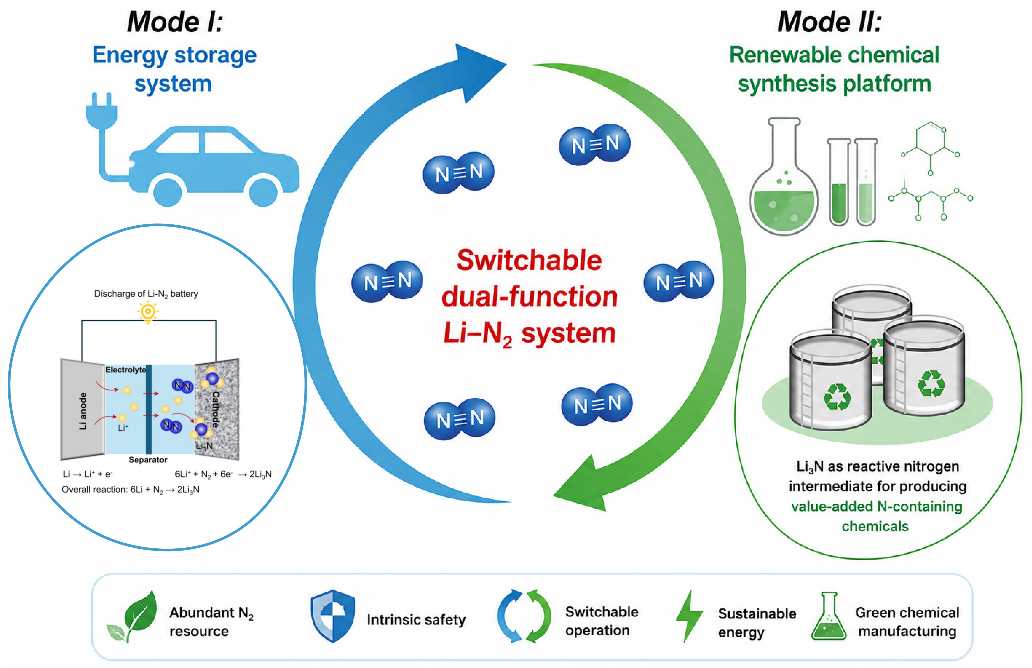
Researchers from Belgium and China have proposed a roadmap to advance lithium–nitrogen (Li–N₂) batteries, identifying key barriers such as poor reversibility, slow nitrogen activation, and unstable cell components. They suggest improved electrolytes, catalysts, separators, and cell designs, alongside standardized testing and flow-type architectures, to enable both energy storage and nitrogen-based chemical production.
A research group from Belgium and China has presented a roadmap for the development of lithium–nitrogen (Li–N₂) batteries.
In these batteries, lithium reacts electrochemically with nitrogen gas to form lithium nitride (Li₃N) during discharge and, ideally, regenerates lithium and nitrogen during charging. Although the first reversible Li–N₂ battery was demonstrated nearly a decade ago, practical development of the technology has remained limited.
“Our work provides the first comprehensive roadmap for the practical development of Li–N₂ batteries,” corresponding author Yu Li told pv magazine. “Rather than focusing on a single catalyst or material, we identify the fundamental barriers limiting reversibility and long-term stability, from reaction mechanisms and characterization methods to electrolytes, separators, and cell architecture.”