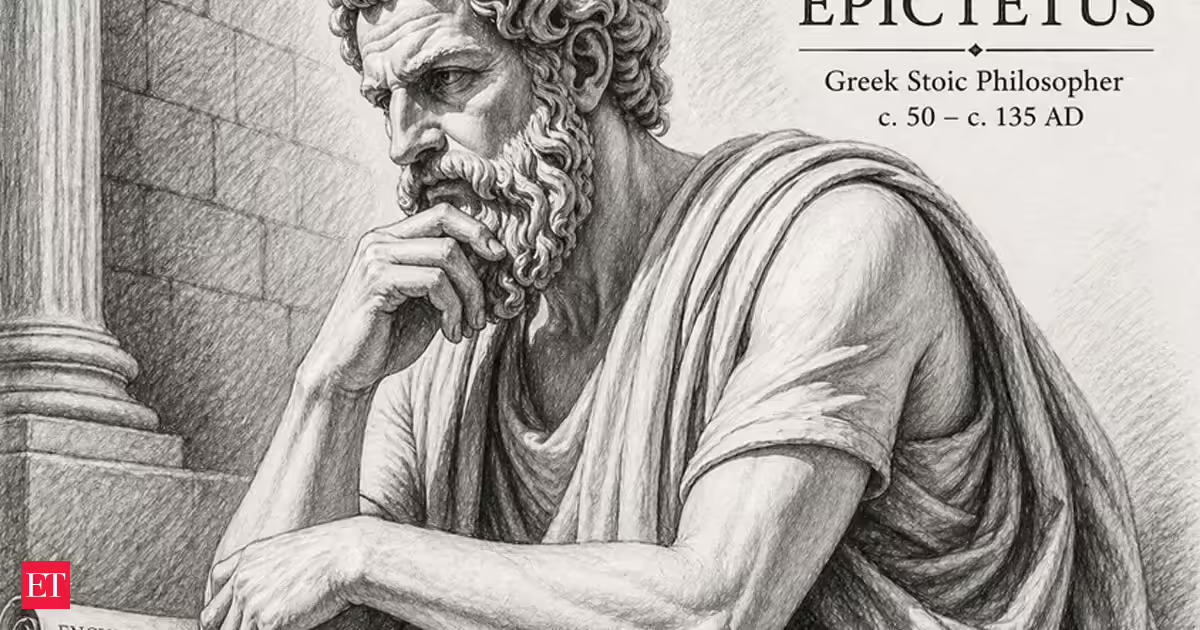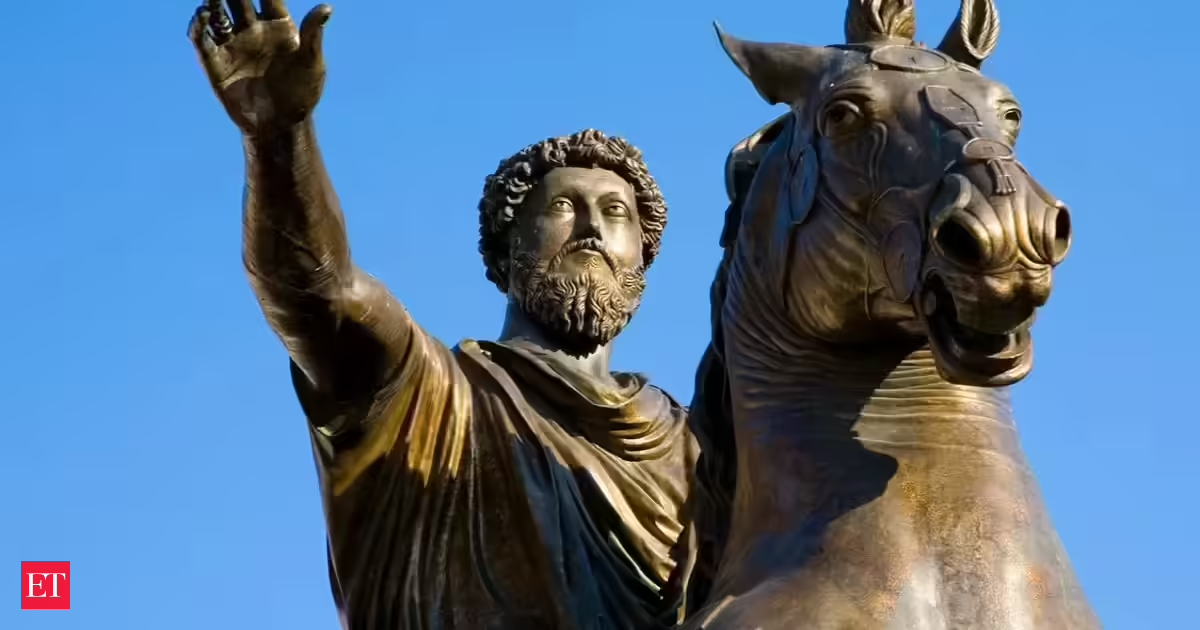
Stoic Thought of the Day: There is a sentence Marcus Aurelius wrote nearly two thousand years ago that still quietly changes people when they actually sit with it. "In your actions, don't procrastinate. In your conversations, don't confuse. In your thoughts, don't wander. In your soul, don't be passive or aggressive. In your life, don't be all about business." That's the stoic thought of the day that most people scroll past. But the ones who stop — really stop — find something unsettling waiting there. A mirror. And what looks back isn't always flattering. Stoicism isn't a productivity hack. It's not a morning routine trend. It is a complete philosophy of how a human being should move through the world, make decisions, endure loss, and still show up with dignity. And this particular stoic thought of the day cuts across five dimensions of human experience simultaneously — action, speech, thought, character, and purpose. That's not coincidence. That's a map. The reason this stoic wisdom hits so hard for modern American audiences is simple: we live in an age that glorifies the opposite of everything Aurelius is describing. We procrastinate and call it self-care. We overcomplicate our conversations and call it nuance. We let our thoughts spiral into anxiety loops and call it being thorough. We oscillate between passive withdrawal and aggressive overreaction and call it personality. And we stay "all about business" while missing every moment that actually mattered. This stoic thought of the day is a quiet indictment of how most of us live — and a gentle, firm invitation to do otherwise.Stoic Thought of the Day: Marcus Aurelius’ Powerful Lesson on Focus, Self-Control, and the Art of Living a Meaningful Life When Marcus Aurelius wrote "don't procrastinate in your actions," he wasn't talking about your to-do list. He was talking about the deeper hesitation humans carry — the gap between knowing what is right and actually doing it. Modern psychology has a name for this: the intention-action gap. Researchers at the University of Sheffield found it is one of the most consistent findings in behavioral science. We know what we should do. We just don't do it. The stoic thought of the day addresses this not with guilt but with clarity: act now, because the only moment you actually have is this one. Think about Theodore Roosevelt, who by all accounts should have spent his life in a sickbed. He was asthmatic, frail, and told from childhood that overexertion might kill him. His father sat him down one day and said something that rewired the boy entirely: "You have the mind but not the body. You must make your body." Roosevelt didn't think about it for a week. He started that afternoon. That is Stoic action. Not recklessness — precision. Doing the thing, in the right direction, without delay. The Roman proverb "Dum differtur vita transcurrit" says it plainly: while we are postponing, life speeds by. The stoic thinker Seneca said the same thing differently — most people aren't afraid of death, they're afraid of the years they wasted before it. Stoic wisdom has always understood that procrastination is not laziness. It is, at its core, a failure of nerve. And nerve is trainable. What Clear Thinking Does to Your Relationships and Your Inner Life The second and third parts of this stoic thought of the day belong together. Don't confuse in your conversations. Don't wander in your thoughts. They are two expressions of the same disease: the unexamined, undisciplined mind that produces noise instead of signal. Think about the last truly important conversation you had. The one where what you said actually landed the way you meant it. Where you were understood without having to explain yourself three times. Chances are you were calm before it. Stoic wisdom teaches that clarity in speech flows directly from clarity in thought — and clarity in thought flows from the discipline of attention. The philosopher Epictetus, who was born a slave and became one of the most influential thinkers of the ancient world, used to tell his students that they had two ears and one mouth for a reason. Listen twice, speak once. And when you speak, mean it. Wandering thoughts aren't a modern invention — Aurelius was writing about them from the palace in Rome. But the volume has been turned up. The average American checks their phone 144 times per day according to research from Reviews.org. Each check is a small act of mental abandonment. Stoic thought of the day practice isn't about being cold or robotic. It's about being present enough that when something actually matters, you're there for it. Full attention is one of the rarest gifts a person can give — and the Stoics understood that it begins with the practice of not letting the mind drift without your permission. The Japanese proverb "fall seven times, stand up eight" speaks to this too. You don't build a stable inner life by never failing — you build it by noticing when you've lost your footing and calmly returning. Every wandering thought redirected is a small act of self-authorship.The Stoic Life That Goes Beyond Hustle Culture The last two lines of this stoic thought of the day might be the most urgent for 2026 America: "In your soul, don't be passive or aggressive. In your life, don't be all about business." Passive-aggressive behavior is the emotional posture of someone who has never been taught to want things clearly and ask for them directly. It is exhausting to live with and exhausting to be. The Stoic concept of "eudaimonia" — often translated as flourishing — requires that you know what you actually want, pursue it with honest assertion, and accept what you cannot control without resentment. Not passive. Not aggressive. Engaged. Steve Jobs once said — in a moment of unusual candor before his death — that lying in a hospital bed was the first time in years he'd been still enough to realize the things he cared about most had almost no connection to the company he ran. That's what "don't be all about business" really means. Not that work doesn't matter. Work absolutely matters. But the stoic life asks what the work is in service of. Purpose is not the same as productivity. A full calendar is not the same as a full life. The Stoic Marcus Aurelius himself ran an empire. He was not telling people to quit their jobs. He was saying: don't let the mechanism become the meaning. There is a difference between a man who builds a business to provide for the people he loves and a man who neglects the people he loves because he is building a business. One is alive. The other is occupied.10 Stoic Thoughts to Carry With You Today These aren't just decorative quotes. Each one is a small act of philosophy you can keep in your pocket: "The obstacle is the way." — Marcus Aurelius "It is not that I'm so smart, it's that I stay with the problems longer." — paraphrased from Einstein, but pure Stoic in spirit "You have power over your mind, not outside events. Realize this, and you will find strength." — Marcus Aurelius "He who fears death will never do anything worthy of a man who is alive." "Waste no more time arguing what a good man should be. Be one." — Marcus Aurelius "If it is not right, do not do it; if it is not true, do not say it." — Marcus Aurelius "The best revenge is to be unlike him who performed the injustice." — Marcus Aurelius "Nothing is more harmful to a person than their own thoughts ungoverned." "Difficulties strengthen the mind as labor does the body." — Seneca "Begin at once to live, and count each separate day as a separate life." — SenecaWhy This Stoic Thought of the Day Changes People Who Actually Use It There is a reason stoic philosophy has survived twenty centuries while most self-help trends last about eighteen months. It doesn't promise you a feeling. It promises you a practice. And the practice — when you actually do it — changes the texture of your day in ways that compound over years. When you stop procrastinating, you stop carrying the weight of everything undone. When you stop confusing people in conversations, your relationships deepen in ways that no amount of time alone can achieve. When your thoughts stop wandering unchecked, a quiet kind of clarity opens up that feels almost spiritual. When your soul learns the middle way between passive and aggressive, you stop being at war with other people — and more importantly, yourself. And when your life becomes about more than just the grind, you start noticing that the things you were always too busy for were actually the things that were going to matter most on the last day. Stoic wisdom isn't cold. It's actually the warmest thing there is — because it takes you seriously. It assumes you're capable of more than drifting. It holds you to a standard not out of judgment but out of respect. Marcus Aurelius wrote these notes to himself. He didn't publish them. They were his private reckoning — a man at the top of the world reminding himself every single morning not to lose the plot. That's the stoic thought of the day. Not a performance. A practice. And it starts right now — with whatever you've been putting off, whatever you've been saying unclearly, whatever part of your life has started to feel like just going through the motions. Stop. Breathe. And begin.
Stoic thought of the day: “In your actions, don’t procrastinate. In your conversations, don’t confuse. In your thoughts, don’t...” - The ancient Stoic life lesson that modern psychology keeps proving right: Why mastering your thoughts, controlling your emotions, and focusing on what matters can transform your future
Stoic Thought of the Day: The enduring appeal of Stoic wisdom lies in its practicality. Unlike advice that depends on perfect circumstances, Stoicism teaches people how to respond wisely regardless of what life brings. Modern psychology increasingly echoes the same message. Discovering the art of balanced living is the ultimate antidote to modern digital burnout. This journey requires us to slow down, reflect deeply, and change how we interact with the world.
1,603 words~7 min read