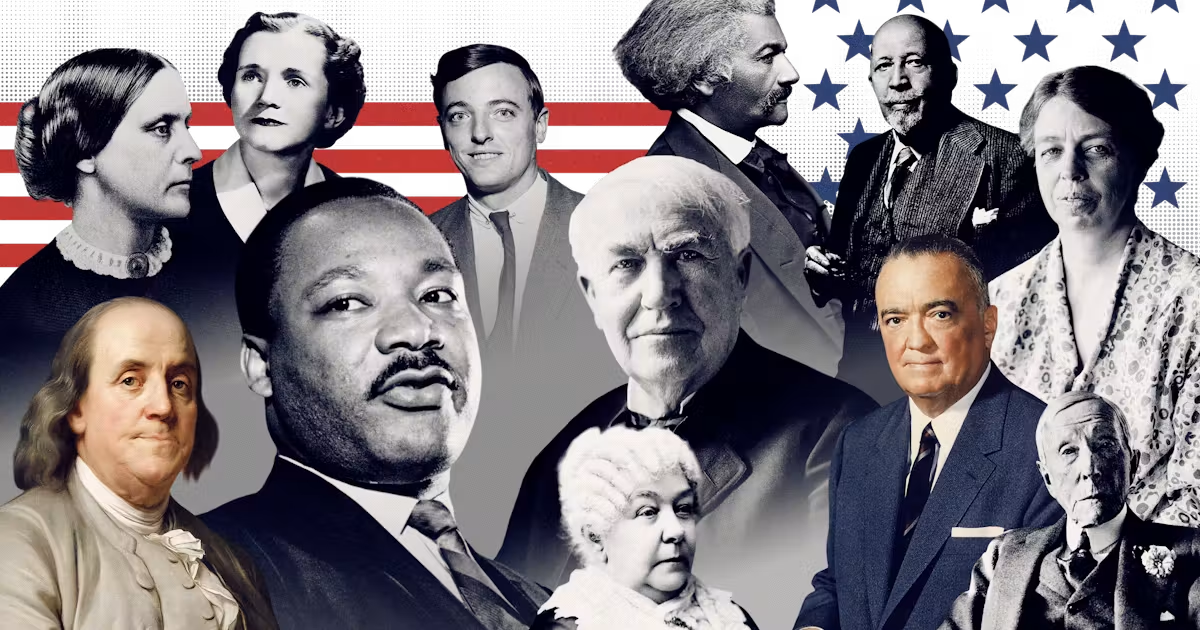
1. Martin Luther King Jr.In 1955, few had heard of him yet. A mere eight years later, he was moving mountains.2. Frederick DouglassBorn into bondage, he was King’s nineteenth-century precursor and the country’s conscience during the Civil War and after.3. Eleanor RooseveltA first lady of many firsts (first to write a newspaper column, first to speak to a national convention), she also went on to a nearly two-decade career vigorously promoting both human rights abroad and reform politics at home.4. Susan B. AnthonyShe was decades ahead of her time in arguing and agitating for women’s suffrage. But she was equally committed to abolitionism.T-5. W.E.B. Du BoisHis The Souls of Black Folk (1903), with its argument about “the color line” in American society, had a seismic impact. He helped found the NAACP but became disillusioned over time, finally moving to Kwame Nkrumah’s Ghana.T-5. J. Edgar HooverNot our favorite, but hard to deny his importance over five decades of American life. He intimidated presidents and hounded movements. But contrary to legend, he was apparently not a cross-dresser.7. Henry FordThe good: He famously paid his employees enough that they could buy the cars they themselves made. The bad: The Dearborn Independent, his virulently antisemitic newspaper.T-8. William F. Buckley Jr.Erudite, supremely self-confident, full of charm, capable of making and keeping liberal friends. But it’s hard to forget his support for segregation and later suggestion that gay men with aids be tattooed.T-8. Thomas EdisonThe light bulb, the phonograph, the motion picture camera. And those three just scratch the surface. His West Orange, New Jersey, laboratory contained “eight thousand kinds of chemicals, every kind of screw made, every size of needle,” and a hell of a lot else.T-8. Elizabeth Cady StantonThe lead organizer of the important suffragist Seneca Falls Convention of 1848 and the co-founder (with Anthony) of the National Woman Suffrage Association. She was also, like Anthony, a fierce abolitionist.T-11. Rachel CarsonShe wrote a 1951 bestseller about the ocean that won a National Book Award, but nothing touched the impact of 1962’s Silent Spring, one of the most influential books of the century. She died of breast cancer just 16 months later.T-11. John Marshall*He wasn’t the first chief justice; he was the fourth. But for good and for ill, Marshall is the one who made the court the final word on U.S. legislation and law.T-11. John D. RockefellerRockefeller’s Standard Oil gobbled up smaller and weaker competitors like bats eat mosquitoes, ending up with around 90 percent of refined oil in the United States. On the plus side, he did leave us the University of Chicago.14. Benjamin Franklin*Everyone knows about the famous kite experiment. But did you know he invented swim fins? When he was just 11 years old?* Franklin and Marshall served in elected legislative office but are far better known for their accomplishments outside that realm.
The Most Important Public Figures Who Never Held Elected Office
These 14 Americans wielded their influence from outside the legislative halls of power
472 words~2 min read