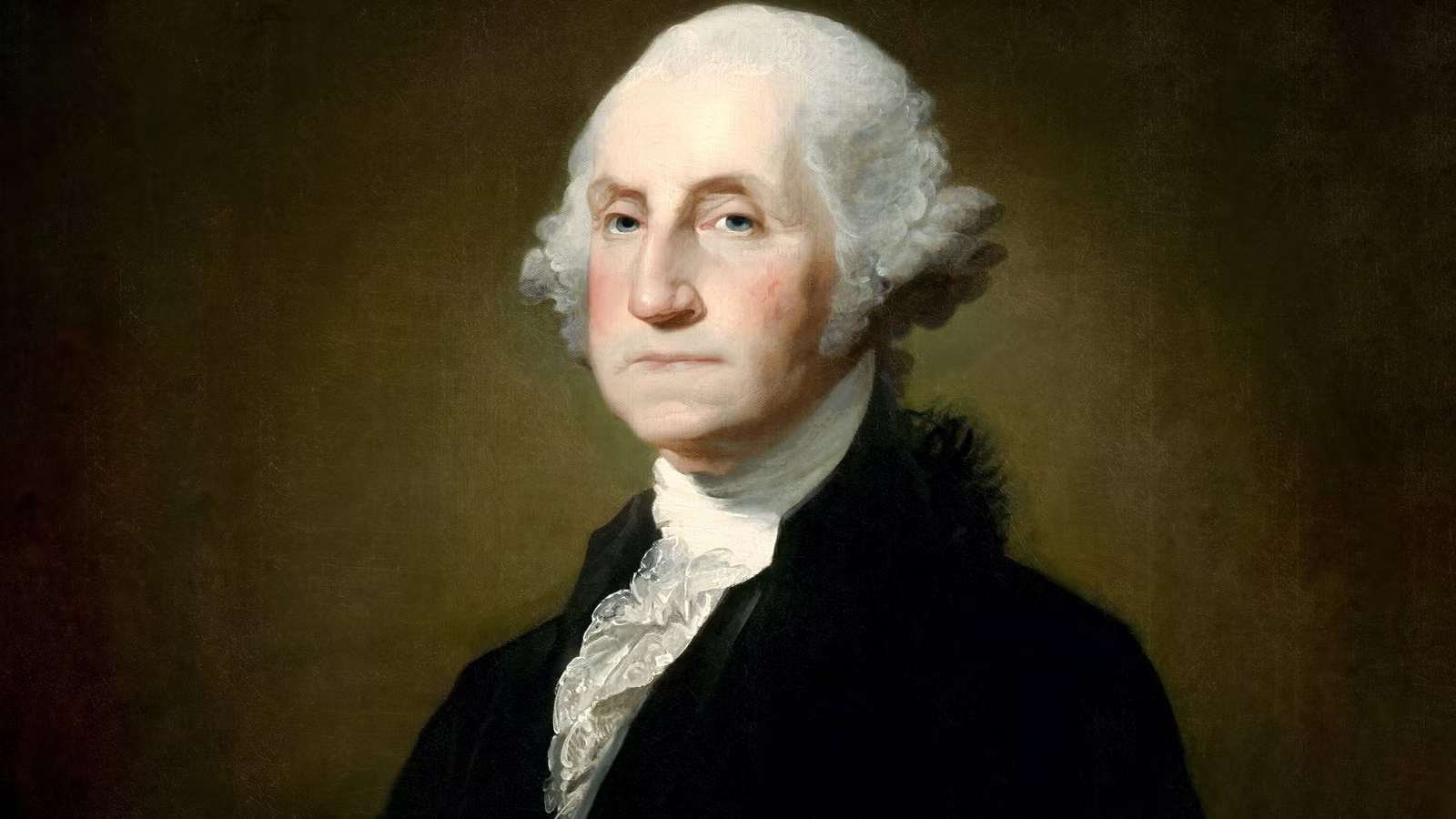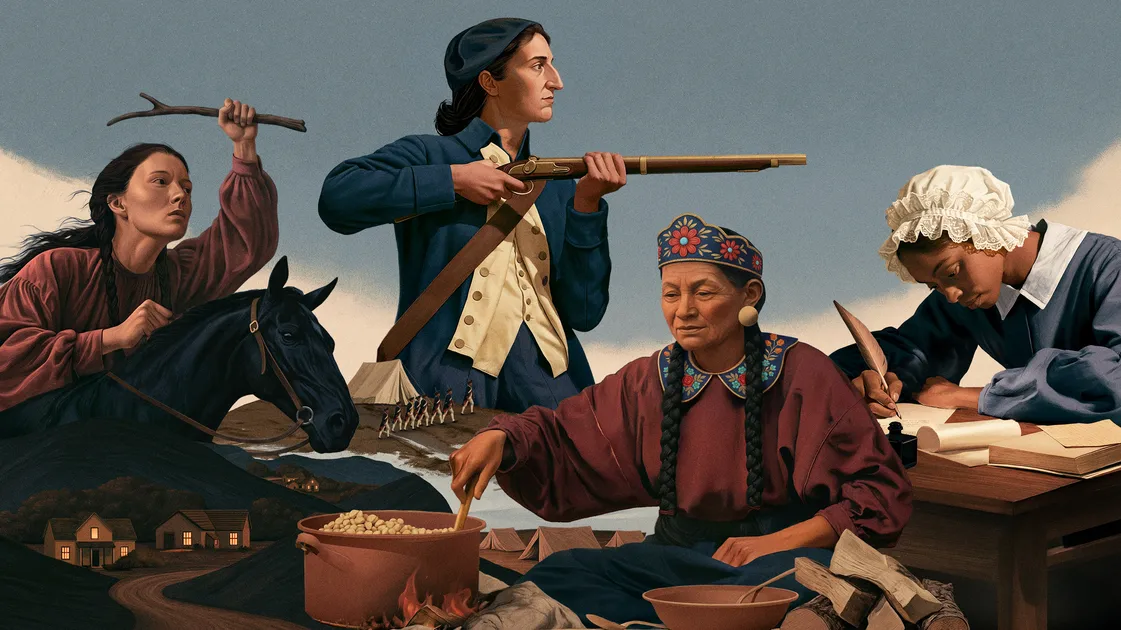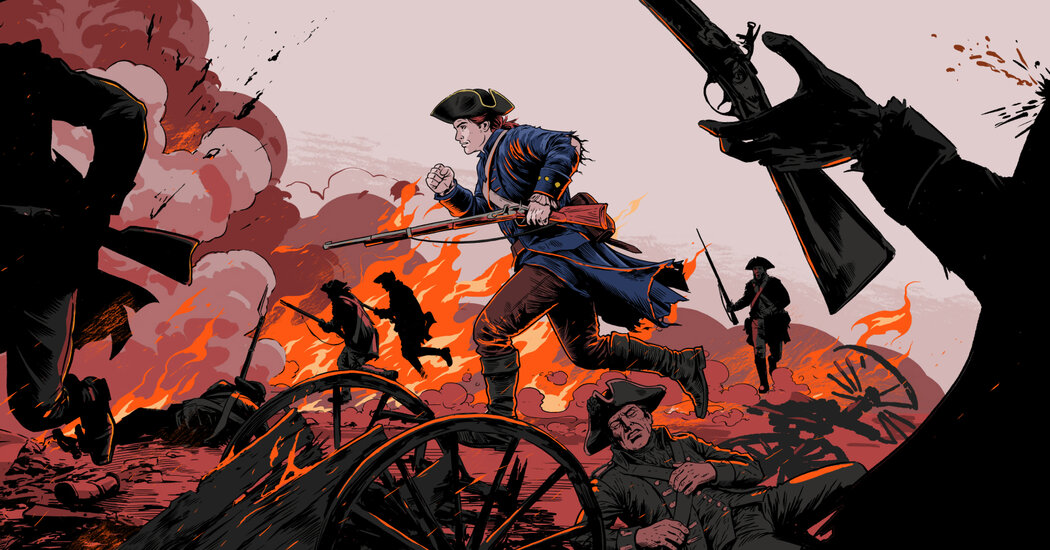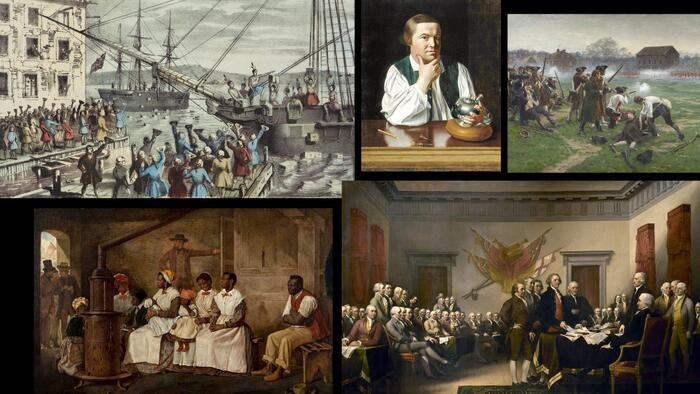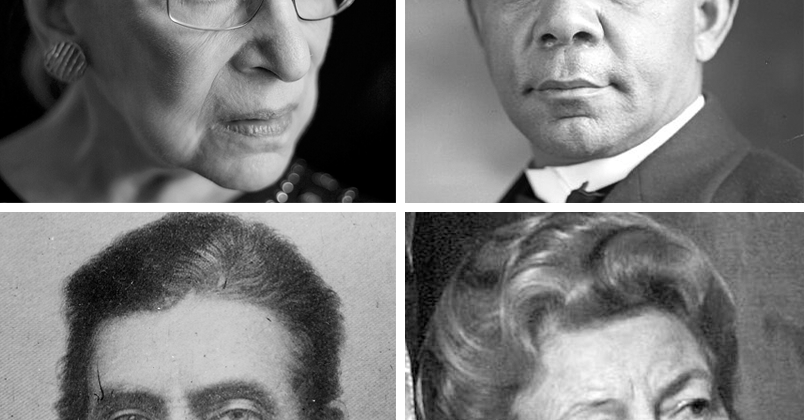
The Minuteman statue in Concord, Mass. Detroit Publishing Company Photograph Collection, via Library of Congress By The New York Times June 19, 2026 To study the history of the United States means confronting that its larger-than-life figures are measured not only against the era in which they lived, but also in the unrelenting, ever-fluid march of time. New information crops up. Fresh moral concerns rise. Contemporary politics shape how we understand yesteryear’s conflicts.Many of the country’s rolling debates have centered on the legacies of its founding fathers like Thomas Jefferson and George Washington, who were slaveholders. Or presidents like Woodrow Wilson, who led the country through World War I and established the League of Nations, but supported racial segregation.Just this year, a New York Times investigation found substantial evidence that the Latino civil rights icon Cesar Chavez had sexually abused young teenage girls for decades. Many of his memorials came down.And since returning to office, President Trump’s administration has moved forcefully to advance its triumphant interpretation of American history.As America celebrates its 250th anniversary, The Times consulted scholars across the country to identify historical figures who shaped the United States — and whose legacies remain debated, a demonstration of how unsettled American history can be. Historians spoke of people who made undeniable contributions in their time, but whose work pointed to the country’s intractable debates over race, gender and political violence.The historical figures below cannot alone tell the story of the United States, but together, they help show how the fight over the country’s narrative has played out over generations — and how that fight continues.David W. Blight, a Yale history professor, said that wrestling over history has long been part of the country’s story: “America is and always has been an argument — it’s an experiment.” Circa 1775 The Minuteman By Jennifer Schuessler The Minuteman statue in Concord, Mass. Detroit Publishing Company Photograph Collection, via Library of Congress On April 19, 1775, just as Paul Revere warned, the British redcoats arrived in Lexington, Mass., leading to a skirmish that left eight dead on the town green. Next, they swept on to Concord, where local militia and specially trained “minutemen” fired what is said to be the first authorized volley of resistance — the famous “shot heard round the world.” Today, a memorial to that battle stands near Concord’s Old North Bridge, showing a nameless minuteman dropping his plow and picking up a musket.That mythical image has appeared on coins, postage stamps, savings bonds, sports logos and, since the 1950s, the official seal of the National Guard. But as the United States cemented its status as a global power, the minuteman also stood at the center of an enduring debate: When does government become tyranny? And when are citizens justified in firing back?In the Cold War, the idea of the flinty citizen soldier, peacefully tending his field but ready to pick up a weapon at a moment’s notice, was invoked in the struggle against the Soviet Union. In 1958, the Eisenhower administration authorized the Minuteman missile program, which grew into an archipelago of intercontinental missiles buried deep underground on Great Plains missile “farms,” ready to respond to a Soviet strike.At the same time, the minuteman figure was claimed by the emerging right-wing militia movement, which cast the U.S. government as tipping into despotism.In the early 1960s, some Midwestern hunters founded the Minutemen, a loosely organized armed group with chapters across the country that raised the possibility of “guerrilla war” against the U.S. government, which it accused of surrendering to “the forces of international Communism.” Another group, the Paul Revere Associated Yeoman, or PRAY, urged “all patriots and conservatives” to arm themselves against “liberals and Reds” who wanted to steal the 1964 election.Those groups, and more recent successors, drew on strains of conspiracy theory-minded thinking that go back to the American Revolution, when many colonists believed that a corrupt British elite was plotting to strip them of their traditional liberties. But scholars have emphasized that the original minutemen were rooted less in individualistic love of liberty than in the densely communal world of 1770s Massachusetts.In his classic book “The Minutemen and Their World,” the historian Robert A. Gross showed that Concord, compared with neighboring towns, was in fact slow to turn to the Patriot cause. And the militiamen were a highly trained force, created by a well-organized local government.The classic image in Concord’s Minuteman monument “is a wonderful symbol of the fighting man as a civilian,” Dr. Gross said in an interview. “But it’s also a myth that is detached from social context and political organization.” 1860-1936 Charles Curtis By Mitch Smith Harris & Ewing Photograph Collection, via Library of Congress When Kamala Harris was sworn in as vice president in 2021, some news outlets said she was the first person of color to hold that office. They were wrong. Nearly a century earlier, Curtis, who was of white and Native ancestry, served as vice president to President Herbert Hoover. Famous in his day, Curtis mostly faded from public consciousness in the decades that followed. That obscurity — even in an age when identity and “firsts” have come to be celebrated — is in no small part because his legacy is hard to embrace for many Native Americans.He was a man of consequence and contradiction. In an era when Washington was almost monolithically white, Curtis ascended to the vice presidency without forsaking his Indigenous heritage, even as he advanced policies that have aged poorly in the eyes of many Native Americans.Born before Kansas became a state, he lived with his grandmother on a Kaw reservation as a young child. After leaving the reservation, he became a lawyer, rose through the ranks of Republican politics and served in Congress before becoming vice president.In his office, he kept “Indian mementos and highly colored pictures of famous Indian chiefs,” The New York Times reported. He also remained on the tribal rolls as a Kaw member even when it was used against him by political opponents, and supported the law that granted citizenship to all Native Americans born in the United States.But Curtis, many scholars agree, also bears some responsibility for the decline of Native cultures, as he promoted assimilationist policies that many Native Americans today regard as having been deeply harmful. He was even the namesake of the Curtis Act, which weakened tribal governments and privatized ownership of many Native lands.Kiara M. Vigil, an Amherst College professor who is Dakota and Apache, summed it up this way in an article for the American Historical Association: “A man who sometimes voted against the best interests of his fellow Indians also achieved a great deal at a time when the odds were against him.” 1800-1859 John Brown By Mitch Smith National Archives and Records Administration At the Kansas Capitol, Brown is immortalized, clutching a rifle, in a larger-than-life mural. Places where he stayed have been turned into historic sites in three states. He has been called a “hero,” “fanatic” and “zealot” — with dismissiveness, reverence or some combination — for his willingness to kill supporters of slavery. How do we take measure of his devotion to the antislavery cause, for his campaign of violence against an institution that itself was murderous and profoundly inhumane?That question has followed Brown since the 1850s, in the buildup to the Civil War, as pro- and anti-slavery settlers flooded into Kansas. Both sides believed Kansas could set the course for the country’s future.After Brown and some of his allies raided the homes of slavery supporters and killed five of them in 1856, more bloodshed followed. Pro-slavery mobs sacked and burned Kansas towns. “Bleeding Kansas” entered the national conscience.Brown escaped death in Kansas, but he found it in Virginia, where he led a raid on the armory at Harpers Ferry. He hoped the raid, in what is now part of West Virginia, would inspire enslaved people to take up arms against slaveholders. But no uprising materialized. Brown, badly outmanned and outgunned, was arrested and executed.In the generations since, Americans have revisited Brown’s legacy. Henry David Thoreau called him an “angel of light.”After the 1995 Oklahoma City bombing, some asked whether Brown had been the country’s first domestic terrorist.And in 2009, on the 150th anniversary of his hanging, the historian David S. Reynolds called for Brown to be pardoned for his “heroic effort to free four million enslaved blacks.”That pardon never came. 1856-1915 By Clyde McGrady Harris & Ewing Photograph Collection, via Library of Congress There is something quintessentially American about Booker T. Washington’s rise to power. His message of self-improvement slots in nicely with what many believe about this country, that anyone can reap the rewards of meritocracy and even the deepest wounds can heal. Washington’s prescription went something like this: Black people, with the support of white America, should focus on industrial education and material progress within their own communities, thus creating the conditions for social and political equality — downplaying demands for full citizenship and the humiliation of Jim Crow racial segregation.Washington’s ideas have been revered on the right, championed by Black conservatives like the economist Thomas Sowell and Justice Clarence Thomas of the Supreme Court.Today, there are even Christian themed comic books featuring Washington’s vow to “permit no man to narrow and degrade my soul by making me hate him.”But Washington’s legacy is more contentious in other precincts.In the summer of 1895, when Southern racial terror lynchings were near an all-time high as the promise of Reconstruction was being dismantled, Washington delivered a speech that came to be known as the “Atlanta Compromise.”He chided Black Americans for intellectual pursuits. “No race can prosper till it learns that there is as much dignity in tilling a field as in writing a poem,” he said at Atlanta’s Cotton States and International Exposition.In his most famous analogy, he said that the races could “be as separate as the fingers, yet one as the hand in all things essential to mutual progress.”As Black people wept in the aisles, white women threw flowers at his feet and white dignitaries swarmed him, according to the historian David W. Blight’s “Race and Reunion.”Newspapers all over the country carried the address and a national star was born.Until that point, many Black leaders had refrained from publicly criticizing Washington, whom they admired. But they also resented his words.W.E.B. Du Bois, his most prominent critic, too supported reconciliation. But, he wrote, Washington’s “propaganda” gave the impression that “the South is justified in its present attitude toward the Negro because of the Negro’s degradation.”Today, the Supreme Court’s recent decisions gutting the Voting Rights Act and affirmative action, as well as the rise of white identity politics, are once again charging the debate about how Black politics should best be organized.In the past, periods of conservative dominance have created opportunities for Black people across the ideological spectrum to forge alliances with conservative forces. At the dawn of the 1980 Reagan Revolution, Black conservatives, including Mr. Sowell and Justice Thomas, more than a decade before his confirmation, gathered to discuss how Reaganism could work to the benefit of Black America.It’s not difficult, perhaps, to imagine a younger Washington-like figure emerging today to capture the country’s attention. 1867-1919 Madam C.J. Walker By Audra D.S. Burch Addison N. Scurlock/Michael Ochs Archives, via Getty Images Madam C.J. Walker was an early 20th-century African American entrepreneur whose products revolutionized Black hair care, even as she drew critics. Amid the harshness of Jim Crow, Walker accomplished what seemed impossible. She built a hair care empire, with thousands of Black female independent sales agents, helping many of them become financially self-reliant.She developed and sold shampoo and scalp ointment through her national network of “beauty culturalists.” By the time she died, Walker had become a philanthropist and self-made millionaire — the first woman, of any race, to earn the distinction in the United States, according to Guinness World Records.“She represented the possibilities in America,” said A’Leila Bundles, her great-great granddaughter and author of “On Her Own Ground: The Life and Times of Madam C.J. Walker.”The first child in her family born free after the Civil War, Walker’s remarkable journey falls in the rags-to-riches genre, but her legacy — viewed through a modern lens and within the evolving politics of Black hair — has been more complicated.In her lifetime and beyond, Walker was accused of promoting European beauty standards, by popularizing the use of hot combs, which uses heat to alter or straighten the texture of natural hair. Adding to the controversy, Walker was erroneously credited with inventing the hot comb. The critiques continued for decades, especially during the natural hair movement in the 1960s and ’70s.Walker defended her products and regimens as intended to improve hygiene, scalp health and hair growth. Without indoor plumbing, people then washed their hair infrequently, and scalp infections and balding were common.“Let me correct the erroneous impression held by some that I claim to straighten hair,” she said in a 1919 Dallas Express article, adding, “I have always held myself out as a hair culturist. I grow hair.”Walker was born Sarah Breedlove to formerly enslaved parents in 1867 in Delta, La. Over a period of 13 years, she was orphaned, married and widowed with a young daughter. She moved to St. Louis, where she worked as a washerwoman until she was 38 years old.There, Walker picked up tips from her brothers who were barbers. And she sold Black hair products for Annie Turnbo Malone, another pioneering Black businesswoman, before starting her line and eventually establishing three schools to train sales agents.In recent decades, new generations have discovered Walker. The U.S. Postal Service issued a commemorative stamp in 1998, she was the subject of a 2020 Netflix mini-series and Mattel later released a Barbie doll.Her legacy is now seen by some in a more flattering light, centered in part on women’s empowerment, said Erica Ball, author of “Madam C. J. Walker: The Making of an American Icon.”She said, “The amount of tenacity that she had, it’s impossible to overstate.” 1875-1948 D.W. Griffith By A.O. Scott Bettmann Collection, via Getty Images Near the end of Spike Lee’s “BlackKklansman,” set in the 1970s, rowdy white supremacists gather to watch D.W. Griffith’s “The Birth of a Nation,” the 1915 epic of the Civil War and the rise of the Ku Klux Klan. Lee, using a crosscutting technique pioneered by Griffith, shifts back and forth from that raucous screening to a more sober gathering, in which an elderly Black man (played by Harry Belafonte) recounts the lynching of a childhood friend to students and activists. The juxtaposition is a reminder that few movies in American history have been as consequential as “The Birth of a Nation.” Based on “The Clansman,” a novel by Thomas Dixon Jr., Griffith’s film spurred the revival of the Klan, which would exert its racist, anti-immigrant influence on American life and politics for decades to come.This film was not a fringe phenomenon. The movie, more than three hours long, was what we would now call a blockbuster, earning $60 million in its first year by some estimates. President Woodrow Wilson hosted a White House screening.Modern cinema had found a heroic origin story. When Griffith died in 1948, the film critic James Agee, writing in The Nation, wrote that “to watch his work is like being witness to the beginning of melody; or the first conscious use of the lever or the wheel; the emergence, coordination, and first eloquence of language; the birth of an art.”Generations of cinephiles promoted a version of Agee’s catechism, consecrating Griffith as film’s supreme technical and aesthetic innovator, an almost Promethean figure. Though he made other films before and after — including the tender “Broken Blossoms” and the bloated “Intolerance” — “Birth” has remained the cornerstone of his reputation.Its incendiary view of U.S. history was hardly ignored. As the revived Klan took inspiration, the N.A.A.C.P. and other civil rights groups organized protests and boycotts, which Griffith complained were an attack on his freedom of speech. Agee, clutching at straws, declared the accusations of racism “unjust,” but there is nothing subtle about the film’s fantasies of Black depravity or its celebration of white violence. And “Birth” remained in the canon as a kind of aesthetic test case, to be admired for its form even as it was (mostly) reviled for its content.Sometimes the ideological passions that impelled a work into existence dissolve over time, leaving behind something that can be appreciated as art. This has not been the fate of “The Birth of a Nation.” If anything, it’s the opposite.The breakthroughs of early cinema that had seemed to Agee and others to be “the work of one man” are now understood as the products of an emerging system of inspired collaboration and constant experimentation. Griffith’s own work looks stiff and sentimental, weighed down with melodrama and grandiosity that may have seemed dated even in 1915. Other filmmakers from that era — including Charlie Chaplin, Alice Guy Blaché and Lois Weber — feel modern in a way he never does.Time has worn away the importance of the art. What remains — what seems, alas, less obsolete — is the hate. 1924-2016 Phyllis Schlafly By Vivian Yee Stephen Crowley/The New York Times Schlafly presented an unapologetic vision of family values that resonates with many Americans to this day. When Donald J. Trump eulogized Schlafly at her funeral in September 2016, he cast both himself and her as underdogs — perhaps reasonably. Mr. Trump looked like the most long shot presidential nominee in living memory. Schlafly, who gave him a rare early endorsement, had in the 1970s slayed the Equal Rights Amendment, which sought to give women equality under the Constitution — a seeming shoo-in, until she got involved. By 2016, much of American life had turned nightmarish for someone like her.Gay marriage: widely accepted. Abortion: legalized. Gender-neutral bathrooms: commonplace on many campuses. Many women no longer measured their success in marriage and children, but in financial independence and personal fulfillment.These days, though, her arguments ring anew in our ears, as a new generation of conservative women challenges feminism’s gains.Today, anti-feminists hold powerful roles in Washington. Social media has gone frilly with tradwives. Their reasoning echoes Schlafly’s: Homemakers enjoy special status, protected and provided for by their husbands. Why give it up?Decades before battles erupted over unisex bathrooms for transgender people, Schafly warned that the Equal Rights Amendment would spawn co-ed bathrooms. Long before “America First” and “stop the steal,” the ultra-isolationist Schlafly accused shadowy “kingmakers” of conspiring to nominate “America Last” candidates for president. She tarred feminists as radicals, just as her heirs do now.To combat the E.R.A., abortion and gay rights, she mobilized formerly apolitical evangelical Christians, helping to build the coalition of religious conservatives that propelled Ronald Reagan to victory and eventually ousted social moderates from the Republican Party.The political divisions that defined those 1970s debates “only got more pronounced over the years,” leading to today’s hyper-polarization, said Marjorie J. Spruill, the author of “Divided We Stand.” “And Schlafly’s tone had a lot to do with it.”Schlafly’s victories came wreathed in paradoxes: She presented herself as a model wife and mother, breastfeeding all six of her children, yet she had resources (her husband, a lawyer, came from wealth) and a housekeeper that allowed her to run political campaigns and churn out books, newsletters and commentary. While exalting homemaking, she lobbied (unsuccessfully) for a top post in the Reagan administration.Calmly, she deflected accusations of hypocrisy, saying that she had raised her children before embracing what she called her “hobby” — politics. Career and homemaking, she said, came “at different times in my life.”Feminists never tire of leveling similar charges today, against women like Erika Kirk, the conservative activist who now leads the influential organization started by her late husband, Charlie Kirk; and Katie Miller, the prominent Republican political operative who promotes motherhood as women’s highest calling.Yet many young women are veering further left, and their conservative peers aren’t necessarily sticking to homemaking, either. At a recent Turning Point USA conference for conservative young women, several speakers openly discussed balancing family with high-powered careers. You could see Schlafly’s influence. You could also see feminism’s. 1933-2020 Ruth Bader Ginsburg By Jeremy W. Peters Todd Heisler/The New York Times Ruth Bader Ginsburg had attained folk hero status as the notorious R.B.G. for her lifetime of legal work dismantling gender bias in the law. But her decision not to retire has put an asterisk on her legacy. As a young woman just out of law school, Ruth Bader Ginsburg found that no New York law firms would hire her. The federal government revoked a job offer after learning she was pregnant. The Supreme Court turned her down for a clerkship.Ginsburg, as a civil rights lawyer and an associate justice of the Supreme Court, helped convince the courts to dismantle the legal and societal structures that had kept this two-tiered system in place.But after President Barack Obama indirectly broached the possibility of her retirement during lunch with her in 2013, she demurred. That choice became a cautionary tale for Democrats who argue that too many of the old guard have selfishly refused to pass the baton to the younger generation.Justice Ginsburg’s defenders say it is unfair to lay the court’s rightward shift at her feet. By the time she died in September 2020, they say, the court had already grown more conservative with the arrival of two Trump appointees, Neil M. Gorsuch and Brett M. Kavanaugh. The third, Amy Coney Barrett, replaced Justice Ginsburg in October 2020, and all three voted two years later to overturn Roe v. Wade in a case decided by 6-to-3.Her supporters argue that Justice Ginsburg would have had to retire before 2015 — when Democrats controlled the Senate — for a reliable assurance that a like-minded replacement would have been confirmed.There was also the widely held expectation that Hillary Clinton would win the White House in 2016, not Donald J. Trump.Nadine Epstein, a journalist and admirer of the justice, wrote an essay whose title captures the debate over her legacy: “Why You Should Stop Being Angry at R.B.G.”“I am quite sure,” she wrote, “that had Justice Ginsburg known the unexpected twist that history would take, she would have responded to Obama’s inquiry differently.”Ms. Epstein added, “A lot of us can say that about a lot of things.”
Ruth Bader Ginsburg, Booker T. Washington and 6 Other Americans Who Shaped U.S. History
As America celebrates its 250th anniversary, The Times consulted scholars across the country to identify historical figures who influenced the United States — and whose legacies remain debated.
3,724 words~17 min read