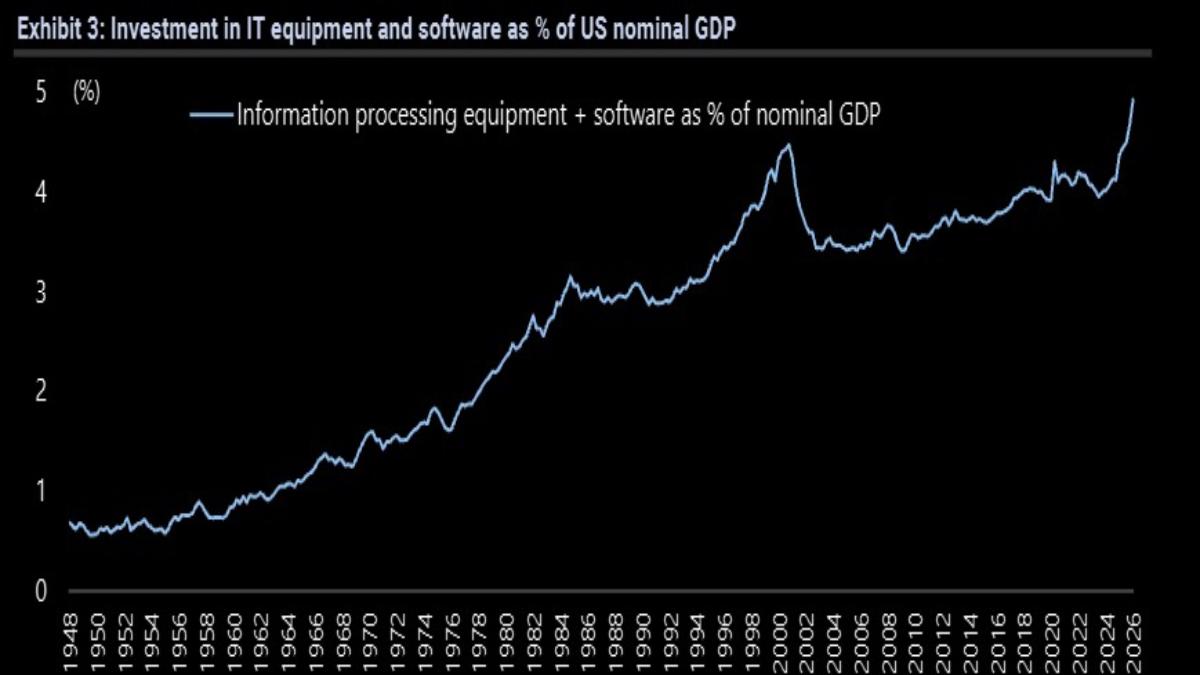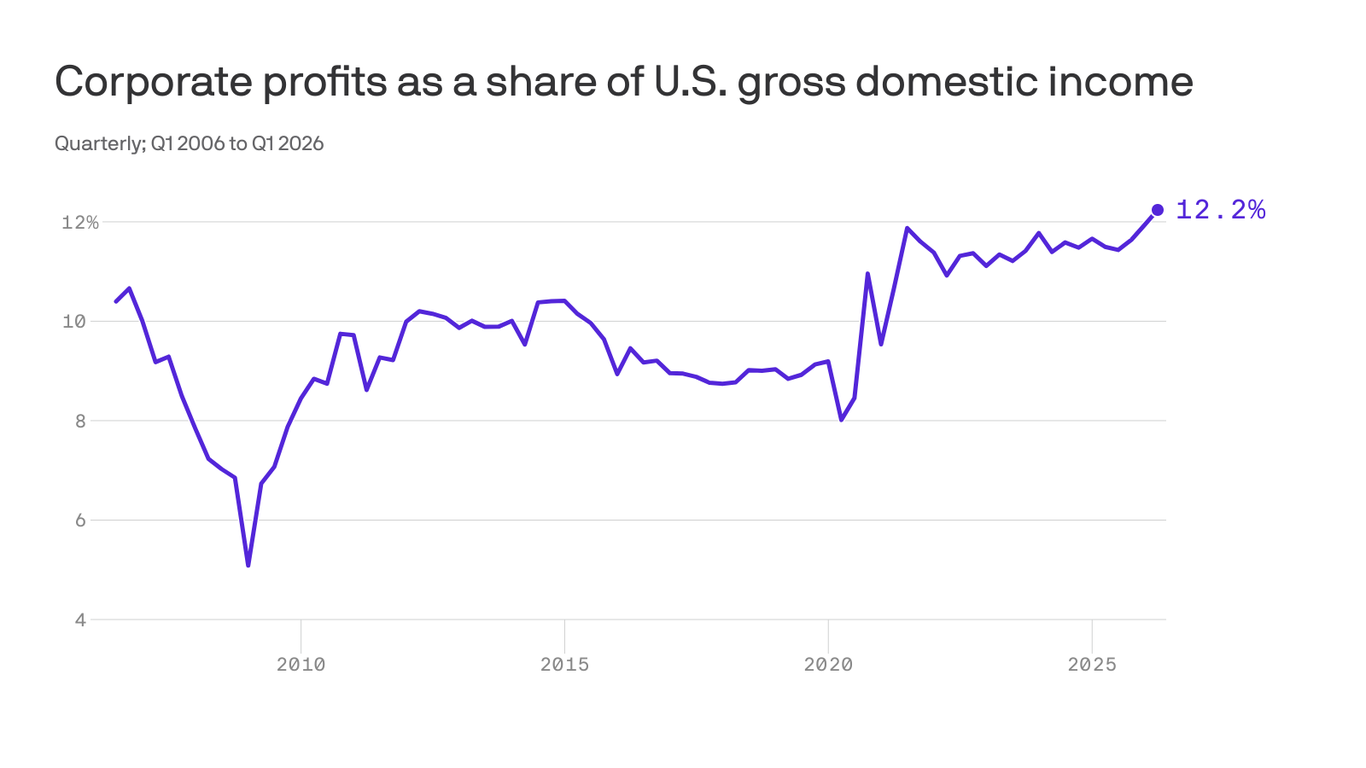
For the better part of the last quarter century, the Global 2000—Forbes’ annual ranking of the world’s largest public companies based on sales, profits, assets and market value—has been a story about globalization’s steady march. Year after year, the world’s largest corporations have largely sold more goods, earned more money, accumulated more assets and built more market value as capital, manufacturing and consumers moved more freely across borders. Despite the headwinds, ranging from President Trump’s trade war, conflict in the Middle East, rising energy prices and sustained inflationary pressure, the global growth story is intact. This year’s Global 2000, the 24th annual edition, reached records in all four categories of combined sales, profits, assets and market value, reflecting the durability of the multinationals that sit at the center of the global economy. The world’s bellwether companies recorded a combined $56 trillion in annual sales (up 6% from last year’s record), $5.5 trillion in profits (+13.9%), and $272 trillion in assets (+12.9%). Most stunning of all, the combined market value of the Global 2000 jumped a whopping 31.8% from last year’s record, adding more than $30 trillion in shareholder value.While the list is still dominated by banks with balance-sheet heft, this year’s movement was driven by AI-linked market value. Hardware and computer equipment providers, semiconductor companies, and software firms (which include hyperscaling giants like Microsoft and Meta) now account for over 10% of the list, or 209 companies, up from 186 last year. The combined market value of these firms has nearly doubled from $23.9 trillion to $41.4 trillion, accounting for more than half (57%) of the list’s net market value increase from last year. To put it plainly: Investor exuberance over AI is driving much of the earnings and valuation growth across global markets. This euphoria has sparked fears of an AI bubble that is elevating stock portfolios and 401(k)s alike. Still, many in the business community believe the AI bull market still has fresh legs. Listen to Richard Attias, chairman of the non-profit Future Investment Institute: “AI is not just a technology: AI is a mindset. AI is a new language. AI will be part of our day-to-day life and businesses,” he remarked earlier this month ahead of Forbes’ annual Iconoclast Summit in New York. “AI will have an impact everywhere.” The biggest AI winners show how broad this trade trade has become. In semiconductors, Nvidia climbed 20 spots to No. 27 and became the most valuable chip company on the list, while South Korea’s SK Hynix, whose high-bandwidth memory chips are essential to AI servers, jumped 107 spots to No. 48. Hardware names also surged, with Taiwan’s Hon Hai Precision, the iPhone assembler and AI server manufacturer better known as Foxconn, climbing 55 spots to No. 82, and SanDisk, the California-based flash-storage company, entering at No. 614 after ranking outside the top 2,000 last year. On the software and cloud side, Alphabet – one of the largest AI hyperscalers – rose five spots to No. 4. CoreWeave, the AI cloud computing firm, climbed 706 spots to No. 1,093 after joining the list last year. The AI trade has also lifted parts of the materials industry, which gained from the more physical side of the chip cycle. Materials companies on the Global 2000 rose 67.5% in market value and increased profits 38.6%, as investors rewarded producers tied to copper, cobalt, lithium, chemicals and other inputs needed for semiconductors, advanced manufacturing, power systems and data centers. British-Australian mining giant Rio Tinto climbed 24 spots to No. 111 after striking a two-year collaboration with Amazon Web Services to put copper made with its Nuton bioleaching technology into AWS’s U.S. data centers. Nucor, the Charlotte, NC-based steel manufacturer, rose 84 spots to No. 416, thanks in large part to demand from data centers for its pre-engineered, plug-and-play steel products (think the huge racks that hold all those computer servers).Speaking of data centers, the construction companies wiring, cooling and building those mammoth facilities are doing just fine. Since last year, the construction industry’s total market value rose 30.7%, while profits jumped 46.4%. One firm thriving in the data center boom is Houston-based Comfort Systems USA, which climbed 698 spots to No. 93. The mechanical contractor says it is seeing “unprecedented demand” from data centers and chip manufacturers, which now account for over half of the company’s $10 billion (annual revenues) business. Another example: Vertiv Holdings, which jumped 353 spots to No. 821. The Westerville, Ohio-based company, which makes the electrical and cooling systems for AI data centers, said its order backlog had more than doubled to $15 billion at the end of 2025 and has also become a key NVIDIA infrastructure partner, helping design the power and cooling systems for what NVIDIA calls “AI factories”—next-generation data centers built to train and run advanced AI models.Even amid the AI boom, banks still dominate the Global 2000 by count and assets. JPMorganChase is No. 1 for the fourth year in a row. As America’s largest bank, with $4.9 trillion in assets, it remains the company that best balances all four components of the ranking. There are 314 banks on this year’s list, more than any other industry, and together they account for $140.4 trillion in assets, more than half the total for all 2,000 companies. Another 136 diversified financial firms made the cut, along with 113 insurers. The reason is built into the ranking: banks and insurers carry enormous balance sheets, while many technology firms are lighter on assets and therefore do not get as much credit for that metric. Elevated interest rates helped, too, allowing banks, insurers and other lenders to earn more profits on loans and fixed-income assets.The list’s top 10 is a snapshot of a changing corporate order. JPMorganChase holds the No. 1 spot, helped by its $4.9 trillion balance sheet, while Amazon rose to No. 2 on the strength of $742.8 billion in sales and a market value of $2.8 trillion. Alphabet climbed to No. 4 and Microsoft tied for No. 7 as investors continued to prize the companies building the software, cloud infrastructure and AI platforms behind the current tech rally. Berkshire Hathaway, Saudi Aramco and Bank of America remain in the top tier because of their profits, assets and cash-generating heft, while three giant Chinese banks—ICBC, China Construction Bank and Agricultural Bank of China—round out the top 10, a legacy of the Chinese banking dominance that defined the list a decade ago. Bank of America is the only company from the original 2003 top 10 still there today. Elsewhere on the Global 2000, substantial gains were made by aerospace and defense companies, which increased profits by 78.5% amid continued conflict in the Middle East and growing government budgets for defense spending. Safran, which makes jet engines and aircraft systems, climbed 398 spots to No. 211; Boeing, the aircraft and defense manufacturer, rose 289 spots to No. 160; and Rolls-Royce, a jet-engine and propulsion specialist, gained 67 spots to No. 263. In terms of geographic breakdown, the United States remains first by a wide margin, with 593 companies headquartered here, though that is down from 612 last year. China has 300 companies, and Hong Kong adds another 40, bringing the Greater China total to 340. Japan ranks third with 179 companies, followed by the United Kingdom with 67, South Korea with 66, and Canada and India with 64 each. The U.S. still dominates by market value, accounting for about $67.9 trillion, more than half the total value of all companies on the list.The Global 2000 remains a monument to the old economy as much as the new one. Banks still carry the most assets, oil companies still generate enormous cash flow and retailers still dominate by sales. The biggest change over the last year was not in what the world’s largest companies sold, but what investors decided they were worth. In 2026, they decided the future belonged to artificial intelligence—and especially to the companies making the chips, servers, memory and infrastructure needed to run it. Only time will tell whether those investors were prescient. More from ForbesForbesThe World’s Largest Tech Companies: Memory Chips Skyrocket Amid AI Data Center BuildoutBy Rashi ShrivastavaForbesThe World's Largest Banks And Financial Firms 2026: JPMorgan's Reign ContinuesBy Brandon KochkodinForbesAmid 2026 Energy Chaos, Oil And Gas Giants ProsperBy Christopher Helman
Inside The Global 2000: AI Has Rewritten The World’s Corporate Scoreboard
The world’s largest public companies are still getting bigger, thanks in no small part to the AI boom.
1,383 words~6 min read