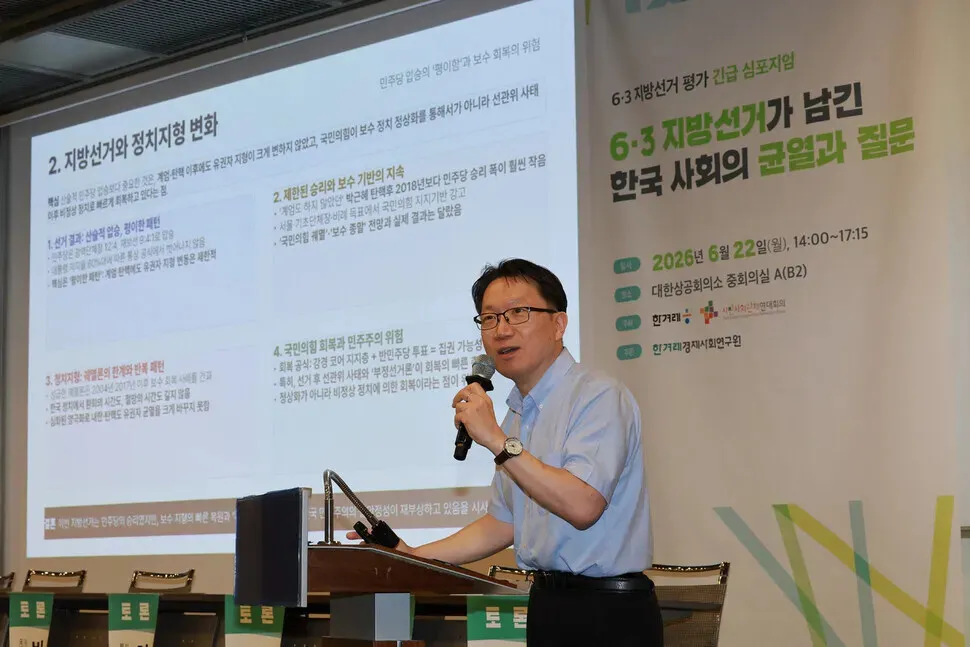
Shin Jin-wook, a professor of sociology at Chung-Ang University, presents at a symposium on questions raised by the June 3 local elections and the social unrest they had provoked, held on June 22, 2026, at the Korean Chamber of Commerce and Industry in Seoul. (Jung Yong-il/Hankyoreh)
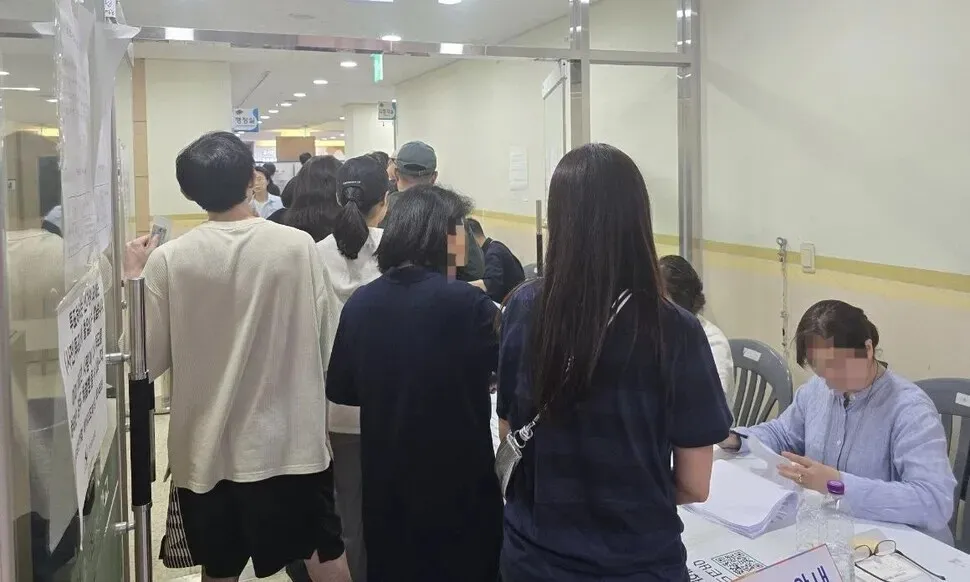
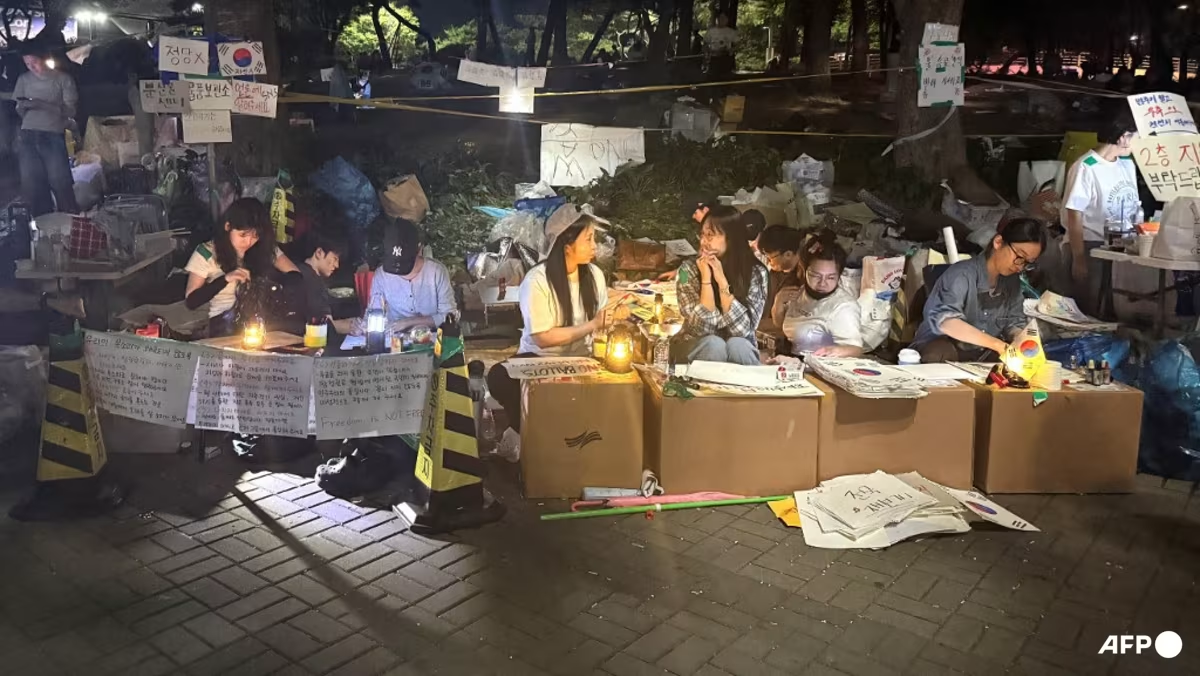
The shortage of ballots at sites around Korea during the local elections on June 3 has “wrecked confidence in our elections and triggered a crisis of democracy,” one analyst said.Shin Jin-wook, a sociology professor at Chung-Ang University, advanced this argument during his presentation at a symposium organized by the Hankyoreh and the Civil Society Organizations Network in Korea to examine questions raised by the June 3 local elections and the social unrest they had provoked. The symposium was held on Monday at the Korea Chamber of Commerce and Industry in downtown Seoul.“The collapse of confidence in the fairness of elections and in the legitimacy of the outcome undermines governance and public compliance with the exercise of lawful authority,” Shin said, referring to the ballot shortage.“The central issue is not how many people were disenfranchised, but rather that the incident has shaken people’s trust in the state’s capacity to properly carry out important duties,” he went on.“What we needed to happen is either for the PPP to change [of its own accord] or for the Democratic Party to win by a landslide [in the June 3 local elections], which would have empowered reformers who want the PPP to change, but neither of those things happened. Even after martial law and impeachment, the electoral landscape hasn’t changed significantly, and the PPP has been rapidly reverting to abnormal politics following the NEC incident,” the professor said.The People Power Party, or PPP, is Korea’s main opposition party. The National Election Commission, or NEC, is an independent constitutional body that oversees Korea’s elections and was responsible for the disastrous shortage of ballots in the recent election.“Considering that a social consensus has not yet crystallized around the nature of the martial law incident in December 2024, the NEC incident has fueled conspiracy theories about election fraud that justify the insurrection, aggravating the constitutional crisis,” Shin said.The sociologist mentioned social media posts asserting that “Yoon Suk-yeol was right” and “I’m finally enlightened” as evidence that “the NEC incident is fueling attempts to justify the martial law incident.”Rep. Kim Young-bae of the Democratic Party and Rep. Park Jeong-ha of the PPP, who represented Korea’s two major parties in a debate held as part of the symposium, argued that both parties had failed in the local elections.“We relied on President Lee’s high approval rating without offering a vision or platform for our party,” Kim said.“Our leadership’s blinkered defiance of public sentiment was the cause of our defeat,” Park concluded.“We’ve really got to build a democracy where voters have [meaningful] choices. We’ve got to fix this situation where the two major parties are crowding out local politics,” said Seo Bokyeung, head of The Possibility Lab, who made a presentation during the symposium.By Jeong Hye-min, staff reporterPlease direct questions or comments to [english@hani.co.kr]