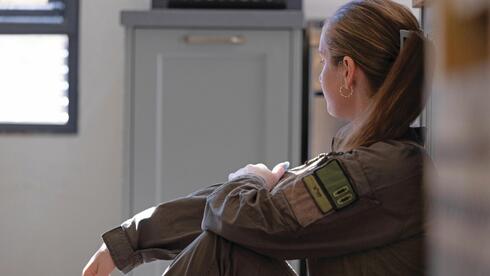
Lt. S., a former professional ballet dancer who gave up a career abroad to enlist in the IDF, was injured when a drone struck her vehicle during operations in southern Lebanon, leaving her with shrapnel injuries and long-term medical complicationsDina Haluts|In the early morning hours this past May, Lt. S., 24, commander of a Technology and Maintenance platoon in the Givati Reconnaissance Unit, crossed the Lebanese border. The mission was to repair a disabled Namer armored personnel carrier deep inside the field together with her noncommissioned officer.“They needed it urgently in order to launch an attack,” she recalls. “On the way, we linked up with one of the fighters who escorted us to the disabled vehicle.”GalleryLt. S. (Photo: Nimrod Glickman)Suddenly, the NCO spotted an explosive drone that had locked onto them and was approaching quickly. “When he was already standing on the Namer’s ramp, he suddenly said to me: ‘That drone is not ours.’ In a second, he came to his senses, pushed me inside the Namer and jumped in after me at the last moment. We had not yet managed to close the ramp from the inside when the drone penetrated the Namer and exploded right next to us. A lot of shrapnel flew at us. I was hit mainly in the face and head, and he was hit mainly in the legs. We shouted to each other to see that we were alive, and then he dragged me out and we ran toward one of the combat companies. They had already heard the explosion and linked up with us. The paramedic gave us initial treatment while my whole face was covered in blood.”S. was evacuated by helicopter to Ichilov Hospital with blast injuries, damage to her eardrum and many pieces of shrapnel in her face, two of them very close to both her eyes. She was taken immediately into surgery and later underwent another operation, but doctors were unable to remove all the shrapnel. She will have to live with some of it for the rest of her life without knowing what the consequences may be. A plastic surgeon also took part in the operation to prevent facial scarring as much as possible.“The way I looked was frightening, but in the end I am glad I took the shrapnel where I did and not in more strategic places, because I could have lost one eye, maybe both,” she says. “There was a lot of luck in this injury. If the NCO had not noticed the drone coming, we would have been in a completely different situation.”A day before she was wounded, her parents had flown to Cyprus for a vacation and received the news there. “The doctor asked me whom to call, and I would not let her call my grandparents or my sister. I was afraid they would panic,” she says. “I told her to notify only my parents, even though they were abroad. She called my mother and there was no answer, so she said I should call myself so she could hear my voice. I called and she did not answer me either, but after a few minutes she called me back on FaceTime. She wanted me to see the sea and said, ‘Turn on the camera,’ but I did not want her to see me like that. I told her I had been wounded and looked a little scary, but I was all right. She got frightened and insisted that I turn on the video, so I asked the doctor to clean my face as much as possible. Even though I still looked frightening, it calmed them down.”S. was hospitalized for a month at Ichilov and was later released home. The scars are barely visible, but she has ringing in her ears and hearing loss, and she cannot open her mouth fully because of a piece of shrapnel lodged in the muscle responsible for opening the jaw.“Let’s say I still cannot eat a hamburger, which I love very much, but I am doing physical therapy and hope it improves,” she says.S. was born in a moshav in the Hefer Valley, the eldest of three daughters. Her mother manages an association for senior citizens under the Lev Hasharon Regional Council, and her father works in high-tech and is a director at Mobileye. Her 23-year-old sister served as a sniper instructor and is now traveling the world, and her 19-year-old sister is doing a year of national service before enlisting.She was actually supposed to be discharged from the IDF as an outstanding classical ballet dancer. In high school, she studied in the dance track, completing 10 units and graduating with honors. At 18, she was set to move to Barcelona after signing a contract with a leading dance company in Spain. But then she decided to give up the tights in favor of coveralls and grease.“I started dancing at age 3,” she says. “I took part in competitions abroad, in New York and Paris. I worked with leading choreographers and with the most successful companies in Israel. I won competitions. It was my dream. My path was aimed there from a very young age, and I sacrificed a great deal for it.”What did you have to sacrifice?
She left a ballet career to join the IDF — and was injured in a Lebanon drone strike
Lt. S., a former professional ballet dancer who gave up a career abroad to enlist in the IDF, was injured when a drone struck her vehicle during operations in southern Lebanon, leaving her with shrapnel injuries and long-term medical complications
3,204 words~15 min read