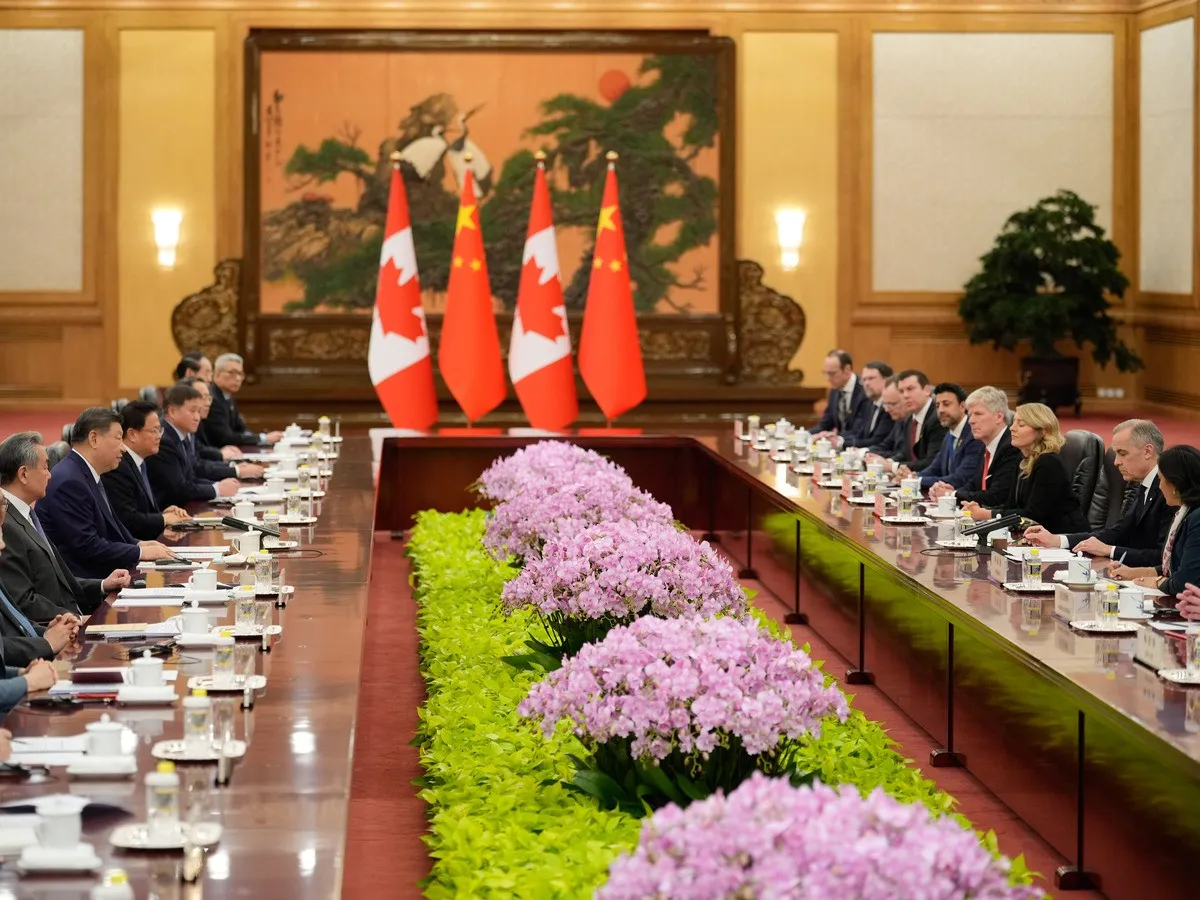
Skip to Content Subscribe Our Offers My Account Manage My Subscriptions FAQ Newsletters Canada Canadian True Crime Canadian Politics Health World Israel & Middle East Financial Post NP Comment Longreads Puzzmo Diversions Comics NP News Quiz New York Times Crossword Horoscopes Life Eating & Drinking Style Sponsored Play for Ontario Travel Travel Canada Travel USA Travel International Cruises Travel Essentials Culture Books Celebrity Movies Music Theatre Television Business Essentials Advice Lives Told Tails Told Shopping Buy Canadian Home Living Outdoor Living Kitchen & Dining Tech Style & Beauty Personal Care Entertainment & Hobbies Gift Guide Travel Guide Amazon Prime Day Deals Savings National Post Store More Sports Hockey Baseball Basketball Football Soccer Golf Tennis Driving Vehicle Research Reviews News Gear Guide Obituaries Place an Obituary Place an In Memoriam Classifieds Place an Ad Celebrations Working Business Ads Archives Healthing Epaper Manage Print Subscription Profile Settings My Subscriptions Saved Articles My Offers Newsletters Customer Service FAQ Newsletters Canada World Financial Post NP Comment Longreads Puzzmo Diversions Life Shopping Epaper Manage Print Subscription HomeNewsCanadaCanadian PoliticsOttawa has new powers to ban Chinese telecom companies. It says it's not planning to use themWhile the legislation may help bolster Canada's security, it could also complicate its foreign affairsLast updated 11 minutes ago You can save this article by registering for free here. Or sign-in if you have an account.Chinese President Xi Jinping and Canada's Prime Minister Mark Carney meet at the Great Hall of the People on January 16, 2026 in Beijing, China. Photo by Pool /Getty ImagesOTTAWA — The federal government has no plans to use its new cyber legislation to ban two Chinese telecommunications equipment companies from Canadian networks, even though Ottawa has described the new law as critical to national security.Enjoy the latest local, national and international news.Exclusive articles by Conrad Black, Barbara Kay and others. Plus, special edition NP Platformed and First Reading newsletters and virtual events.Unlimited online access to National Post.National Post ePaper, an electronic replica of the print edition to view on any device, share and comment on.Daily puzzles including the New York Times Crossword.Support local journalism.Enjoy the latest local, national and international news.Exclusive articles by Conrad Black, Barbara Kay and others. Plus, special edition NP Platformed and First Reading newsletters and virtual events.Unlimited online access to National Post.National Post ePaper, an electronic replica of the print edition to view on any device, share and comment on.Daily puzzles including the New York Times Crossword.Support local journalism.Create an account or sign in to continue with your reading experience.Access articles from across Canada with one account.Share your thoughts and join the conversation in the comments.Enjoy additional articles per month.Get email updates from your favourite authors.Create an account or sign in to continue with your reading experience.Access articles from across Canada with one accountShare your thoughts and join the conversation in the commentsEnjoy additional articles per monthGet email updates from your favourite authorsSign In or Create an AccountorThe government passed amendments last week to the Telecommunications Act, giving Ottawa the power to ban telecom gear from companies deemed to be security threats, or even strip that gear from existing Canadian networks. The legislation was widely seen as an effort to boost Canada’s cyber defence against two fast-growing Chinese companies: Huawei Technologies and Zhongxing Telecommunication Equipment, better know as ZTE.But at a time when Ottawa is trying to mend fences between the two countries and further diversify Canadian exports beyond the United States, a government source said there are no plans to use the new powers from Bill C-8 to take action against companies from China or elsewhere.After the legislation was passed last week, a government news release said the new law will allow the Carney Liberals to begin implementing “concrete measures” that will strengthen the security of Canada’s telecommunications networks. “Canada’s national security depends on strong cyber defence,” Defence Minister David McGuinty was quoted as saying in the release.Despite underscoring the new law’s importance, the government doesn’t seem interested in talking about it publicly. Spokespeople for McGuinty and Industry Minister Mélanie Joly did not respond to interview requests.Analysts say they expect the government to stay quiet.Iain Grant, a telecommunications analyst at SeaBoard Group, said the government doesn’t need to publicly direct Canadian telecom services companies to avoid Huawei and ZTE products because those companies’ gear already represents too much risk. If the services companies bought the Chinese equipment and were later forced to strip the gear from their systems for security reasons, Grant said, it would cost a lot more than what they would have saved on the initial purchase.“Why would you risk it?” asked Grant. “Although there may be some initial savings, nobody is coming to assist you in recovering the costs to remove and replace.”Grant said the Chinese companies’ potential customers in Canada — large telecom services companies such as Bell Canada, Rogers Communications, Telus and Vidéotron — are well aware which equipment companies are seen as national security threats.Fen Hampson, an international affairs and Internet governance specialist at Carleton University in Ottawa, said the new legislation didn’t need to explicitly mention China or Chinese companies. “It’s pretty clear who they might have in mind.”Security questions involving telecom networks go back almost as far as the networks themselves.In 2022, Ottawa announced a ban on the use of new 5G equipment from Huawei and ZTE in Canadian networks. The new legislation goes further by giving the federal cabinet authority to order telecom services companies to stop using products or services from specified suppliers and to require removal of existing equipment. The legislation also gives Ottawa the ability to use enforcement mechanisms and penalties for non-compliance.Hampson said Canadian telecommunications services companies have already been cutting back in recent years on their use of Chinese equipment, in part because of their anticipation of this type of legislation.A spokesman for the Canadian Telecommunications Association, whose members include most of the major telecom services companies, said security has always been a priority and that the industry looks forward to using the regulation to make networks stronger.One of the big remaining questions, analysts say, is how much Chinese gear — now deemed a national security threat — remains in Canadian telecommunications networks and may have to be removed. That process has already started in many cases.Nick Kyonka, the industry association’s spokesman, said he had no information on that question.While the legislation may help bolster Canada’s security, it could also complicate its foreign affairs.Hampson said Chinese officials won’t be surprised by this legislation, but that doesn’t mean that it won’t still ruffle some feathers in Beijing. “If you’re trying to assuage the dragon, this is going to not sit well with the Chinese.”The two Chinese companies are seen as rising stars in that country’s stable of exporters. While not owned by the state, they’re seen as typical of many Chinese companies that are expected to bend to the government’s wishes, making them potential security risks for spying and malware. Both Huawei and ZTE are based in the tech-heavy southern Chinese city of Shenzhen and have enjoyed strong international growth, largely using a business model of strong technology, government subsidies and lower wages than many of their rivals.In both cases, however, their overseas success has been constrained by security concerns and U.S.-led sanctions against them.Canada's national security depends on strong cyber defenceEurope and the U.S. have already taken similar steps to the Canadian law. Europe has added incentive to declare the Chinese companies a security threat as they’ve been taking market share in recent years from Sweden’s Ericsson and Finland’s Nokia, two companies that, along with South Korea’s Samsung Electronics, are leaders in the market.The legislation was passed at a time when Canada and China have taken important steps since Carney took the helm last year towards thawing what has been frosty relations in recent years.In January, China agreed to reduce tariffs and other trade barriers on a number of Canadian agricultural exports, while Canada agreed to reduce its tariff on 49,000 Chinese-made electrical vehicles a year to the 6.1 per cent rate that it charges for those with most-favoured-nation status. Prior to the deal, Canada had charged a 100 per cent surtax on Chinese EVs.While Trump said he understood why Canada would make such a deal, other American officials were critical. U.S. Trade Representative Jamieson Greer, for example, warned that the deal could lead to Chinese EVs gaining a foothold in North America. Trump later threatened further tariffs if the Canada-China deal were expanded.National PostOur website is the place for the latest breaking news, exclusive scoops, longreads and provocative commentary. Please bookmark nationalpost.com and sign up for our daily newsletter, Posted, here. Join the Conversation This website uses cookies to personalize your content (including ads), and allows us to analyze our traffic. Read more about cookies here. By continuing to use our site, you agree to our Terms of Use and Privacy Policy.
Ottawa has new powers to ban Chinese telecom companies. It says it's not planning to use them
Ottawa has no plans to use its new cyber legislation to ban two Chinese telecommunications equipment companies from Canadian networks.
1,476 words~7 min read