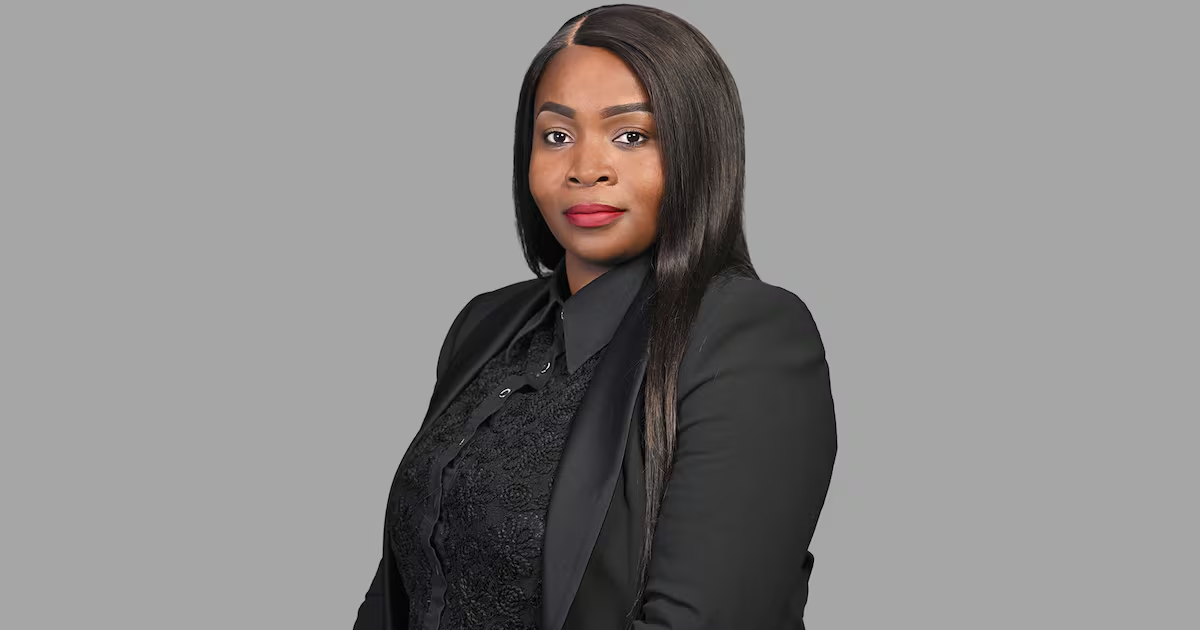
Africa’s legal landscape has undergone a profound transformation over the past decade, with rapid digital adoption and the rise of alternative legal service providers fundamentally reshaping the profession. For an industry historically steeped in tradition and cautious in its embrace of change, this shift has required a generation of leaders capable of navigating increasing legal, commercial, and operational complexity. That complexity is even more pronounced for firms operating across multiple African jurisdictions, where success depends on leadership that is not only commercially astute and technologically forward-looking, but also deeply attuned to the realities of doing business across borders. Corporate and commercial law firm Cliffe Dekker Hofmeyr (CDH) has found such a leader in Phetheni Nkuna. Recently appointed as chief operating officer (COO), Nkuna will oversee the firm’s operations across the continent, supporting the continued cross-border integration and broader Pan-African business strategy.Beyond the letter of the lawAs the legal profession continues to evolve globally, Nkuna notes that clients increasingly expect legal advisers to move beyond purely technical legal interpretation and operate as strategic business partners. “Clients today expect their legal advisers to understand their industries, anticipate regulatory shifts, and deliver strategic, business-oriented counsel. A mere knowledge of the law is no longer sufficient,” says Nkuna.Since joining CDH’s Employment Law practice in 2020, Nkuna has continued to advance her career, graduating with an MBA from GIBS in 2021 and joining the firm’s executive leadership team in 2023.She has become an increasingly influential figure within the firm’s executive management. She has helped shape operational strategy, advance client and business development priorities, and strengthen the firm’s people-centred approach to growth.Nkuna also emphasises the need for a different approach to innovation and technology. Firms can no longer afford to view innovation and technological literacy as secondary capabilities. “Lawyers who cannot engage meaningfully with legal technology will find themselves at a significant disadvantage,” she says. “We need to move from seeing this as peripheral to deliberately making it foundational. It has become a critical skill.”At the same time, the emergence of alternative legal service providers — including legal process outsourcing firms, managed legal services, and technology-driven platforms — has intensified competitive pressure on traditional firms, forcing them to rethink service delivery models, operational efficiency, and value propositions.For Nkuna, this changing landscape reinforces the importance of adaptability and multidisciplinary thinking within the profession. “Lawyers today need to do so much more than simply analyse legal risk and regurgitate the law — the market increasingly demands trusted business advisers,” she says.In her role as COO, Nkuna will continue driving operational excellence across the business while supporting both fee-earning and business services teams. A key priority will be ensuring that CDH’s people are equipped with the structures, skills, and resources required to deliver consistently high-quality outcomes for clients across jurisdictions.Building the lawyers of tomorrowAlongside operational leadership, Nkuna has also played an important role in shaping CDH’s people development and transformation agenda. She is deeply committed to advancing women in the workplace through mentorship initiatives and female wellness programmes, including maternity coaching and initiatives focused on psychological safety within the organisation. These efforts form part of her broader leadership philosophy centred on sustainability, inclusivity, and long-term talent development.Nkuna believes that developing the next generation of legal professionals is both a business priority and a broader responsibility to the profession itself. “Leading firms like CDH occupy a privileged position in the legal ecosystem, and with that privilege comes significant responsibility,” she says.“We have the resources, expertise, and institutional infrastructure to make a meaningful contribution to the development of the next generation of legal professionals across South Africa, Kenya, and Namibia. This is not merely a matter of corporate social responsibility — it is a strategic imperative.”She says the future success of the firm and the profession will depend on their ability to identify, nurture, and retain diverse talent capable of operating in an increasingly complex environment.“At CDH, we invest substantially in our training programmes, mentorship structures, and transformation initiatives, because developing young talent is not simply about filling vacancies. It is about building a pipeline of future leaders who reflect the diversity across South Africa, Kenya and Namibia who are equipped to navigate an increasingly complex legal and commercial landscape,” says Nkuna.She has already demonstrated her ability to think strategically, lead decisively, and drive meaningful progress across CDH’s South African operations. Her appointment reflects the firm’s broader commitment to building a future-focused Pan-African business that is operationally agile, innovation-driven, and positioned to meet the evolving needs of clients across the continent. This article was sponsored by Cliffe Dekker Hofmeyr.
Steering transformation in a changing legal profession
SPONSORED | New COO Phetheni Nkuna: a strategic, decisive leader driving meaningful progress across Cliffe Dekker Hofmeyr’s South African operations
758 words~3 min read