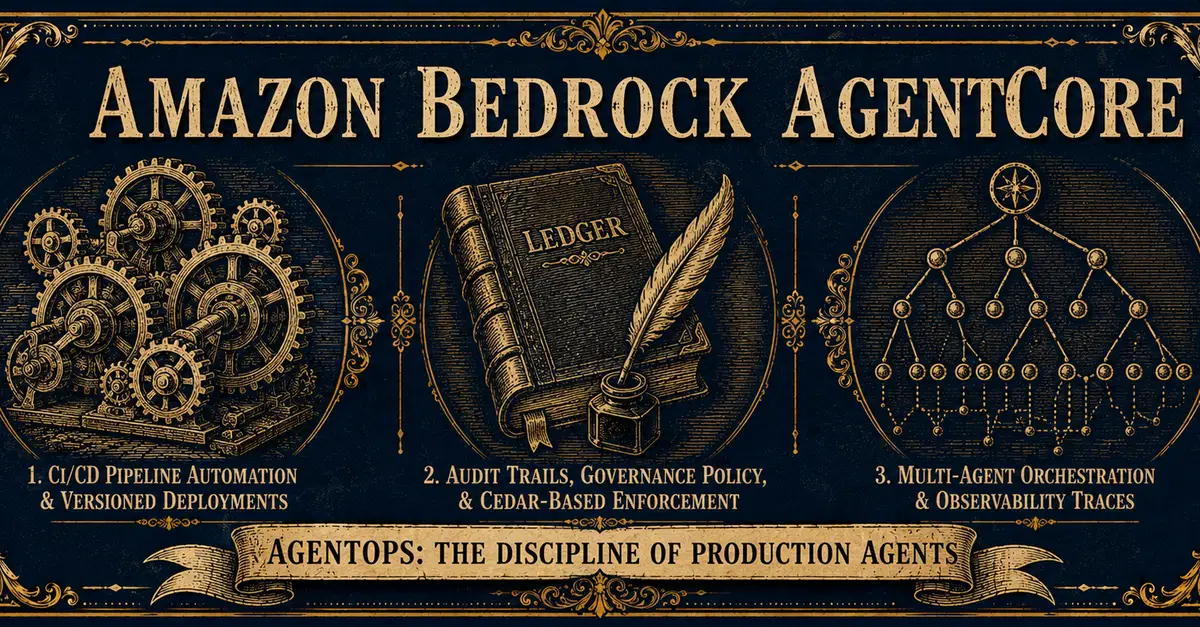
After 16 years building financial platforms on AWS, I've learned that the most dangerous question in architecture isn't 'does this work?' — it's 'who operates this at 2 AM when it breaks?' Bedrock AgentCore is AWS's answer to the problem of operationalizing AI agents beyond the notebook: managed runtime, memory, tool-use, guardrails, and traceability in a single control plane. This ADR documents how I arrived at the decision to adopt it — or not — in a regulated financial environment, and the consequences you need to internalize before doing the same.
Context and Forces
The scenario that motivated this decision is recurring in financial institutions: a product team wants to expose an AI agent to internal analysts — capable of querying market data via API, running risk calculations in Lambda, retrieving context from regulatory documents via RAG, and recording every action in an immutable audit trail. The MVP worked in two sprints with LangChain + Claude via Bedrock. The problem surfaced the following week.
Five forces made the decision urgent: (1) Cross-turn state management — financial agent sessions last minutes, not seconds; reliably maintaining context in stateless Lambda is brittle. (2) Regulatory traceability — every tool call, every model decision, every response must be auditable with timestamp, identity, and full payload, without relying on ad-hoc logging. (3) Guardrails as contract — in finance, the agent cannot leak PII, cannot recommend products without disclaimers, cannot execute irreversible actions without human confirmation. Implementing this manually in every agent is guaranteed technical debt. (4) Unpredictable token cost — without per-session budget control, a faulty agent loop can consume tens of dollars in minutes. (5) Runtime portability — the platform team doesn't want to maintain a custom agent scheduler; they want an SLA contract with AWS.