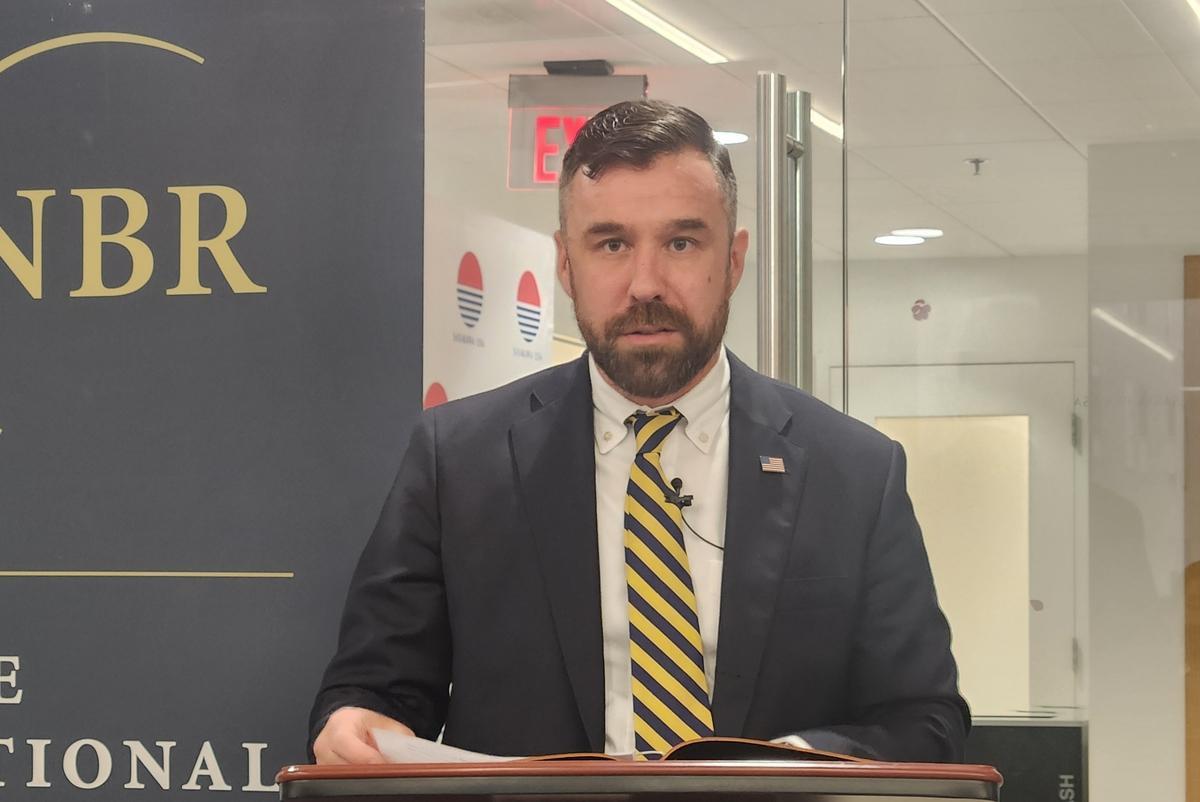
Russ Headlee, senior bureau official for cyberspace and digital policy at the State Department, speaks during a forum hosted by the National Bureau of Asian Research in Washington, June 23. Yonhap
WASHINGTON — A senior U.S. official on Tuesday cited South Korea's requirements for physical isolation of government servers and data localization policies as "barriers" to the rise of artificial intelligence (AI) in the Asian country, calling for a shift toward "modernized" digital regulations.
Russ Headlee, senior bureau official for cyberspace and digital policy at the State Department, made the remarks during a forum in Washington, warning against "appeals to digital sovereignty" that are "designed to discriminate against American companies."
"In the Republic of Korea (ROK), the rapid advancement of AI has hit barriers, including requirements for physical isolation of government servers and blanket data localization policies that, from our point of view, pose a significant risk for the ROK itself," he said during the forum hosted by the National Bureau of Asian Research.
"Our position is that digital sovereignty should mean verifiable control, not physical possession ... Shifting toward modernized regulations with logical server separation and cross-border data flows for low- to moderate-tier data would allow the ROK to harness the benefits of AI for the public sector, particularly for cyber defense," he added.