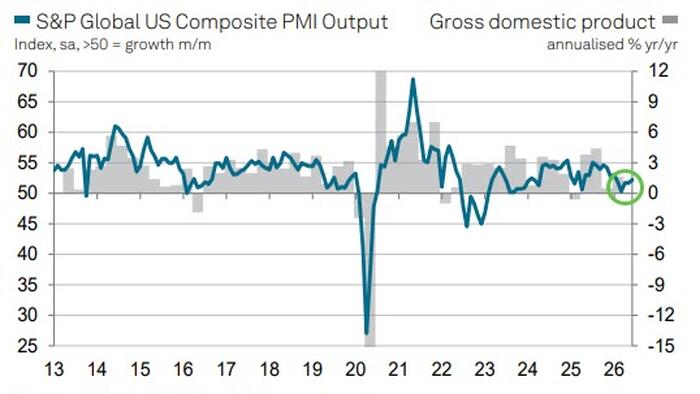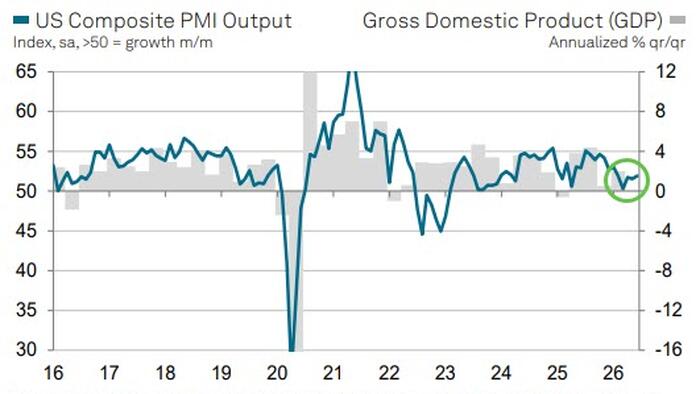
S&P Global’s Purchasing Managers’ Index showed growth accelerated in June, for both services and manufacturing. The index edged up to 52.2, a five-month high — anything over 50 signals that private-sector business activity is expanding. It’s another sign of strength, resilience, call it what you will, for the U.S. economy.Take a look at other major developed economies, though, and it’s a decidedly different story. Some of our key trading partners’ S&P Global PMI readings were just plain mediocre, driven in part by the recent surge in oil prices. In the eurozone, business activity contracted modestly for the third straight month. And within that, the biggest economies were some of the weakest. Germany hit a one-and-a-half-year low, France clawed its way back a bit from a more-than-two-year low. “Yet again the United States continues to post pretty robust growth, amid all the global turbulence and uncertainties,“ said Eswar Prasad, a professor of economics and trade policy at Cornell University. “For the rest of the world, it’s not as pretty a picture.”The U.S. is a major spoiler of that picture — it caused the oil and supply-chain disruptions that resulted from the war with Iran. “[Japan, the EU, the U.K.,] all of them are dealing with a significant uptick in inflation. This has put a damper on what was already a pretty soggy set of economic prospects,” Prasad said.The dampest is the United Kingdom, said Jennifer Lee, senior economist at BMO Capital Markets.“For the U.K., it’s almost like when it rains it pours. Composite PMI: 14-month low. Now they’re dealing with yet another new prime minister. The unstable political environment is unsettling for businesses,” she said.There is a silver lining in the recent global PMI data, said Gary Schlossberg at the Wells Fargo Investment Institute. While business activity is still contracting in many developed economies, it’s doing so less than in May. “The slowdown is decelerating. A lot of that has to do with the fact that there’s a little bit less concern about the situation in the Gulf. The two sides are talking,” he said.And crucially, global oil prices have fallen to within about $10 dollars of their pre-war level. This month’s PMI reports indicate that other input prices paid by businesses have now peaked, and are heading down again.
A key index shows the U.S. economy is expanding. Elsewhere, not so much
The S&P Global’s Purchasing Managers’ Index showed U.S. growth for June, but readings for some of the country’s key trading partners are just plain mediocre.
379 words~2 min read