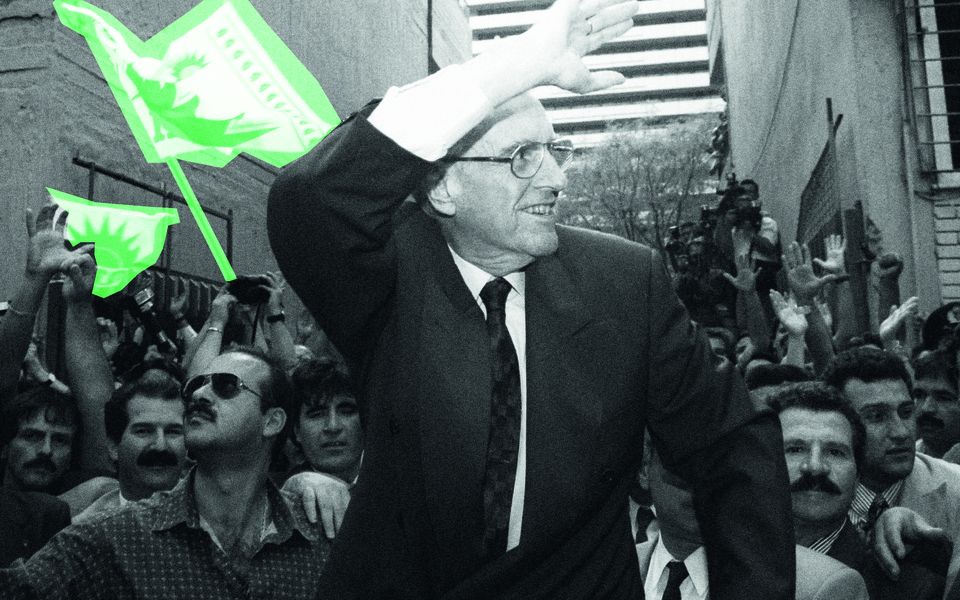
Thirty years after his death, PASOK founder Andreas Papandreou remains perhaps the most defining political figure of the long period after the restoration of democracy in Greece in 1974. For some, he was the charismatic leader who gave voice to the “unprivileged” and redressed a historical injustice against those who had been excluded from public life in post-civil war Greece. For others, he was the architect of a culture of populism, hyper-politicization and statism, the consequences of which weighed on the country for decades.
Both readings contain nuggets of truth. But neither is sufficient on its own to explain the “Andreas” phenomenon.
If conservative statesman Konstantinos Karamanlis was the politician who restored democratic legitimacy after the dictatorship, Papandreou was the one who contributed to its social and cultural democratization. The “first” period after the collapse of the right-wing military junta, between 1974 and 1981, built the institutions of the newly formed democracy: the legalization of the Communist Party of Greece (KKE), a new Constitution, restoration of parliamentary normality, and integration into the European Community.
However, for large parts of Greek society – the defeat of the Civil War, the politically excluded, the lower class and rural residents – democracy still remained something relatively distant, an institutional condition without full emotional integration.