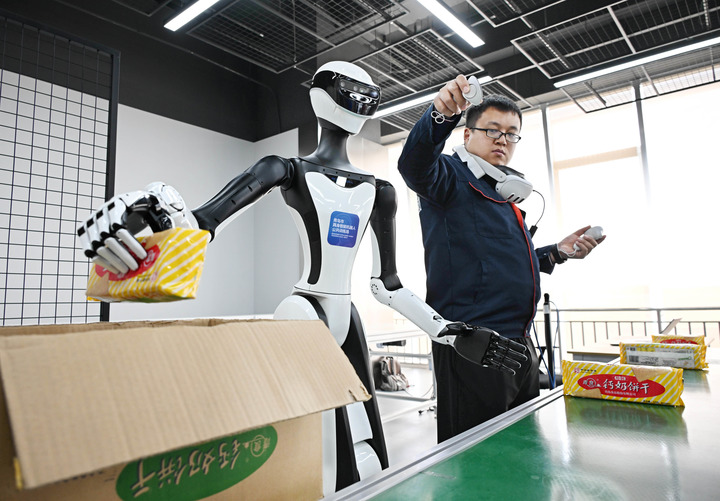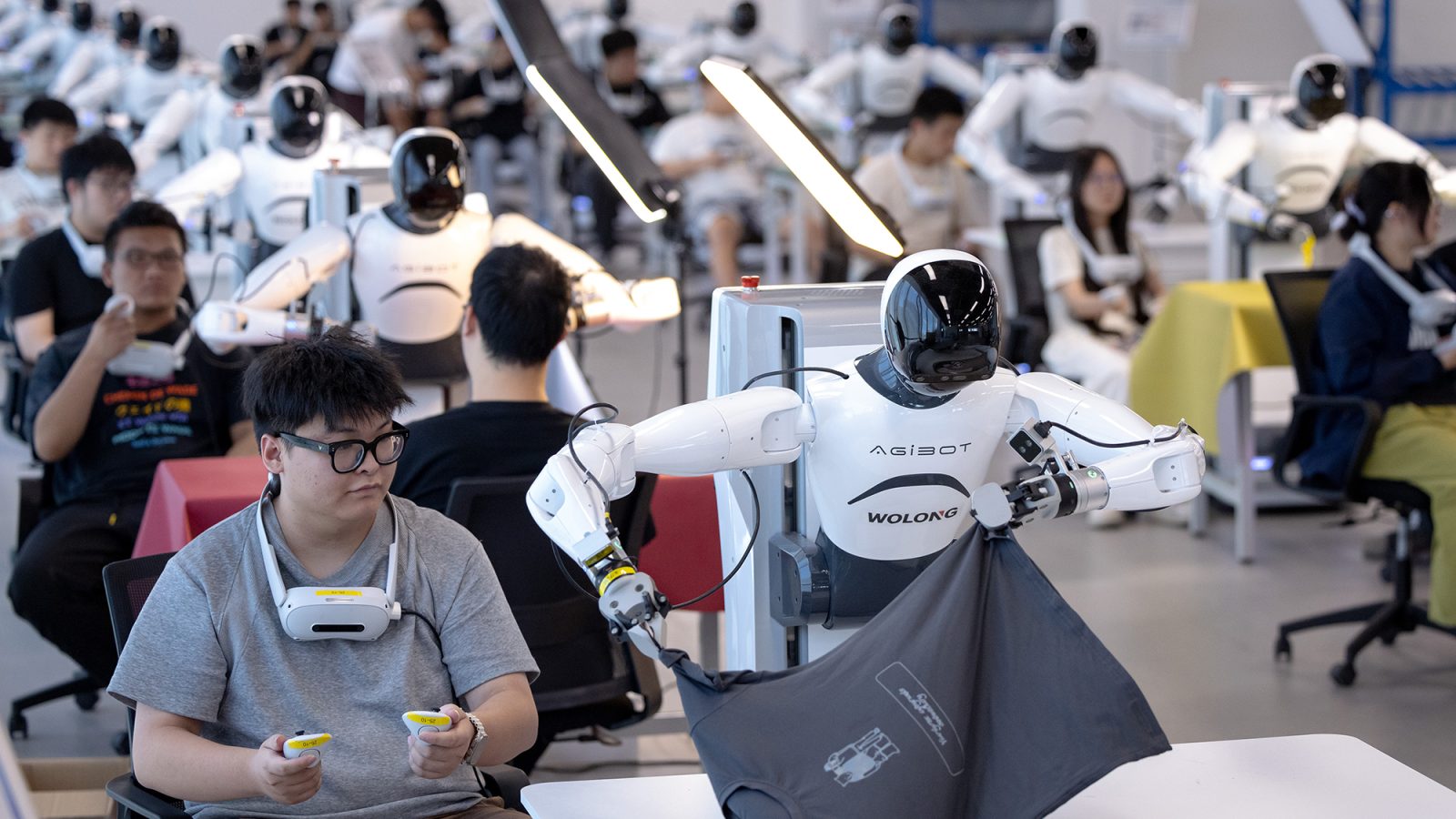
Inside a brightly lit office in Shanghai, Kim’s task for the week was to pretend he was opening the door of a microwave. Wearing a virtual reality headset and exoskeletons on his arms, he repeated the movement hundreds of times a day so that the humanoid robot next to him could learn it. On other days, Kim mimics folding clothes, or stacking wooden blocks.
Kim, a 20-year-old computer science major, works as a trainer at a leading robotics startup. He is one of hundreds of robot trainers across China, whose job is to generate movement data for robots, which the government sees as key to increasing productivity, addressing labor shortages, and cementing its technological edge.
“We call ourselves cyber-laborers,” Kim told Rest of World, speaking under a pseudonym because he is not authorized to talk to the media. “It’s a fine gig, though a bit boring.”
Kim is an essential part of China’s strategy to grow into a powerhouse of robotics, seen as the next front in the U.S.-China tech race. In early 2025, the Chinese government highlighted embodied intelligence — or artificial intelligence in the physical form — as a priority for the country, sparking an investment frenzy in the development of robots, including humanoids, which can one day think and act like humans.