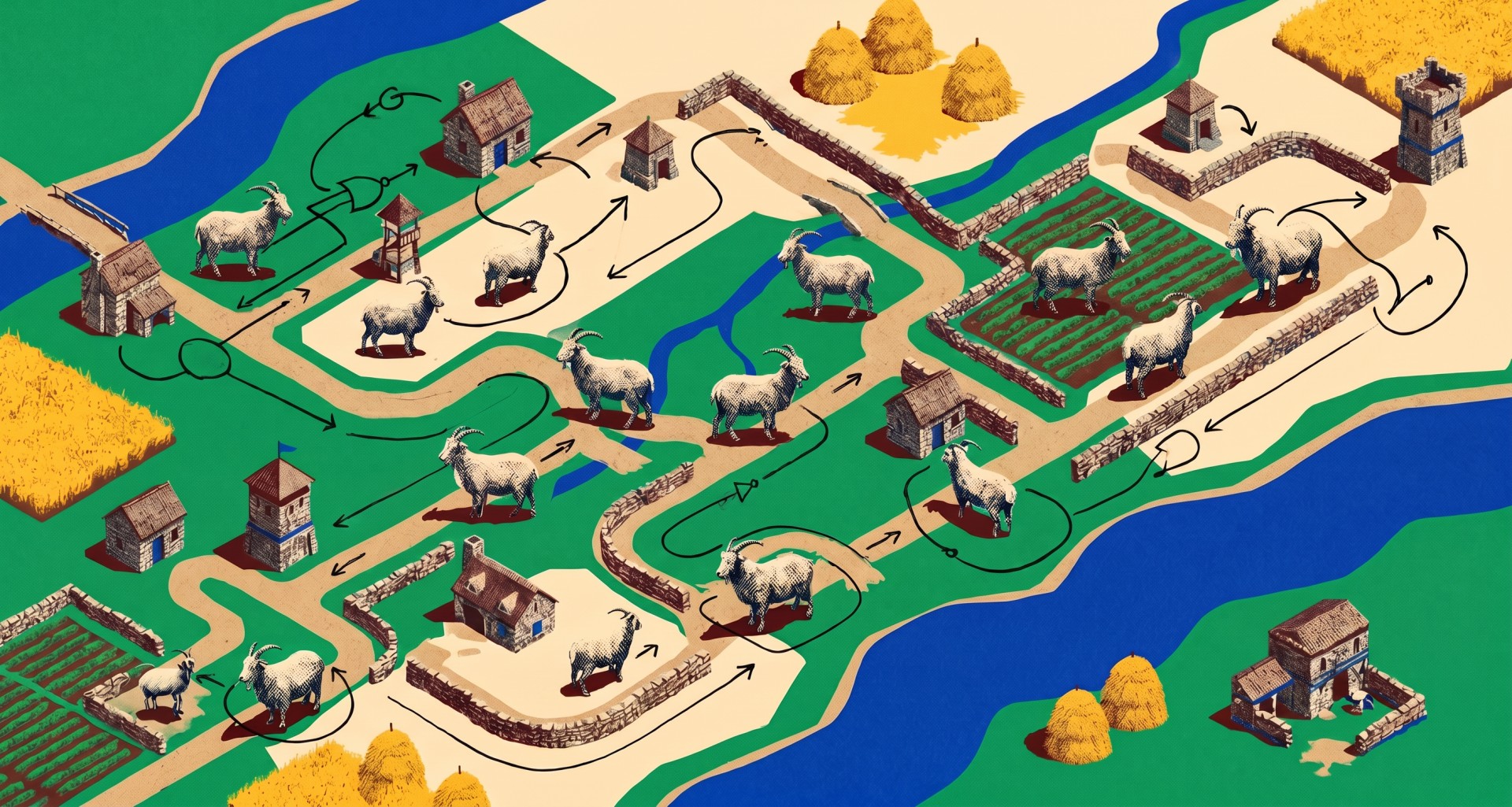
Goats are comedy gold. They headbutt confused cats! They faint! They make hilarious noises! Really hilarious noises! They do unspeakable things to the sheriff! And sometimes they’re complete and utter… well, let’s just say that as an Australian, I feel compelled to shout out the immortal Kevin, whose epithet shall not be spoken in polite American company but whose YouTube career should be rejoiced in all its foul-mouthed glory. The point is that if you wanted to, say, emphasize the inherent absurdity of claims that large language models are somehow sentient, then short of actually just getting hold of a parrot and dumping the entire internet into its little post-saurian pea brain, you could do worse than illustrating your argument with goats. And hey, what do you know? It appears that a researcher at Microsoft has done just that. Perhaps prompted by the galaxy-brained singularity-themed nonsense emerging from his contemporaries at competing companies, a researcher named Adrian de Wynter decided earlier this year to demonstrate that claims for and against the sentience of LLMs require some manner of actually measuring the validity of such claims. In particular, as described in his paper “If LLMs Have Human-Like Attributes, Then So Does Age of Empires II,” de Wynter sat down to demonstrate that at present, we lack any reliable “widely-accepted experimental protocols or schools of thought” for evaluating claims of sentience.
Frustrated Microsoft Researcher Uses Goats in 'Age of Empires II' to Demo the Absurdity of LLMs
Would you view a GoatGPT response differently to ChatGPT? Even if they worked the exact same way?
1,180 words~5 min read