Audio By Vocalize
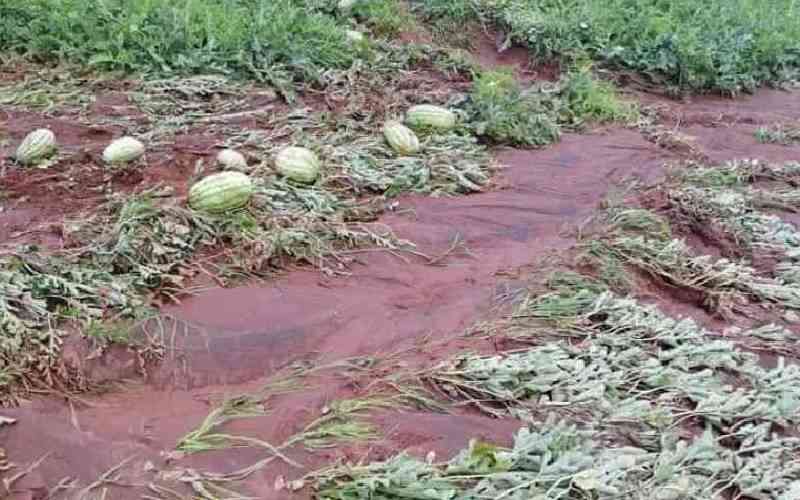
Watermelon farm destroyed by floods. [File, Standard]
The world marked World Environment Day on 5 June, a moment that shines a spotlight on a reality communities are already living through. Climate change is no longer a distant threat; it is reshaping lives in real time, determining where people can live, how they earn a livelihood, and whether they can remain in the places they call home. Each day, families lose homes to floods and storms, while prolonged droughts wipe out crops and livelihoods. Entire communities are caught in a cycle of repeated shocks, forced to rebuild repeatedly.
In Kenya, this year’s commemoration was accompanied by a sign of cautious progress. The country’s recent breakthrough, becoming the first in Africa to receive climate disaster funding through the Santiago Network on Loss and Damage, marks an important turning point. The Sh90 million allocation is modest, but its true significance lies in what it demonstrates: that loss and damage finance can be mobilised, that affected communities can be clearly identified, and that funding can be channeled with purpose.
For financial institutions, this is more than a milestone worth acknowledging. It is a clear signal of where the future of capital is heading and what it will take to access it. The central lesson is not about the amount disbursed, but about readiness. Climate finance is increasingly available, but it is not passively distributed. It flows to institutions that can demonstrate structure, credibility, and impact on a scale. Kenya’s experience shows that when needs are clearly defined and aligned with real communities, funding follows. The task ahead is to replicate and expand this model, transforming isolated successes into sustained financial flows.