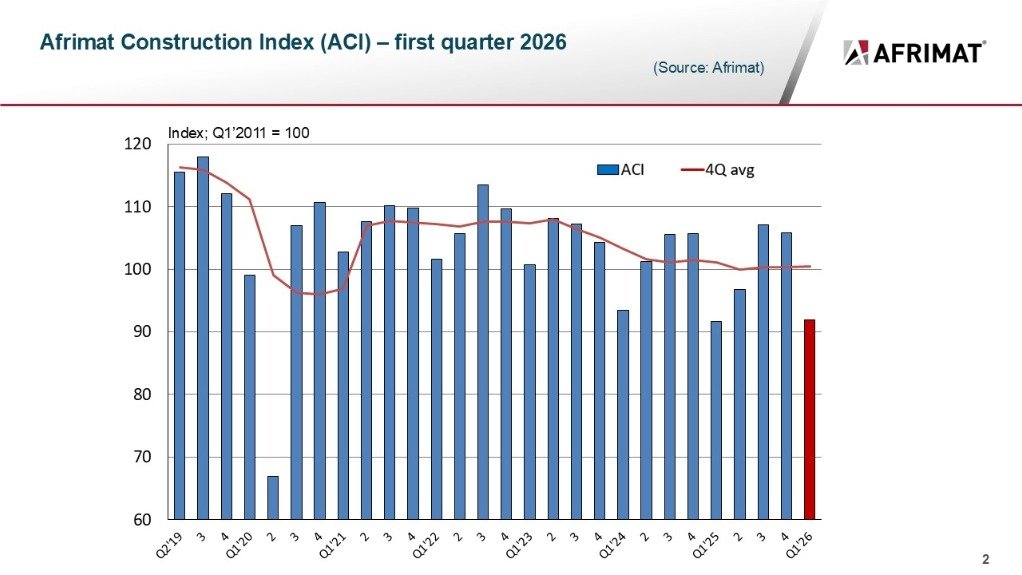
South Africa’s construction sector is showing its most sustained signs of recovery since the pandemic, with the Afrimat Construction Index (ACI) posting a third consecutive quarter of seasonally adjusted growth as employment, construction activity and demand for building materials improve.The index, compiled by Optimum economist Roelof Botha on behalf of Afrimat, rose 0.3% year-on-year in the first quarter, adding to signs of a gradual recovery in a sector that has spent much of the past decade constrained by weak fixed investment and sluggish economic growth.While the headline increase was modest, the underlying data painted a more encouraging picture.The value of construction works and buildings completed both rose 5.1% year-on-year, while employment in the sector increased by 5.9%, adding 74,000 jobs compared with the first quarter of 2025. There were also gains in retail sales of hardware products and sales of building materials.“The most impressive aspect of the latest ACI reading is the stability that has crept in for two key indicators — the value of non-residential buildings completed and the value of construction works,” said Botha.The seasonally adjusted ACI has advanced for three consecutive quarters for the first time since 2020, indicating that the sector may be moving beyond the sporadic rebounds that have characterised much of the post-pandemic period.Five of the index’s 10 constituent indicators showed positive year-on-year growth during the quarter, while salaries and wages remained unchanged. Three of the four declining indicators contracted by less than 2%.Botha said the construction sector continues to outperform many parts of the economy when it comes to job creation.“It is also encouraging that employment levels in the construction sector have managed to outperform job creation in most other sectors, with 74,000 more jobs in the first quarter of 2026 than a year ago,” he said.Despite accounting for only 5.5% of total value added in the economy, construction generated 11% of all new jobs created during the quarter, highlighting the sector’s importance to South Africa’s employment prospects.The recovery is being supported by an improving macroeconomic backdrop. GDP expanded by 1.4% year-on-year during the quarter, while lower interest rates have reduced financing costs for developers and contractors.“Lower interest rates have played an important role in lowering the cost of capital formation,” said Botha.The outlook for the sector is also being supported by a strengthening tender pipeline. According to Industry Insights, overall construction tender activity increased by 11.4% year-on-year in the first four months of 2026, with KwaZulu-Natal, the Eastern Cape and North West recording notable gains.Botha believes conditions could improve further should inflationary pressures continue to ease.“The peace accord between the US and Iran may lead to a resumption of the rate-cutting cycle during the second half of the year,” he said.The reopening of the Strait of Hormuz could help lower global inflation pressures and support further monetary easing.“A lowering of the prime rate will go a long way to restoring profitability in the construction sector, which is sensitive to the cost of capital — especially in residential construction,” said Botha.Commenting on the results, Afrimat CEO Andries van Heerden said the group’s renewed focus on aggregate quarrying — the extraction and processing of crushed stone, sand and gravel used in construction and infrastructure projects — had proved beneficial, as activity gradually improves across the industry.“Our renewed focus on aggregate quarrying has proved to be well-timed, not only as a significant contributor to the FY2026 results but also as reflected in the results of the ACI,” he said.Business Day
Construction sector shows strongest signs of stability since 2020, Afrimat index finds
Value of construction works and buildings completed both rose 5.1% year-on-year
575 words~3 min read