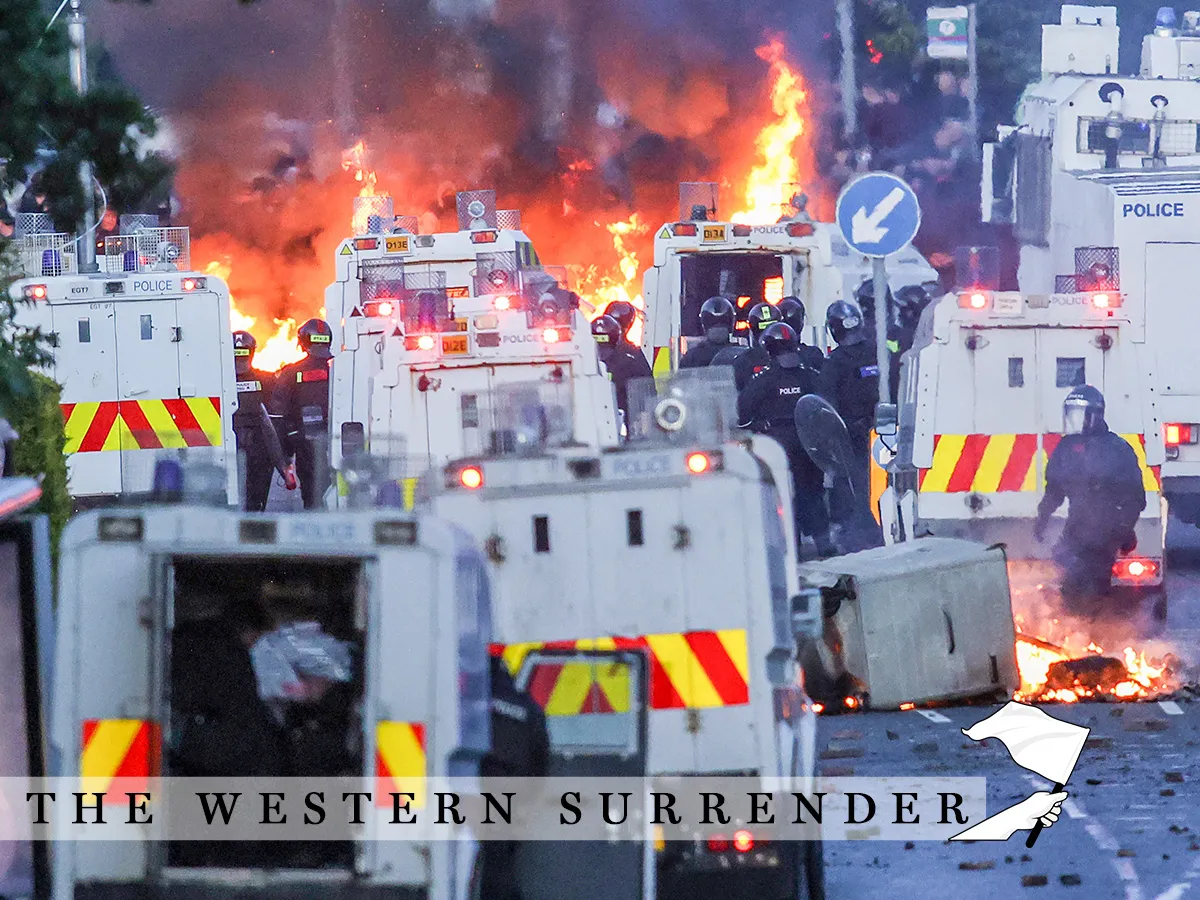
Skip to Content Subscribe Our Offers My Account Manage My Subscriptions FAQ Newsletters Canada Canadian True Crime Canadian Politics Health World Israel & Middle East Financial Post NP Comment Longreads Puzzmo Diversions Comics NP News Quiz New York Times Crossword Horoscopes Life Eating & Drinking Style Sponsored Play for Ontario Travel Travel Canada Travel USA Travel International Cruises Travel Essentials Culture Books Celebrity Movies Music Theatre Television Business Essentials Advice Lives Told Tails Told Shopping Buy Canadian Home Living Outdoor Living Kitchen & Dining Tech Style & Beauty Personal Care Entertainment & Hobbies Gift Guide Travel Guide Amazon Prime Day Deals Savings National Post Store More Sports Hockey Baseball Basketball Football Soccer Golf Tennis Driving Vehicle Research Reviews News Gear Guide Obituaries Place an Obituary Place an In Memoriam Classifieds Place an Ad Celebrations Working Business Ads Archives Healthing Epaper Manage Print Subscription Profile Settings My Subscriptions Saved Articles My Offers Newsletters Customer Service FAQ Newsletters Canada World Financial Post NP Comment Longreads Puzzmo Diversions Life Shopping Epaper Manage Print Subscription HomeNP CommentThe Western Surrender: English liberty has been sacrificed to silence critics of immigrationNo. 3: The British state has little tolerance for those who dissent from liberal orthodoxiesLast updated 12 minutes ago You can save this article by registering for free here. Or sign-in if you have an account.Fires burn around police vehicles as protesters (behind) stand off with police in Glengormley, north of Belfast, Northern Ireland, on June 10, 2026, following a brutal stabbing. (Photo by Paul Faith / AFP via Getty Images)All that is great about western civilization is being undermined by a progressive political and cultural project that aims to reject and rewrite our history, prioritize group identity above the individual and embed this agenda into our laws and institutions. Welcome to The Western Surrender, an NP Comment series ranking the five Anglosphere countries by their adoption of these ideas. Today we feature No. 3, the United Kingdom.Enjoy the latest local, national and international news.Exclusive articles by Conrad Black, Barbara Kay and others. Plus, special edition NP Platformed and First Reading newsletters and virtual events.Unlimited online access to National Post.National Post ePaper, an electronic replica of the print edition to view on any device, share and comment on.Daily puzzles including the New York Times Crossword.Support local journalism.Enjoy the latest local, national and international news.Exclusive articles by Conrad Black, Barbara Kay and others. Plus, special edition NP Platformed and First Reading newsletters and virtual events.Unlimited online access to National Post.National Post ePaper, an electronic replica of the print edition to view on any device, share and comment on.Daily puzzles including the New York Times Crossword.Support local journalism.Create an account or sign in to continue with your reading experience.Access articles from across Canada with one account.Share your thoughts and join the conversation in the comments.Enjoy additional articles per month.Get email updates from your favourite authors.Create an account or sign in to continue with your reading experience.Access articles from across Canada with one accountShare your thoughts and join the conversation in the commentsEnjoy additional articles per monthGet email updates from your favourite authorsSign In or Create an AccountorLONDON — The English have long found the sugary effusions one encounters at public events in, for example, the United States, slightly embarrassing and therefore best avoided. We seldom crank our sentimentalism to 11, and generally prefer things running at six or seven.This newsletter from NP Comment tackles the topics you care about. (Subscriber-exclusive edition on Fridays)By signing up you consent to receive the above newsletter from Postmedia Network Inc.We encountered an issue signing you up. Please try againEven as the United Kingdom has changed profoundly, this vestige of Englishness has, in the round, held firm. I suspect this is partly why wokeness manifests in subtler ways here than it does in other corners of the Anglosphere. Public figures took the knee for George Floyd, but there was no Minneapolis Mayor Jacob Frey-style performative sobbing; nor did we declare for anarchist “autonomous zones,” as in Seattle.As the majority of the population are those indigenous to the British Isles, there is no fretting over indigenous English land; indeed, such talk remains taboo. I suspect even if there were, Australia’s National Sorry Day would be a little too on the nose for us; our scientific journals would be wary of Indigenous “ways of knowing”; and one hopes we would not follow in Canada’s footsteps by inventing an Indigenous genocide.This, dear reader, is not for a want of trying. The soul is willing, but our cheeks are too prone to blushing. Britain may not be as bedecked in LGBTQ flags as other countries, but our institutions are not to be underestimated. They are stocked with technicoloured men (and women), with technicoloured hearts, who are all too willing to use their lanyards as a garrote around the neck of a centuries-old tradition of English liberty, free speech in particular. This process is arguably all the more sinister for the lack of attendant frippery.The birthplace of Milton’s Areopagitica today arrests 12,000 people each year for social media posts. Consequently, Britain is no longer classified as an open country in a leading global freedom of expression index, now ranking among Colombia, Nigeria, Romania and South Africa. The nation that defeated Napoleon’s armies today rewards its soldiers with a lifetime of litigation, and rewards those who’ve built careers hounding them with honorifics and the highest offices in the land. For decades, the state ignored the rape and sexual abuse of thousands of English girls by largely Pakistani grooming gangs, declining to pursue the perpetrators for fear of appearing racist. This crime was enabled because the state privileged sensitivities around the ethnicity of the perpetrators over the abuse suffered by the mostly underaged, white working-class victims.These developments would have been inexplicable to the British men who stormed the beaches at Normandy, fighting for precisely the liberties that are now so cavalierly dispensed with. A pathological obsession with racial grievance, denigration of British history, an aversion to free speech and thought were for the past half millennium as alien to England as polar bears and Hungarian folk dancing. They were not homegrown. The ultra-progressivism we call “woke” wafted, like the rest of the world, into Britain from the United States.Enoch Powell, the late Conservative MP famous for his so-called “Rivers of Blood” speech warning of the dangers of mass immigration, had a finely tuned barometer for two things above all: alien manners and muddled thinking. In the late 1960s he began compiling a file on the ideological import from American campuses that combined both, naming it “The Thing.”His file eventually grew to thousands of clippings. Another foreshock was registered by J. R. R. Tolkien as early as 1956, when he observed Oxford “dons yelling ‘fascist,’ at high table, at colleagues who in mild voices venture to disagree with them.” The “Lord of the Rings” author put this down to the “rot and stink … left by liberalism devoid of religion.” The persuasive case made by the historian Tom Holland among others that wokeness is a Christian heresy, with many of the trappings of a religion, makes this insight into proto-wokeness seem rather prescient.Unsurprisingly, the first heretic put to the torch for this new religion was the man who was one of the earliest to identify it. “Those whom the gods wish to destroy, they first make mad,” warned Enoch Powell in his much-maligned 1968 address to Conservative party members in Birmingham. “We must be mad, literally mad,” he continued, “as a nation to be permitting the annual inflow of some 50,000 dependants, who are for the most part the material of the future growth of the immigrant-descended population. It is like watching a nation busily engaged in heaping up its own funeral pyre.”In the fortnight following Powell’s speech, he received 100,000 letters, just 800 of which were in disagreement. The speech had morphed into the largest unofficial plebiscite in English history. Yet the commentariat and political class responded with rank horror, excoriating Powell for his speech, which, in retrospect, vastly understated the demographic transformation that had been set in motion (a transformation that has largely taken place without concern for integration or shared values). Powell was fired from his role as shadow secretary of state for defence, and the discomfort around discussing immigration, alluded to in his speech, hardened in the following decades into Britain’s most unassailable taboo.Powell was not Britain’s first cancellation, but he was arguably its most consequential: providing a template for the unpersoning that would become a defining feature of British life. He put the lie to the old adage that no man is a prophet in his home town, for his remarks resonated in his native Birmingham, yet were condemned by Westminster. Powell’s speech contained racial stereotypes — “charming, wide-grinning piccaninnies” — that were offensive even at the time, and undermined the parts of his speech that have proved prescient.In recent years, Powell’s reputation has undergone some reconstruction. His biographer, historian and member of the House of Lords Simon Heffer, wrote an essay for the Telegraph in May titled: The Sectarian Nightmare Predicted By Enoch Powell Is Here. Another lord, Daniel Hannan, regularly quotes Powell and has declared him his political hero.Powell foresaw the proliferation of lobbies for minority interests and grievances: “immigrant communities can organize to consolidate their members, to agitate and campaign against their fellow citizens and to overawe and dominate the rest with the legal weapons, which the ignorant and the ill-informed have provided.” The “anti-racist” ideology that today animates Britain’s police forces, and the rise of Muslim-first parties across the country, are but two data points that vindicate Powell’s prediction.Powell was unusually clear-eyed about where this transformation might ultimately lead. “As I look ahead,” he said, “I am filled with foreboding; like the Roman, I seem to see ‘the River Tiber foaming with much blood.’ ” The United Kingdom has seen multiple race- and immigration-related protests and riots in recent years in response to horrific crimes committed by migrants. Just the week before last, a Sudanese migrant attempted to behead a disabled man in Belfast, sparking days of violent clashes between locals and police, as well as arson attacks on immigrant accommodation. This is just instance among many more, which amount to, if not rivers of blood, a current that shows no sign of abating.The British state’s response to such disturbances has for decades been the same as its response to Powell: to defenestrate those complaining from polite society, further muzzle the population with an ever-thickening labyrinth of speech codes and equality laws, and double down on the root cause. The Thing has so thoroughly colonized the minds of British officialdom that most are unwilling or unable to conceive of an alternative course.Last week, the-soon-to-be-former prime minister, Sir Keir Starmer, reached for his favourite lever during turbulence: social media restrictions. He announced social media curfews for under-16s. “I am not prepared to compromise on the safety and happiness of our children, and that is why this ban must happen, and why this ban will happen,” Starmer said. The timing — one week after the Belfast riots, which the establishment on both sides of the Irish Sea attributed largely to the malign influence of Elon Musk’s X — is unlikely to be coincidental. Requiring social media firms to verify the ages of their users could prove to be a Trojan Horse for ending online anonymity. If the bill passes, users will have to verify their identification. For a state that is increasingly hostile to voices dissenting from liberal orthodoxies, and disposed to arresting those voices, the immense usefulness of this policy need not be spelt out.Freedom of speech has fallen to such depths, even the utterances of grieving families are not safe from interference. Earlier this month, Vickrum Digwa, a Sikh man, was sentenced for murdering Henry Nowak, an 18-year-old white student. There was public outrage at the response of the police, who seemed more concerned with a false allegation from Digwa that Nowak had racially abused him than a dying teenager, who was handcuffed in his final moments. On June 13, something that sounds faintly conspiratorial but that many of us have long suspected was confirmed to be true: a “secretive government propaganda unit,” as the Daily Mail put it, filled with “spies, spinners and soldiers” is routinely deployed to “control the narrative” following atrocities that may inflame racial tensions. The Research, Information and Communications Unit apparently “made sure that the liaison team dealing with the family were well briefed.” It has been claimed that the unit “intervenes to write statements by the families of victims of potentially racially linked incidents to stop them from inflaming tensions further with their remarks.” The newspaper’s source said: “You can see their fingerprints all over the statements released by the families of victims in these volatile situations — they usually have a similar tone.”Put simply, the British state intervenes to choreograph the response to the backlash arising from the predictable consequences of political decisions it has made. It accomplishes this partly by ventriloquizing the relatives of victims, whose words are then wielded, as happened with Henry Nowak’s family, as a rod for the backs of critics of those decisions. In response to the popular outrage at Nowak’s treatment by police in his final moments, described by Nigel Farage as anti-white discrimination, Starmer said: “The grieving family have asked us not to respond in the way that the leader of Reform (Nigel Farage) has responded. They’ve asked us not to.… They make a simple plea of us as human beings, to: Please. Not. Exploit. That. That is their plea to us. And we all need to reflect on those words of Henry’s father.”This is the politics of Munchausen syndrome by proxy: the British people were rightly outraged by the Nowak case, the facts of which bear the hallmarks of two-tier policing. This is entirely healthy, yet they are told, once again, they are sick.Britain did not broadcast The Thing to the world; that accolade is reserved for the United States. It lacks an indigenous population The Thing permits sympathy for, sparing it some of the headline-grabbing excesses of Canada, Australia and New Zealand. But don’t be fooled: The Thing has dined well on these islands, and its presence is made all the more insidious for announcing itself less in drag story hours than in the dull bureaucratese of the British state.National PostMichael Murphy is a journalist based in London. He writes for the Daily Telegraph and presented the documentary, ‘Ireland is full! Anti-Immigration backlash in Ireland.’To ensure you catch every entry in The Western Surrender series, sign up for our NP Platformed newsletter at nationalpost.com/platformed. You can also bookmark The Western Surrender page. Send any feedback and questions to npplatformed@postmedia.com. Join the Conversation This website uses cookies to personalize your content (including ads), and allows us to analyze our traffic. Read more about cookies here. By continuing to use our site, you agree to our Terms of Use and Privacy Policy.
The Western Surrender: English liberty has been sacrificed to silence critics of immigration
The British state has little tolerance for those who dissent from liberal orthodoxies
2,504 words~11 min read