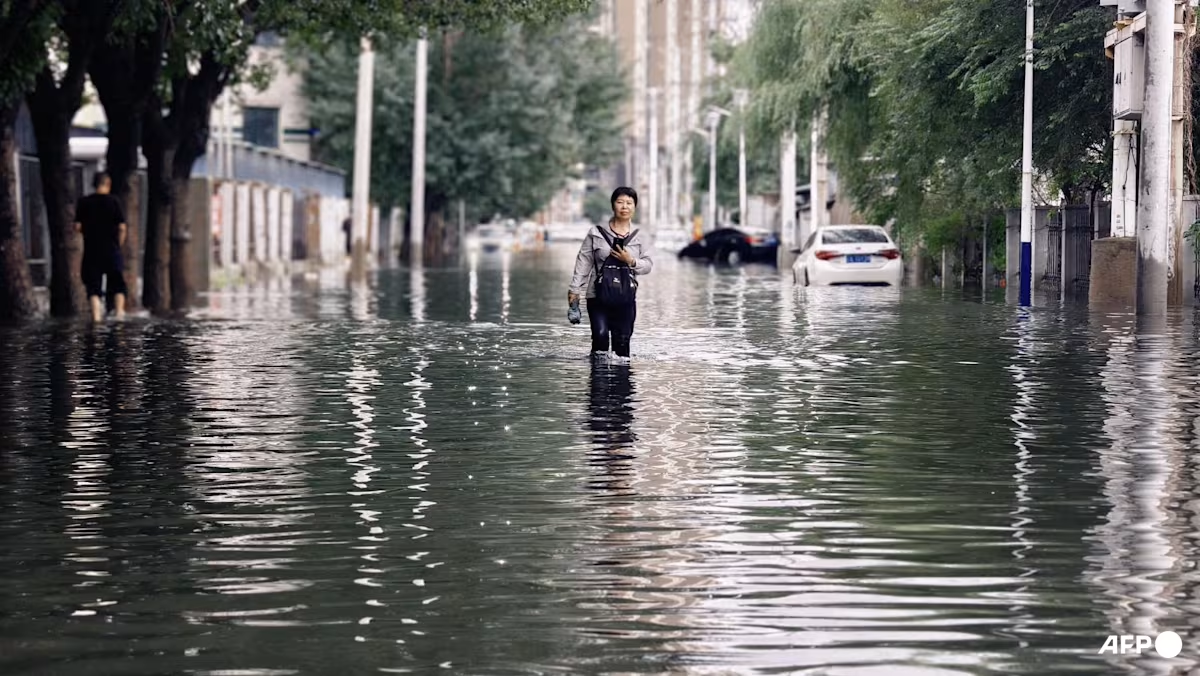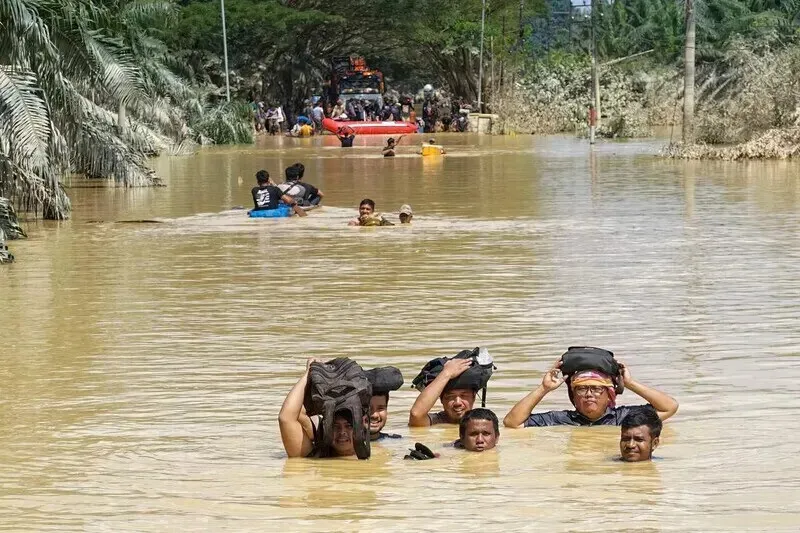
Residents wade through floodwaters in North Sumatra, Indonesia, following catastrophic flooding and landslides in November 2025. (AFP/Yonhap)
Asia experienced widespread extreme weather last year, including severe heat waves, flooding and glacier retreat, while a marine heatwave larger than China or the United States swept across regional waters, underscoring a warming trend that is advancing faster than the global average, a World Meteorological Organization report said.The WMO on Wednesday published its State of the Climate in Asia 2025 report, which assesses regional climate trends using key indicators including temperature, precipitation, glacier mass, ocean conditions and weather-related disasters. The report follows the organization’s State of the Global Climate report published in March and is issued annually.According to the report, Asia’s average temperature in 2025 was 0.96°C above the 1991-2020 average, ranking between the second- and fourth-warmest years on record. In 2024, temperatures were 1.04°C above average, making it one of the warmest years ever recorded.The WMO said Asia has been warming faster than the global average, with the rate of warming during 1991-2025 roughly twice that seen during 1961-1990.Last summer, Japan, China and South Korea all endured severe heatwaves, recording their highest temperatures on record. Unusually intense monsoon rains and tropical cyclones triggered devastating floods in several countries, including Pakistan, Sri Lanka and Vietnam. In contrast, parts of West and Central Asia experienced below-average rainfall and prolonged drought conditions.A particularly alarming finding concerns ocean heat content, which measures the amount of heat stored in the upper 700 meters of the ocean and is a key indicator of global warming. The report states that ocean heat content reached its highest level since records began in 1960.Between July and September last year, more than 10 million square kilometers of Asian waters were affected by strong marine heatwaves, an area larger than either China or the United States.