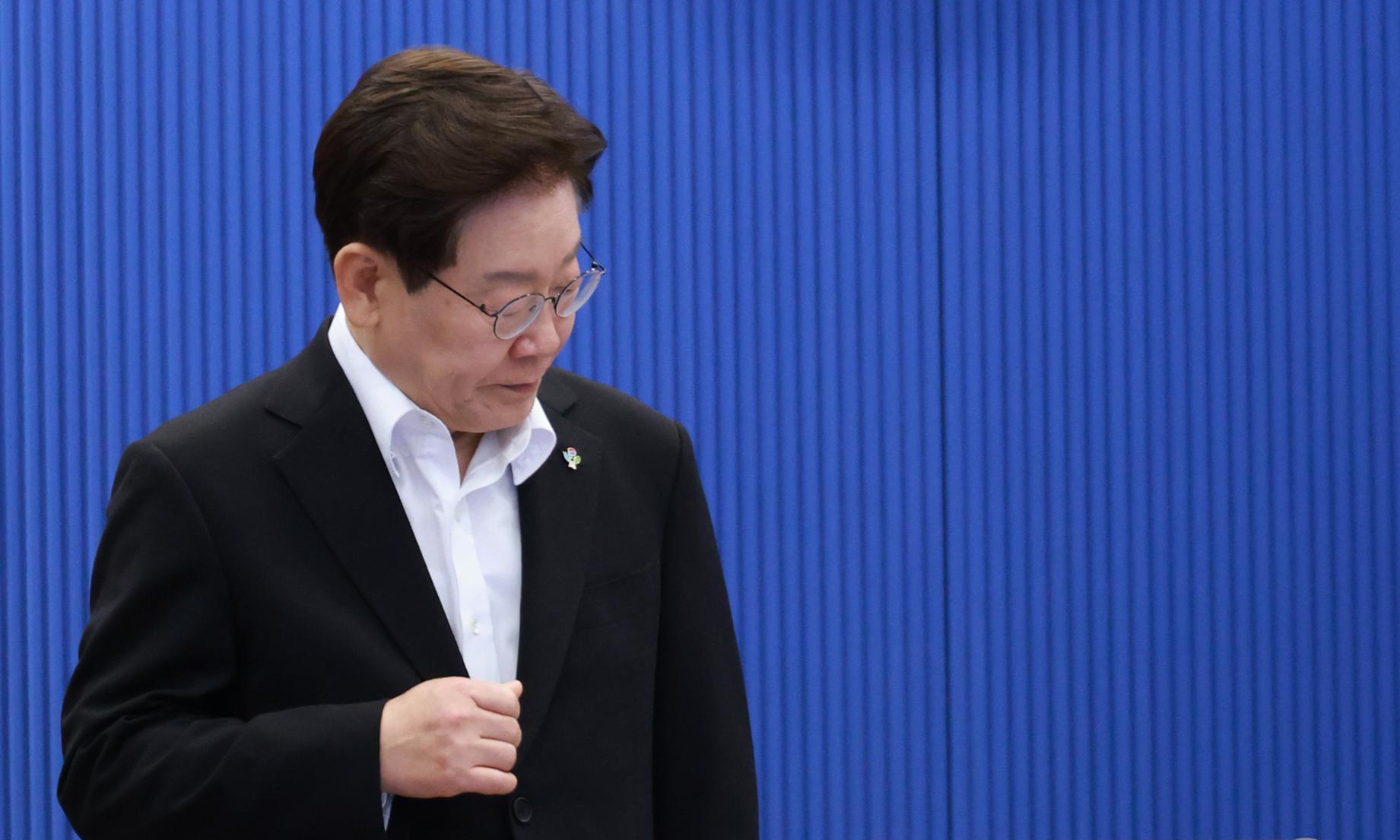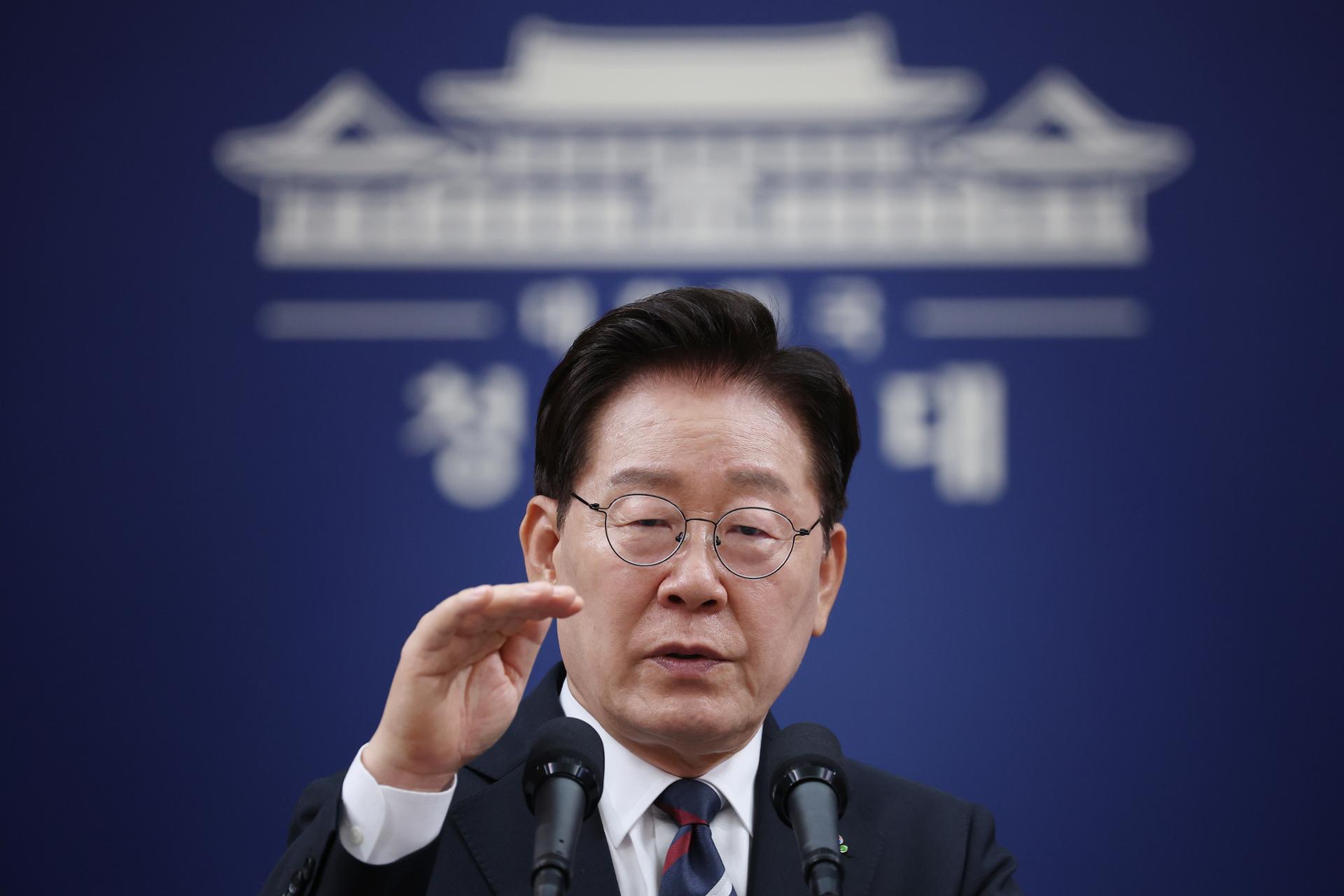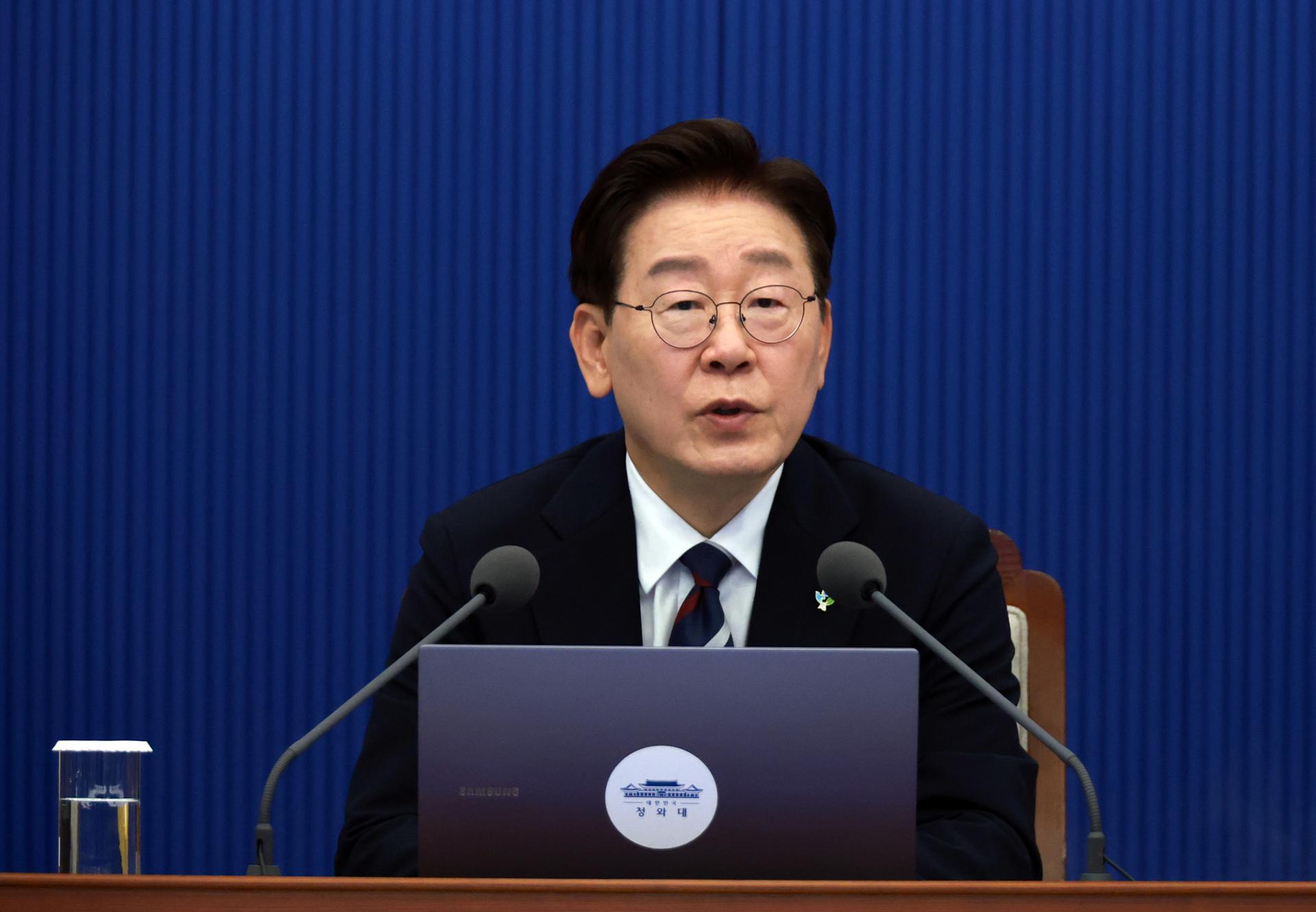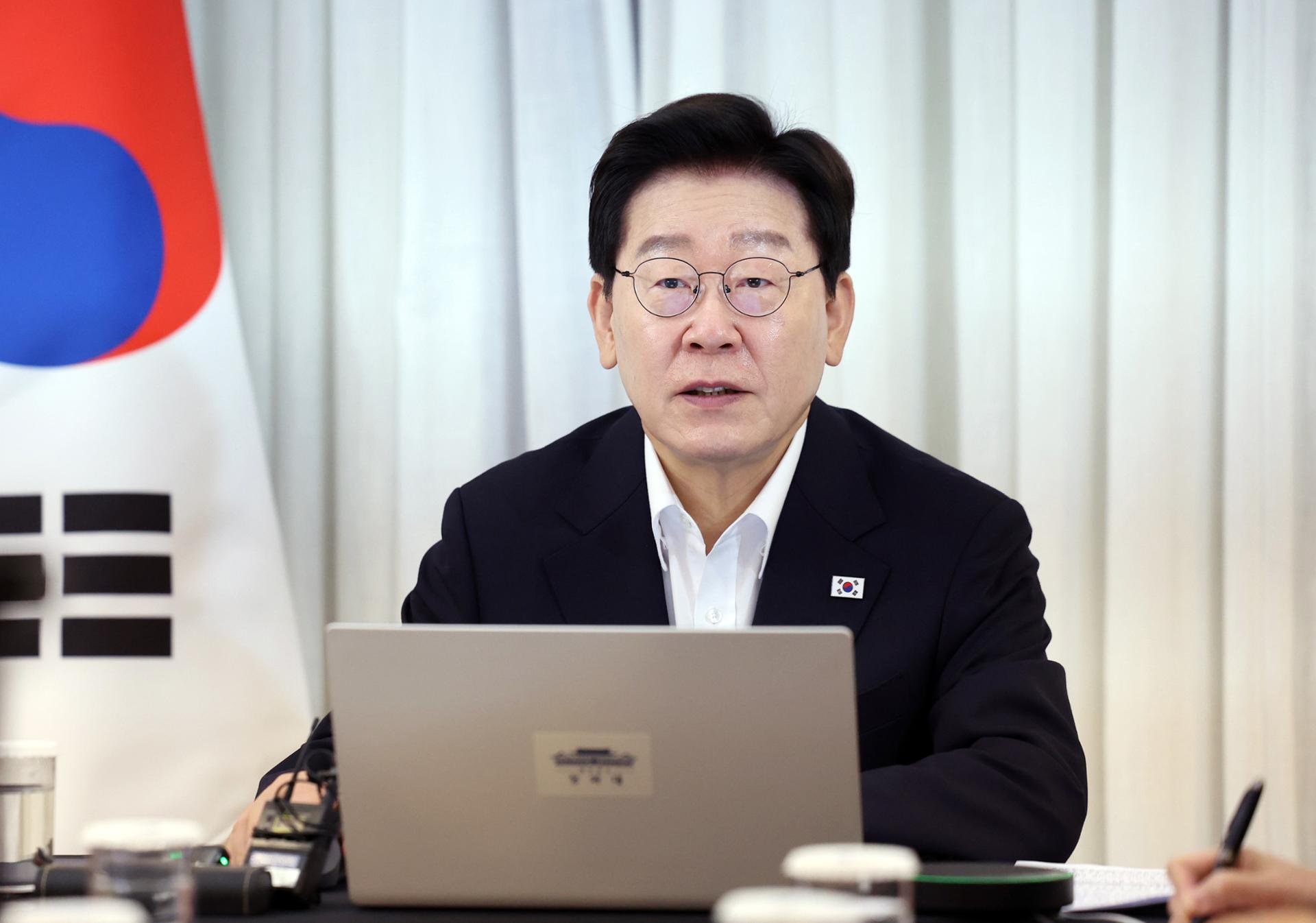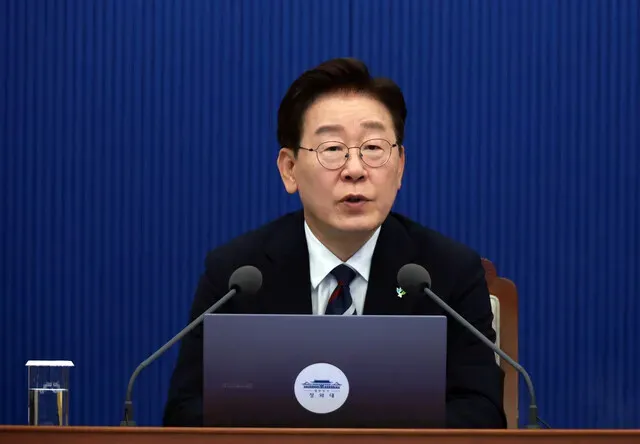
President Lee Jae Myung speaks at a meeting of senior aides held at the Blue House on June 19, 2026. (Yonhap)
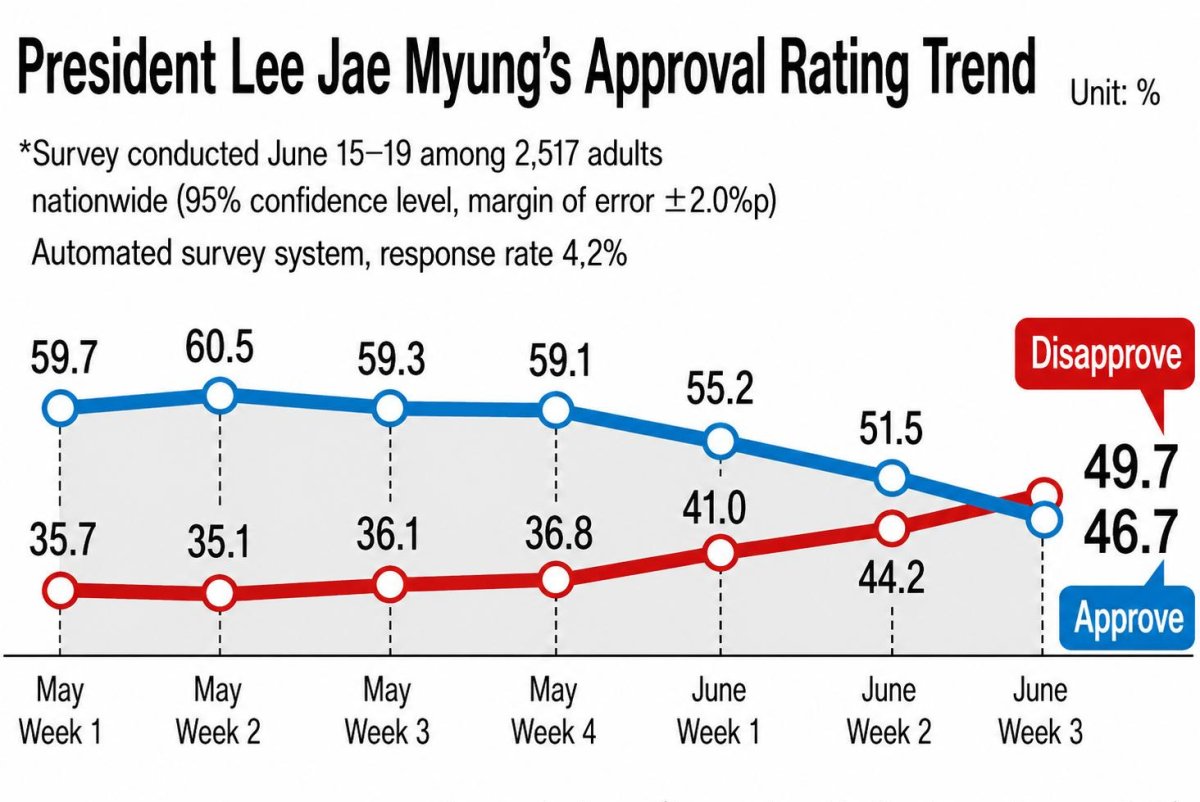
President Lee Jae Myung’s approval rating has fallen below 50% for the first time since taking office, with negative ratings of the South Korean leader now outweighing the positive.In response, the Blue House said it “takes seriously and humbly accepts” the poll numbers and vowed to “pay close attention to the concerns and wishes of the people.” Experts believe the president’s declining approval rating is due to several factors, including the shortage of ballots in the recent local elections and infighting within the ruling Democratic Party.A nationwide survey, commissioned by the Energy Economic News, was conducted by Realmeter from June 15-19, polling 2,517 constituents aged 18 or above via an automatic response system. The poll had a margin of error of plus or minus 2 percentage points at a confidence interval of 95%.The poll found that positive ratings of Lee fell 4.8 percentage points from the previous week to 46.7%, while negative views rose 5.5 percentage points to reach 49.7%. Although the two assessments fall within the margin of error, it marks the first so-called “death cross” in which positive ratings dip below the negative since Lee came to power, and the first time the president’s approval rating has fallen below 50% in a Realmeter survey.The president’s approval rating, which stood at 59.1% in a poll taken in the fourth week of May, just before the local elections, has tumbled by more than 10 percentage points in the space of three weeks. The largest decline was seen in the Daegu and North Gyeongsang regions, where support for the incumbent president dropped by 9.9 percentage points to 34.6%.The scope of the decline was 7.6 percentage points in Incheon and Gyeonggi (44.8%), and 7.4 percentage points in Seoul (39.8%). Lee’s approval fell by 4.9 percentage points to 47.5% among self-described moderates and by 3.2 percentage points to 80.4% among progressives. Waning support for Lee since the local elections earlier this month has also been confirmed in other opinion polls. A nationwide Gallup Korea poll conducted from June 9-11 that surveyed 1,002 constituents aged 18 or older found that 57% of respondents approved of Lee’s job as president, with 35% disapproving. (Gallup’s poll had a margin of error of plus or minus 3.1 percentage points at a confidence interval of 95%. It was conducted via phone interviews using virtual mobile phone numbers.)Realmeter and political scholars believe the main reasons behind Lee’s declining popularity are asset polarization, signs of discord between the Democratic Party and the Blue House manifesting ahead of the national party convention in August, and the National Electoral Commission’s ballot shortage fiasco in the recent election.“Fighting within the ruling party and the growing belief that someone needs to be held accountable for election mismanagement served as negative influences toward the political situation as a whole,” Realmeter stated. “Despite positive factors such as success from President Lee’s European visit and the KOSPI breaching the 9,000 mark, concerns over polarization in the asset market have become more pronounced, and declining support primarily among moderates and those in the capital area caused the approval rating to slide even further,” the polling agency went on.Some Democratic lawmakers have also suggested that growing inequality is to blame for Lee’s sinking poll numbers. “The KOSPI reaching 9,000 is of no relevance to young people. It just makes their sense of deprivation and despair more acute,” Rep. Ko Min-jung wrote in a Facebook post the same day.Experts say internal party conflict and political mismanagement are contributing to recent shifts in public sentiment.“The recent spat between the Blue House and the Democratic Party in the lead-up to the national party convention would be one reason, and outside the party it also appears that some conservatives have left the ranks over the election mismanagement issue,” said Lee Jae-mook, a professor of political science at Hankuk University of Foreign Studies.Lee Jun-han, a professor of political science at Incheon National University, concurred that infighting in the president’s party may be a factor. “It is typical for a president’s approval rating to spike while abroad on official business, but in this case approval for President Lee fell despite attending the G7 summit as he appeared to be implicated in the internal strife,” he said. Both the Democratic Party and the Blue House responded humbly to the latest poll numbers. “The recent fluctuation in the approval rating appears to be a reflection of the people’s assessment of public welfare and the overall state of governance,” the Blue House stated in a commentary released Monday. Rep. Kang Jun-hyeon, the chief spokesperson for the Democratic Party, met with reporters after a high-level party meeting. “We feel a heavy sense of responsibility and will be engaging in dialogue within the party,” he said. Those in government also appeared to be rattled by fears over a loss of momentum in state administration.“There are lingering effects from the June 3 local elections, and division among our base ahead of the national party convention also played a part,” one Blue House official stated. “This is not something we can just brush aside, as there is a risk that we could lose momentum to govern.” The ruling party isn’t exempt from feeling a sense of crisis.“Isn’t it right to treat the outcome as self-explanatory and accept it?” quipped one multi-term lawmaker from the capital region. “There are several matters still remaining to be dealt with such as the confirmation hearing for prime minister nominee Han Seong-sook and the parliamentary audit of the National Election Commission, so we will have to wait and see [how long the decline will continue].”By Seo Young-ji, staff reporterPlease direct questions or comments to [english@hani.co.kr]