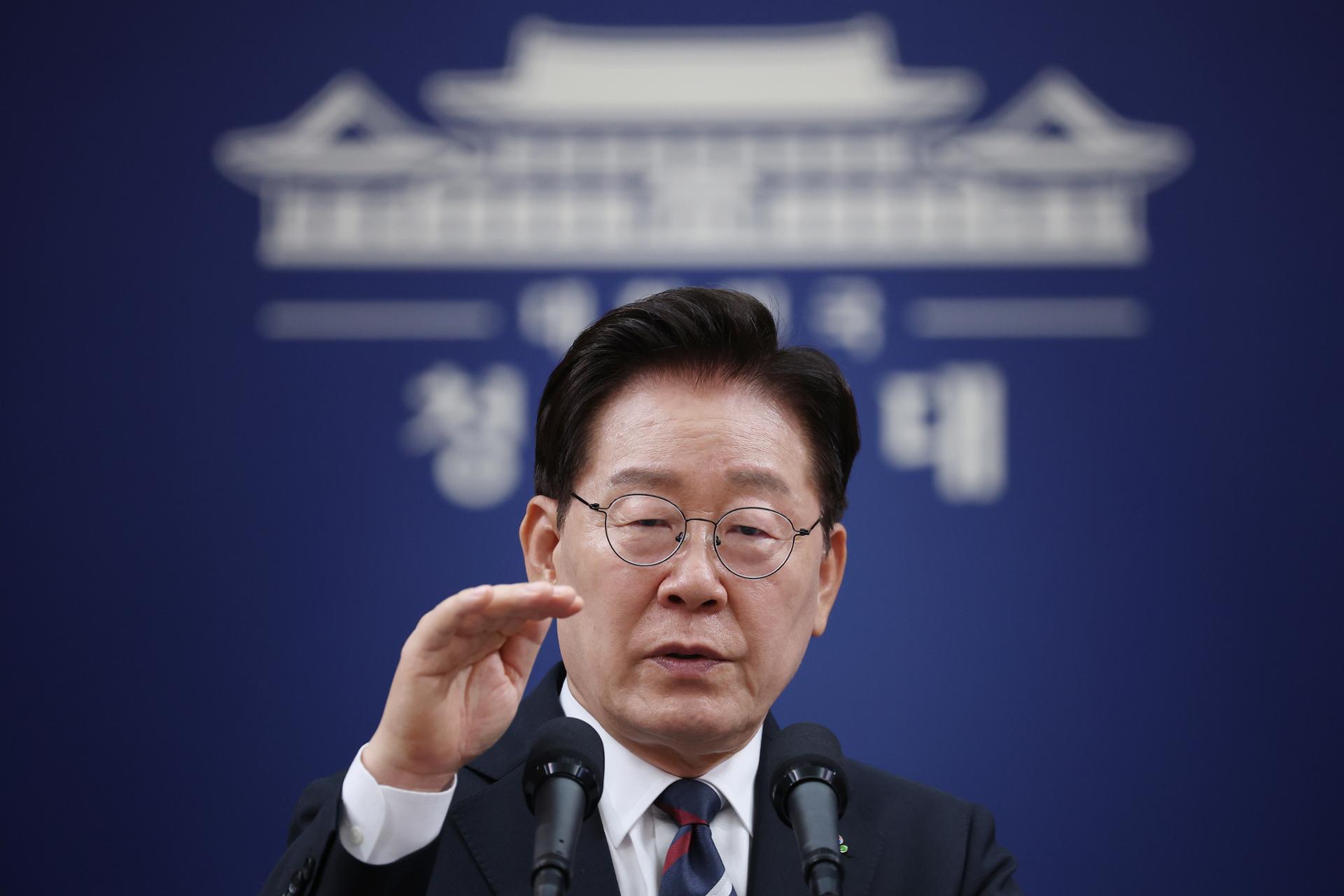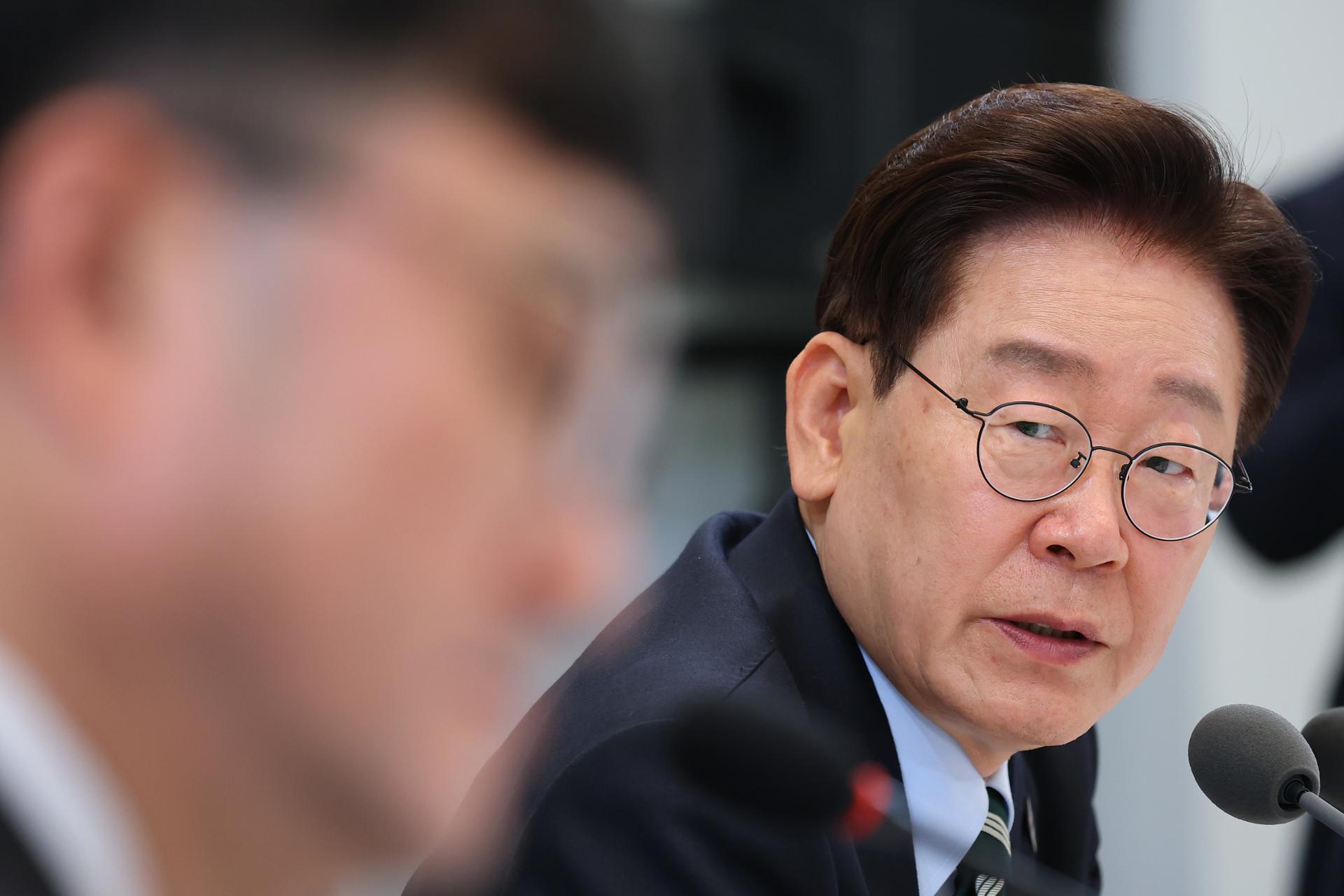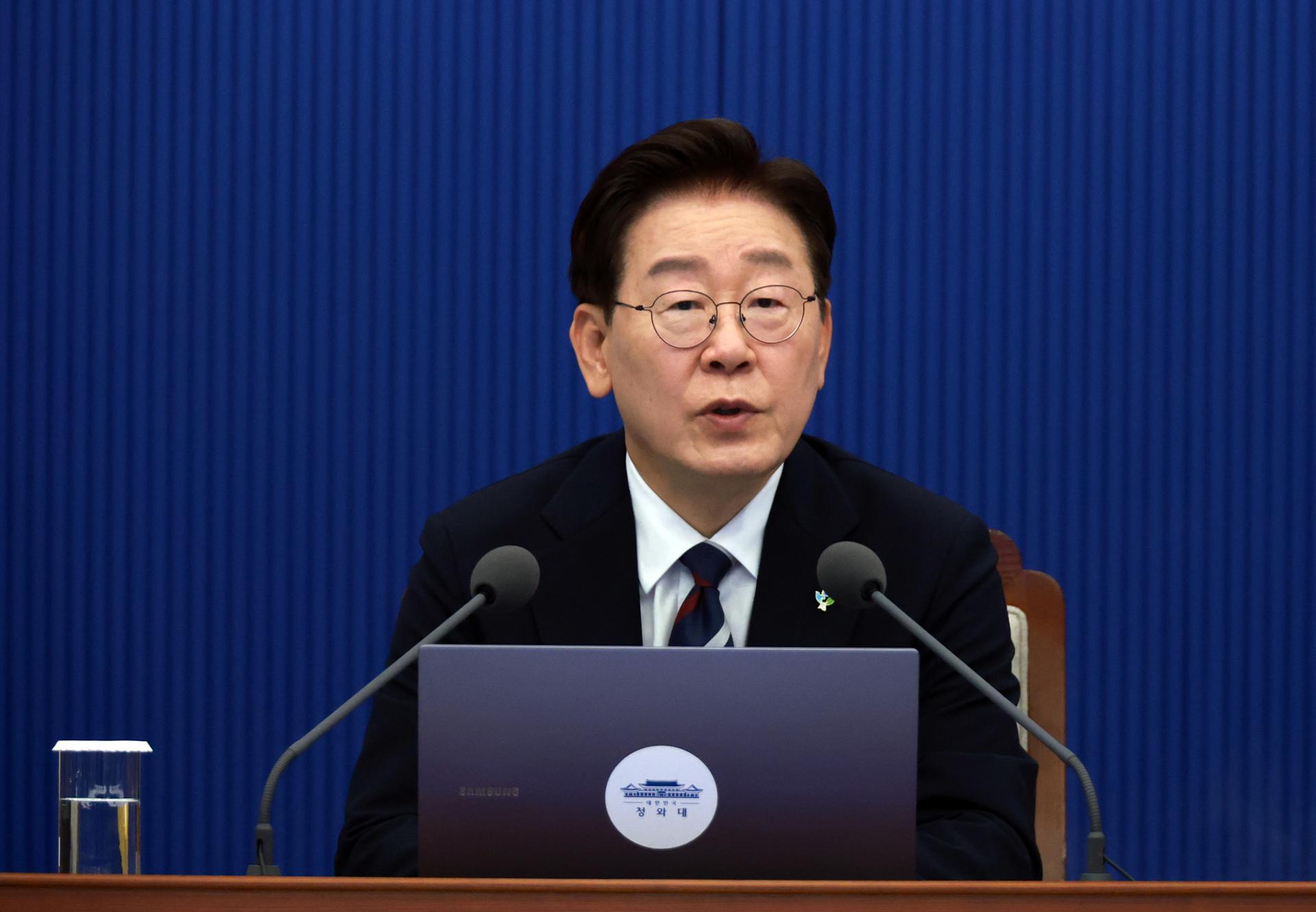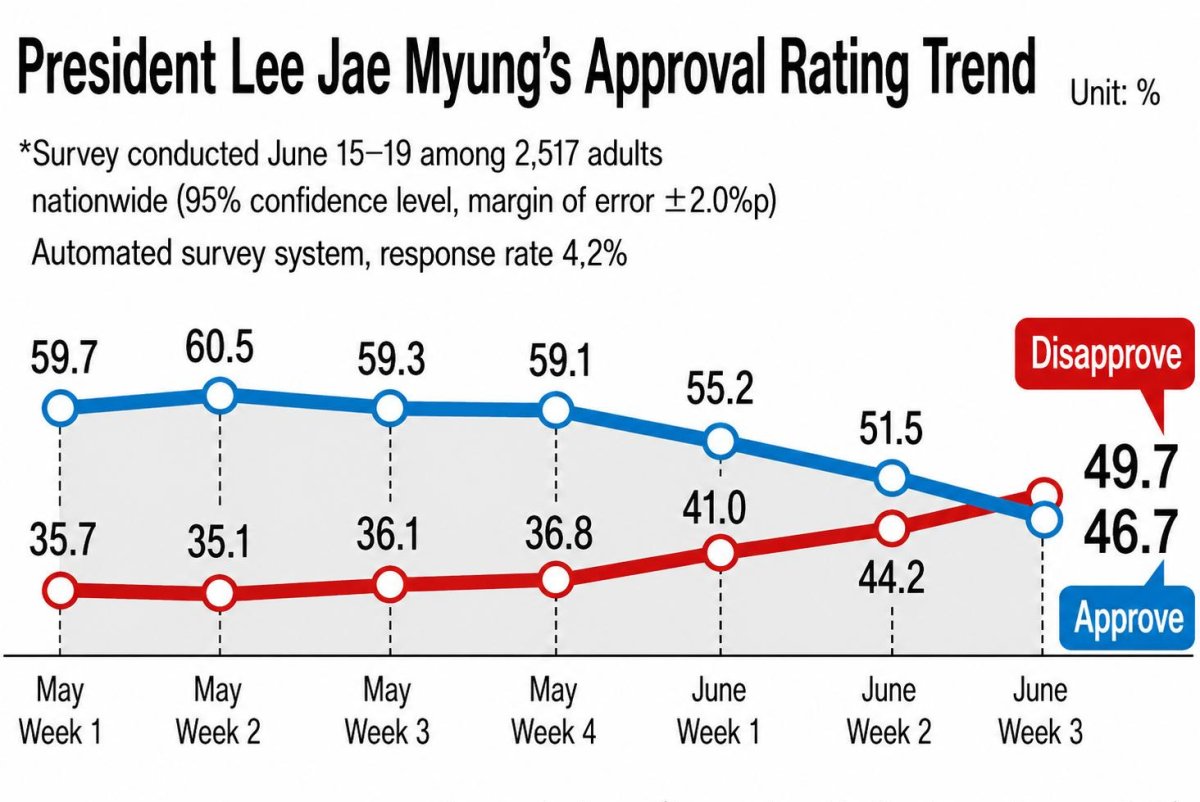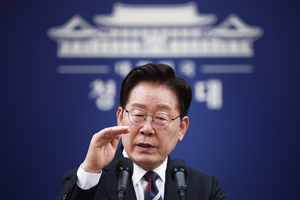
President Lee Jae Myung answers reporters' questions during a briefing on the outcome of his attendance at the G7 summit and European trip at the Chunchugwan press center in Seoul on June 19. (Yonhap) President Lee Jae Myung's approval rating dropped for the fifth consecutive week as negative views of Lee surpassed positive views for the first time since he took office, according to a poll released Monday.The survey by local pollster Realmeter found that 46.7 percent of respondents approved of Lee’s job performance, down 4.8 percentage points from the previous week. It marked the first time his approval rating has fallen below the 50 percent threshold since he assumed office on June 4, 2025.Negative evaluations rose 5.5 percentage points to 49.7 percent, placing them ahead of positive ratings within the survey’s margin of error of plus or minus 2 percentage points.The remaining 3.6 percent of respondents said they were unsure.Realmeter attributed the decline to "growing demands for accountability following the election management fiasco and escalating infighting within the ruling party over its leadership race."The pollster analyzed that "both (issues) have weighed negatively on the broader political landscape despite some positive factors, including the perceived success of Lee's European trip and the Kospi's breakthrough above the 9,000-point mark."Concerns over widening disparities in the asset market appeared to erode support among moderate voters and residents of the greater Seoul area, the pollster added.The nationwide survey was conducted from June 15-19 among 2,517 voters aged 18 and above using an automated response system.A separate Realmeter survey conducted on June 18 and 19 found that support for the conservative People Power Party remained ahead of the ruling Democratic Party of Korea for a second straight week, though the gap narrowed.Support for the ruling Democratic Party rose 2.1 percentage points to 40.1 percent, while support for the main opposition People Power Party slipped 2 percentage points to 42.3 percent.The difference between the two parties narrowed to 2.2 percentage points from 6.3 points a week earlier.Realmeter said the People Power Party faced mounting pressure in responding to controversies surrounding ballot shortages during the June 3 local elections, including debates over holding a full rerun and abolishing early voting."The party's approval rating turned downward as internal conflicts, including disputes over the leadership's resignation, overlapped with those controversies, weakening cohesion among conservative voters and leading to a continued exodus of younger voters in their 20s and 30s," the pollster said.The pollster attributed the Democratic Party's rise to what it described as a crisis-management phase following a bipartisan agreement to launch a National Assembly investigation into the election administration failures."Despite factional tensions within the party, an emphasis on unity behind the government's success helped strengthen support among its base, leading to a rebound in the party's approval rating," Realmeter said.
Negative views of Lee overtake positive for first time: poll
President Lee Jae Myung's approval rating dropped for the fifth consecutive week as negative views of Lee surpassed positive views for the first time since he t
463 words~2 min read