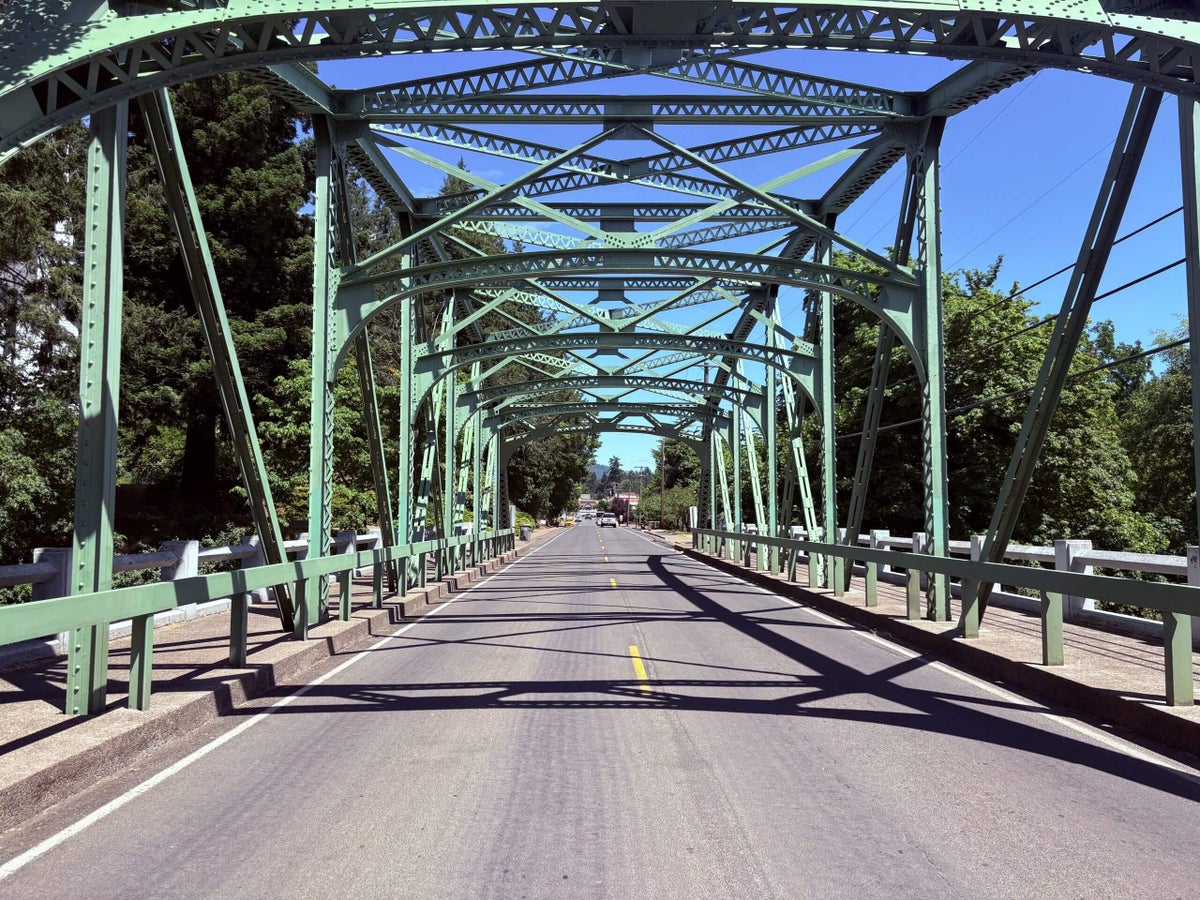
Brownsville, Oregon, population 1,694, is set adrift in time, a place only disturbed when a tractor from the surrounding farmland rolls through. Main Street evokes the sense of a lost idyll in a shattered world: beneath an oaken portico, there is a hardware store called Carlson’s, over the road there is a post office, then there is a doctor, a pharmacy and a dentistry. In the days when Brownsville had a bank, there was barely any reason to leave; people were born, they worked and lived here their whole lives, but over recent decades it has become more of a bedroom community due to the interstate, 15 or so kilometres away, offering access to cities such as Eugene, Salem and even Portland, a couple of hours by car. Rather than being in the middle of nowhere, one of its residents, Leisa Keizer, suggests it is now “in the middle of everywhere”.Still, everyone seems to know everyone else, and conversations are happening in Brownsville’s saloon, which has changed hands recently, and is more modern inside than you might assume, considering the log-panelled exterior is another thing about the town that hasn’t altered that much. They have televisions in there and it feels a bit more like a sports bar now.Get free access to the most comprehensive World Cup coverage in The Athletic appThe World Cup is live and a couple are watching the USMNT secure their second victory in the competition, beating Australia, 2-0. “We didn’t know much about soccer,” says a man, before the woman sitting next to him explains that the sport caught their attention through the Welcome to Wrexham documentary series, which launched in the U.S. in 2022. “There’s obviously the thing with the two guys (actors Rob Mac and Ryan Reynolds, the club’s American and Canadian celebrity co-owners),” she says. “But we kinda liked the story around it, the struggling town rising through the leagues.”We almost miss a goal because the commentary on the screen in front of us is muted and the clientele in the saloon otherwise seem to be enjoying whatever song is running from the jukebox, which for the rest of the first half appears to be on a loop of hits by Celine Dion and Cher.This has been the way in each of the three U.S. states I have visited covering the 2026 World Cup — the night before in Portland, which is not a tournament host city, many of the pubs, bars and restaurants with televisions fixed to their walls had the soccer on but drinkers and diners tended not to be focused, with the games acting as an accompaniment to their evening rather than the focus of it.Between matches, in a dive bar proud of its no-television policy, curious staff were talking about the World Cup but one guy serving, while realising the U.S. was a co-host, did not know the country also had a team competing. The story might not be entirely representative of how an entire nation is responding to the event, because with each American victory appetite is increasing, but it is a reflection of the way things are in Brownsville.A TV screen shows the United States vs Australia game (Simon Hughes/The Athletic)Tim Stoll, 62, who volunteers at Brownsville’s Picture Museum each Friday, only moved here five years ago. In an earlier part of his life, he used to attend Portland Timbers MLS matches. “Oh yeah, we’ve been watching it (the World Cup) at home a little bit,” he says. “Saw the first U.S. game… would I say we watch soccer all the time? No, but I umpire baseball for the kids around here. Soccer’s getting bigger but it’s baseball season for the kids. That’s the buzz around town.”Brownsville has a 20-acre park, which has soccer nets, but the town’s only school didn’t have enough boys interested enough to fill a team this year, so they joined with another school from a town called Lebanon. The attention is probably only what you would expect from a place of this size, especially when soccer was competing for attention last Friday with the Linn County Pioneer Picnic, Oregon’s oldest continually held event, having started in 1887.
Searching for the World Cup in the land of Stand By Me
The Athletic visited Brownsville, Oregon - where the iconic movie was filmed in 1985 - to see whether soccer's biggest event is taking hold
1,989 words~9 min read